


We monitor local and global trends to assess the potential impact on our markets and customers. As the external market and environment change, we review our strategy to capture new opportunities and to mitigate emerging risks.
COVID-19
South Africa and the rest of the world are being severely impacted by COVID-19 and ensuing social and economic disruptions. In FY2021, these disruptions affected Telkom’s operations across all the components of our operating environment and are expected to continue to do so in FY2022.
1–4
Key external theme
Estimated timeframe in which it will significantly impact Telkom1
1.
Local
economic
headwinds
Local
economic
headwinds
3.
Intensified
competition
Intensified
competition
Short term
2.
ICT sector
and
technology
ICT sector
and
technology
4.
Regulatory
environment
Regulatory
environment
Medium term
Long term
Related material theme
| 1 | For this report, short term is the next financial year (ending 31 March 2022), medium term is the period to 31 March 2024 and long term is beyond April 2024. |
![]() Local economic headwinds
Local economic headwinds
Context
COVID-19 and the subsequent hard lockdown caused havoc on South Africa’s already faltering economy, with economic growth hitting record lows in 2020, contracting by 7.0% from 2019. Economic growth is forecast to expand by 3.1% in 2021 and 2.2% in 2022.
South Africa’s rising debt to gross domestic product (GDP) trajectory has been tempered somewhat, estimated now to peak at 88.9% in 2025/26, compared with the previously estimated peak of 95.3% of GDP. The risk of public debt default remains high, with credit rating agencies remaining sceptical of the country’s ability to effectively curtail rising public debt. Consequently, the risk of further sovereign credit ratings downgrades remains.
Implications for our strategy
Telkom will continue to factor in the risk of potentially higher borrowing costs and environmental changes. We continue to focus on sustainable cost management and targeted capital investments to mitigate the downside risk of lower economic growth, as well as climate change considerations.
For further reading
Our strategy review
Group Chief Financial Officer's report
Dramatic increase in the gap between South Africa’s GDP and population growth rates
Year-on-year growth (%)

Source: Stats SA National Accounts and Mid-year population estimates; National Treasury GDP estimates for 2020
![]() ICT sector and technology
ICT sector and technology
Context
It is expected that hybrid work from home/office conditions will become entrenched, due to practices developed in response to COVID-19. In addition, increased virtual engagement for learning, extra-mural meetings, shopping and entertainment further emphasises the requirement for good quality, high-speed broadband services that enable streaming and video-heavy collaboration tools.
Customers are demanding that the network provides fibre and mobile services that can adapt flexibly to their requirements. The role of service providers is evolving beyond network security to end-to-end security, thus opening new business models. Traditional enterprise technology growth will remain under pressure. However, integrated cloud/SD-WAN solutions will gain increased importance as enablers for integrated security, home broadband and office applications.
Implications for our strategy
Telkom continues to ensure that the end-to-end communications network (access, aggregation and transmission) is constantly available and can scale appropriately in line with increased subscribers and exponential traffic growth.
Telkom is developing integrated solutions for selected vertical markets, including health and retail. These are combining connectivity and information security with tailored ICT applications to expand South Africa’s digital footprint. We also see an opportunity to use aggregation nodes and new network topologies, to bring data centres and cloud-based computing power closer to the edge.
To meet customer expectations, we seek an optimal balance between crafting meaningful partnerships and developing internal skills and capabilities.
For further reading
Our strategy review
Social and relationship capital
Accelerated growth in South Africa’s fixed-data traffic
Year-on-year growth (%)
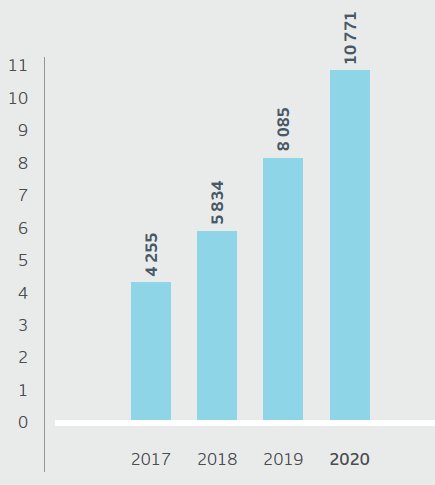
Source: Omdia 2020
![]() Intensified competition
Intensified competition
Context
The competitive landscape within the South African ICT sector continues unabated. A combination of the pent-up demand for data, disruptive pricing by challengers such as Telkom, as well as regulatory pressure has prompted incumbent mobile operators to reduce the data cost.
In addition, the pervasive rollout of fibre by new and niche infrastructure players and aggressive pricing by ISPs have led to a reduction in overall fibre broadband pricing while speeds increase. This is expected to further intensify over the next two to three years.
Implications for our strategy
Telkom remains true to its data-led strategy. The pricing regime remains value based, giving customers a quality network experience at an affordable price. We are extending our market-leading fixed wireless broadband products into the pre-paid market. For example, our Mo’Nice product offers customers personalised data offers through powerful data analytics.
Telkom will continue to drive growth in non-connectivity and valueadded services revenue, through our diversified product offerings such as airtime lending, Telkom Plus, Ringa Music and Telkom One.
For further reading
Our strategy review
Productive capital
Continued fall in South African fixed broadband average revenue per user (ARPU), despite growth in broadband connections
Broadband connections ('000)
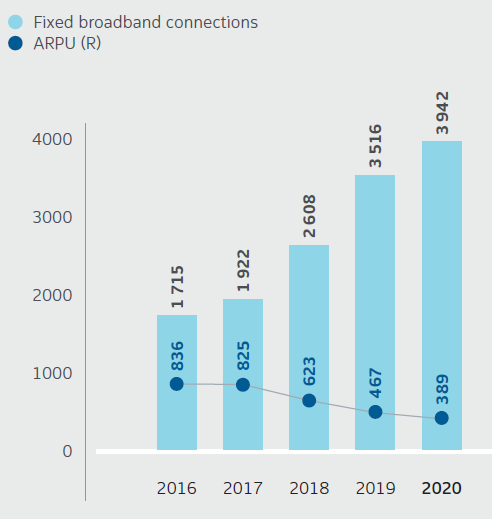
Source: Omdia 2020
![]() Regulatory environment
Regulatory environment
Context
The release and licensing of additional high-demand spectrum remain key to determining the future structure of South Africa’s mobile communications market.
The granting of temporary spectrum licences in response to COVID-19 proved that access to sub-1 GHz spectrum is necessary for Telkom to compete effectively in the mobile communications market.
The implementation of the new pricing methodology for wholesale broadband access, following the Competition Commission's Data Services Market Inquiry report, was viewed positively by ISPs and consumers. Both have benefited from lower broadband prices.
The final results of ICASA's Priority Markets Inquiry into the efficacy of competition in the mobile broadband market are expected later in 2021.
Implications for our strategy
Telkom has remained steadfast in its view that the licensing process of spectrum needs to be carried out in a responsible and procompetitive manner. We remain cooperative in seeking a solution and have instituted legal proceedings to ensure that the process of assigning high-demand spectrum is one that will result in a market structure that supports fair and effective competition with the larger mobile operators.
For further reading
Engaging with our stakeholders
COVID-19
South Africa’s service revenue for mobile data becomes significantly higher than for mobile voice
Revenue (R'billion)
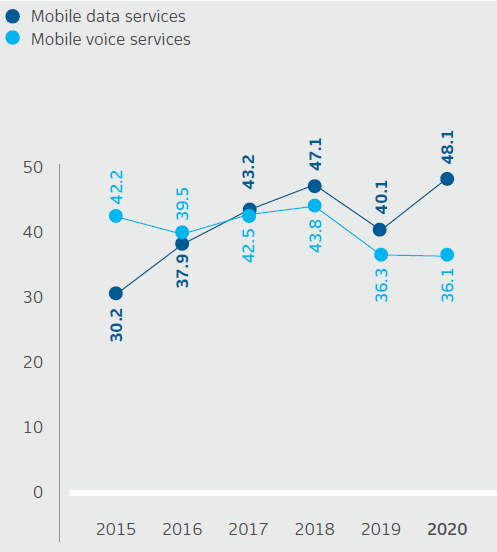
Source: ICASA – The state of the ICT sector in South Africa, March 2021
Previous