


Progress on our value creation strategy: Group Chief Executive Officer’s report
Telkom’s purpose of seamlessly connecting customers to a better life is especially relevant today. When the physical world shut down, we continued to connect people virtually. As our world embraces a digital reality, we aim to ensure that South Africa has the digital capabilities to compete.
Key highlights

revenue


customer
base


connectivity
rate


improved by


EBITDA
improved to

This year was the toughest year I have experienced in a corporate environment. Telkom had to radically adapt to a new way of working with implications for culture, technology and processes. We had to respond to higher consumer demand while simultaneously adjusting our business to weather less favourable trading conditions.
As a provider of essential communication services to South Africa during a crisis, Telkom ’s modernised network infrastructure, product offering and dedicated workforce enabled us to overcome signifi cant challenges and exceed customer expectations.
Our focused investment over the last few years has created a data-led, fi bre-based network which enabled us to address the surge in data demand as South Africans began working from home. We also contributed to combating COVID-19 through supporting government, learners and our employees.
Our resilient revenue performance, driven mainly by the continued growth in our Mobile business, combined with a lower and more sustainable cost base, resulted in pleasing earnings growth and solid FCF generation. While it is never easy to do, we continued with the planned restructure of the business, and have emerged from the initial crisis as a leaner, more effi cient organisation.
Our business today
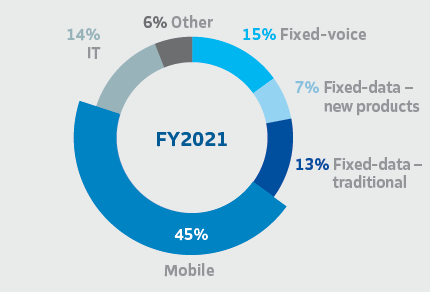
Revenue contribution to Group
%
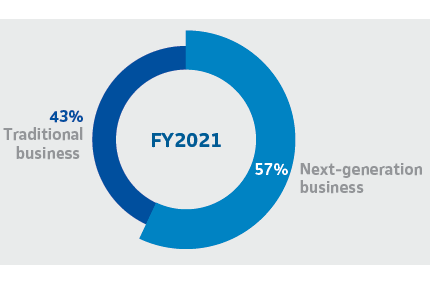
EBITDA contribution to Group
%
Responding to our operating environment
The inevitable local outbreak of COVID-19 and resulting national lockdown in March 2020 came at a time when the South African economy could least afford it. Unemployment rose to record levels, touching 32.5% in the final quarter, meaning 7.2 million people were unemployed, up from 30.8% in the previous three months**. As business confidence dipped to new lows, businesses cut salaries, retrenched employees and delayed project spend.
As an essential services provider, we were able to trade throughout the lockdowns; however, these poor economic factors took a toll on certain areas of our business. Competitive responses intensified as promotions and pricing became a tool for competitors to attract and retain customers.
COVID-19 also accelerated the entry of new digital niche players in our market. These players will disrupt our market in unexpected ways. We must respond with innovative products that are quick to market.
We operate in a constantly evolving environment where advances in technology and changing customer demands require that we also transform the business for long-term growth and sustainability. Over the past decade, we have fundamentally changed our core business by moving from voice to data, from legacy to fibre, fixed wireless and to mobile, and from connectivity to IT services and digital ecosystems. We have evolved from being a monopoly player to competing with rivals across all our business units. We welcome healthy competition as it makes us better and forces us to continually improve.
Performance overview
In the face of a challenging environment, Group revenue grew 0.4% to R43.2 billion. This growth continues to be driven by our Mobile business with revenue growth sufficient to offset the fixed-voice revenue decline and revenue pressures emanating from COVID-19.
Our sustainable Cost Management programme continues to underpin improved Group profitability and EBITDA margin. We optimised direct costs and contained operating expenses below inflation. Consequently, EBITDA grew 11.7%* to R12.0 billion* with the EBITDA margin expanding by 2.8 ppts to 27.7%*.
The performance of our business units varied as each was uniquely impacted by COVID-19, which demonstrates the diverse nature of our underlying business unit portfolio.
Our Mobile business continued its growth trajectory as we surpassed 15 million subscribers during the year with an average revenue per user (ARPU) of R104. As a growth area of our business, our intentional and focused allocation of capital to a data-led and fibre-enabled mobile network successfully prepared us for the significant increase in data demand and broadband mobile services brought about by more people working from home. Mobile broadband traffic increased 53.2%, resulting in mobile data revenue growing by 41.0% and underpinning the 34.5% increase in mobile service revenue to R16.9 billion.
BCX suffered a decline in revenue as the national lockdown and the work-from-home response impacted fixed-voice revenue from enterprise customers. Information technology (IT) revenue also came under pressure as corporates deferred capital expenditure (capex) and delayed projects given the increased levels of uncertainty. Supply chain disruptions also impacted businesses as countries were locked down across the globe. In response, BCX successfully focused on optimising its cost base with a clear focus on cash preservation, resulting in EBITDA increasing 6.6%*.
| * | Based on pro forma financial information. Refer to Restatements and adjustments for the reconciliation of the reported figures to the adjusted figures. |
| ** | Department: Statistics South Africa – Quarterly Labour Force Survey, 4th quarter 2020. |
Key strategic themes underlying performance

Evolution of the business
- Evolution1 of technologies
- Evolution5 of revenue mix
- Evolution6 of skills

Monetising infrastructure portfolio
- Fixed mobile network1
- Mobile network2
- Data centres3
- Masts and towers4

Formidable Mobile2 business
- Sustainable financial performance
- Good quality customers
- Mobile business strength

Broadband leadership
- High-speed broadband1 (fixed)
- Mobile network2 (wireless)
- Fibre ecosystem1
| 1 | Refer to Openserve. |
| 2 | Refer to Telkom Consumer. |
| 3 | Refer to BCX. |
| 4 | Refer to Gyro. |
| 5 | Refer to GCFO report. |
| 6 | Refer to HR report. |
Yep!, which focuses on small and medium businesses, was negatively affected by the responses to COVID-19, which included a national lockdown, retrenchments, salary increase suspensions and small business closures. We are, however, excited about the digital, e-commerce and fintech business opportunities as adjacent revenue opportunities driven by Yep!. We have seen some good progress with a number of digital platforms being launched including the Telkom e-business platform, which has an early uptake of 98 521 business customers on average using the platform on a monthly basis.
We witnessed good growth in the early stages of our funeral cover and mobile device insurance products launched during the year.
The need to consume multiple digital services led to an increase in data consumption in Openserve, driven by a surge in data traffic across fixed fibre and carrier connectivity solutions. This drove an increase of 2.9 ppts in the fibre to the home (FTTH) connectivity rate to a pleasing 51.1%, as homes passed increased by 20.7% to 549 957. Despite the increased revenue growth in FTTH and carrier-based connectivity solutions, the ongoing impact of COVID-19 on the Enterprise segment saw a continued weakening in legacy voice and data requirements. This led to a revenue decline of 10.9% to R13 485 million. We are excited that our fibre-based transport and access infrastructure enables us to convert last mile infrastructure into a seamless end-to-end customer experience, providing scalable revenuegenerating opportunities in the near future.
Gyro masts and towers continued to grow by commercialising existing towers and executing a new build pipeline. Masts and towers revenue increased by 6.6% to R1 237 million, supported by an 8.0% growth in the number of new leases.
Notwithstanding the challenging trading environment, the Group delivered robust underlying earnings growth of 88.1%* to R2.6 billion*, growing BEPS and HEPS by 89.6%* and 53.4%*, respectively, compared to the prior year.
I am pleased that we turned the corner on the FCF challenges we witnessed in the past. For the past two years, we sustained strong FCF generation. In the current year, FCF grew 15.8% to R2.1 billion despite an increase of 8.9% to R8.4 billion in capital investment. The improvement was despite significant once-off impacts relating to restructuring and tax payments relating to prior years.
Our strong liquidity has enabled us to strengthen our balance sheet, repaying maturing debt of R1.1 billion. Our net debt to EBITDA on a reported basis improved from 1.3x in the prior year to 0.9x.
| * | Based on pro forma financial information. Refer to Restatements and adjustments for the reconciliation of the reported figures to the adjusted figures. |
Risk management
Our risk environment has been greatly altered by the COVID-19 pandemic with some existing risks exacerbated and other new risks emerging.
South Africa’s economic situation was critical before the pandemic and rapidly deteriorated in the resulting national lockdown. This meant that many of our customers faced severe financial difficulties, and numerous enterprise customers faced financial challenges and had to radically rethink and reduce their business.
A remote working environment has increased the risk of cyberattacks including malware, phishing emails and other malicious behaviour. We invest resources into training employees and providing clear and straightforward IT guidelines that will increase overall cyberliteracy within the business.
The pandemic disrupted global supply chains with a knock-on impact on our business. We have had to reassess our supply chain including identifying high-risk suppliers, assessing the adequacy of inventory levels and accelerating the qualification of new suppliers.
A risk unrelated to the pandemic is the challenge of navigating an uncertain regulatory environment. It takes time to fully absorb the implications of new regulation and legislation on our business. A lack of clarity curtails our ability to create additional long-term value.
We await critical rulings on spectrum licensing. We believe that lawful spectrum licensing will promote competition between operators and should not entrench the current duopolistic structure. We would like the process to be speedy, but not at the expense of fairness and transparency. Ultimately, the right decisions should go some way to levelling the playing field.
COVID-19 response
Throughout the year, our number one priority in response to COVID-19 was to ensure that our people were safe. This included both physical and mental wellbeing. We offered free counselling and COVID-19 screening to our employees and families. About 80% of our employees have worked from home since the national lockdown was announced. We have adjusted well to working from home and will only fully return to the office once it is safe to do so.
Once we had protected our people and assets, we extended assistance to our customers. We reduced prices, increased speed and broadband bundle sizes, granted payment holidays and extended payment terms during lockdown levels 4 and 5. We supported our SME customers by offering free access to the new Yep! marketplace and desktop applications.
In total, we spent approximately R100 million on COVID-19- related matters across our various stakeholder groups including employees, customers and communities. We took full advantage of the temporary release of spectrum to address the shift in traffic patterns prompted by COVID-19. When South Africa needed us, we were proud to step forward.
Outlook
The South African economy is expected to recover in the coming year with the International Monetary Fund predicting a GDP growth rate of 3.1%. While this is a positive indication, we predict that the year ahead will not be easy.
We observe the COVID-19 vaccine rollout with great interest. The nation’s economic wellbeing and the health of our people depend on this being done successfully. We are eager for a rapid vaccine rollout which will see the virus in retreat and a return to some sense of normalcy.
We have the resilience to not only withstand difficult circumstances but also to find value within these conditions. We have a solid asset base to build from and we will spend the coming years unlocking further value in our business. The journey ahead will be enabled by our strong performance culture, strategic clarity and an understanding of our immediate priorities. We will continue to focus our capex spend on the growth areas of our business including fibre, mobile and our masts and towers portfolio.
Our strong and flexible balance sheet and strong cash flow conversion provide us with various funding options for growth opportunities, both organic and inorganic.
The 5G Commercial trail demonstrated readiness forward and support of a Non-Standalone deployment of 5G New Radio technologies.
The digital world is upon us and presents compelling new opportunities. I see huge potential in equipping South Africa to compete globally through developing our digital capabilities.
Change to the GCFO
This past December Tsholofelo Molefe resigned as GCFO. Working with Tsholo was a true gift and I will always appreciate the time she spent at Telkom. During her two-year tenure she led an effort to derisk the balance sheet, optimise working capital management through structural change and enhance the capital allocation framework to focus on return on investment. She has left a strong finance platform behind.
That we were able to replace her within a month is a testament to the depth of talent within our business. It was a pleasure to welcome Dirk Reyneke as our new GCFO. Dirk has been with Telkom for almost a decade and has held positions as CFO of various divisions and subsidiaries. His understanding of the business is exceptional and he is a worthy successor to Tsholo.
Appreciation and condolences
This year has been difficult for both Telkom and the country. I am grateful for the strength and resilience of our people. I thank my Executive team and employees for their dedication and hard work throughout the year. My heartfelt condolences go out to the employees and their loved ones who have succumbed to COVID-19.
I also thank our Board for its unwavering encouragement. The Board was there to guide the Executive team and also challenge us when required. Finally, thank you to our customers and service providers for their enduring support as we continue our growth story.
Sipho Maseko
Group Chief Executive Officer