



Our remuneration philosophy, policy and framework
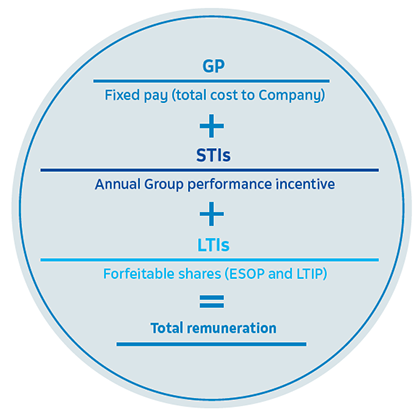
Remuneration philosophy and policy
The Group remuneration strategy is designed to attract, motivate and retain high-calibre talent, and supports the delivery of our strategy in a sustainable manner without encouraging undue risks.
It is increasingly challenging to retain experienced Executive leadership, and to attract the necessary talent required for the new and growing areas of our business. Meeting these challenges requires a competitive and attractive remuneration offering.
To ensure we remunerate all employees competitively, we use market and industry benchmarks. These benchmarks determine appropriate market-related offerings, and higher than minimum prescribed wages.
Telkom recognises “equal pay for work of equal economic value” principles and strives to remunerate employees doing substantially the same work, within the same range under the Labour Relations Act, 66 of 1995.
Telkom recognises that there could be differences which are attributed to the following:
- Individual’s seniority or length of service
- Individual’s qualifications, ability, competence, critical skills or potential above required levels of performance for the job
- Individual’s performance (all employees are equally subject to Telkom’s performance management system)
- Demotion due to restructuring without a concomitant reduction in remuneration
- Individual’s lack of relevant experience for a job level
- Any other non-discriminatory differentiator
Fair and responsible remuneration
Telkom applies the principles of fair remuneration based on job complexities and relative job worth, including similar performance outcomes. Our remuneration policy follows the same fundamental principles across all employee levels. Remuneration must be externally competitive and internally equitable.
We continuously review our practices to ensure that remuneration levels are appropriate across functional areas of the business and that employees are remunerated fairly. Where any anomalies are identified, these are addressed as part of our annual remuneration review process.
We believe fair and responsible remuneration can be defined as follows:
Fair
- Rational, easy to understand and not subject to emotions
- Free from discrimination, favouritism and self-interest
- Linked to individual and Group performance
- Purposeful to address unfair discrimination
Responsible
- Independent with oversight (approved within the DOA)
- Pay decisions must be equitable
- Sustainable (link to value creation) and output driven
In ensuring fair and responsible remuneration, Telkom focuses on the important issues of employment equity, gender equity and pay differentials. As we continuously review our practices at all levels of remuneration, we ensure that any pay differential based on race or gender is adequately addressed.
The gender wage gap across all grading/complexity levels in Telkom ranges between 0%-3%. The gender gap is within acceptable tolerance levels. A key component that may impact the gender wage gap is gender composition. The gender wage gap was calculated on the actual value of what a woman would earn if she occupied the same position as a man across all levels (job complexity/grade levels).
The Telkom race wage gap ranges between 0%-4%. The race wage gap is calculated on the actual value of what a black employee would earn in comparison to a white employee if they occupied the same position as a white employee across all levels (job complexity/grade levels). The Company has made a concerted effort over a number of years to deal with inequalities, taking into consideration the principle of equal pay for equal work.
Remuneration objectives and principles
The remuneration policy is designed to attract talent in a competitive labour market and enable Telkom to achieve the following objectives:
- Promote sustainable value creation through transparent alignment with the Group strategy
- Ensure proper risk management processes, and that remuneration is aligned with both short and long-term performance
- Ensure all employees are remunerated competitively relative to industry benchmarks, provided with appropriate incentives to encourage performance and rewarded for their individual contributions to the Group’s success
- Ensure that remuneration is affordable and reasonable in terms of sustainable value creation for shareholders
Our remuneration and reward policies and practices are based on the following principles:
- Motivate and reinforce superior performance
- Encourage the development of organisational, team and individual performance
- Develop future required competencies and skills
- Employees should share in the success of the Group
- Aim to get the appropriate remuneration mix to ensure the Group achieves its strategic financial and operational objectives in the short and long term
- Is fair and non-discriminatory
Remuneration structure and risk management
Our remuneration structure aligns with the Group strategy and the agreed risk appetite, which seek to reward success fairly, responsibly and transparently, while avoiding overpaying. Remuneration risk is reviewed to align remuneration decisions with strategic business objectives. Remco ensures that:
- The remuneration policy is transparent
- Remuneration incentive plans are reviewed annually
- Executives are not involved in any remuneration policy decisions which impact their individual remuneration directly
- The remuneration policy includes malus and clawback policy provisions which apply to all STI amounts paid and vesting of share awards (LTI)
Remco annually reviews the Group’s financial results to determine STI payments before any payments are made to Executives and other employees. Performance conditions for shares to vest as per the rules of the scheme are reviewed prior to vestings being approved. The Remco has full discretion to adjust the final payment or vesting downwards if it believes circumstances warrant it.
Remco has the discretion to use either malus or clawback as it sees appropriate. In the case of malus, the award may lapse wholly or in part, may vest to a lesser extent than it would otherwise have vested, or vesting may be delayed. In the case of clawback, Remco may recover incentive payments that were paid for up to three years after the relevant payment date or recover the vesting value of shares vested for up to three years after the relevant vesting date since introduction thereof.
Malus and clawback will be triggered in the following events:
- If there was misconduct or material misstatement of performance, material miscalculation of performance condition outcomes and/or gross misconduct by a participating employee, or where the actions of an employee resulted in reputational damage to the business
- If the business suffers a material downturn in financial performance due to irregularities or a material failure of risk management
- If awards were based on material misstatements of the Group’s financial results, or information arises which would have caused benefits to lapse or would have resulted in Remco rewarding differently had the information been known at the time
- If the business suffered a material financial loss as a result of actions or circumstances attributable directly to an employee or which could have been avoided by the reasonable actions of an employee
- If the Board or Remco, in their discretion, deem it necessary to apply malus or clawback
GPs

Fixed GPs comprise a basic pensionable salary, retirement provision and flexible benefits, which include a non-pensionable allowance and a motor allowance where applicable.
Salary is paid monthly. Fixed pay is reviewed annually, and any increases are typically effective from 01 April each year.
GPs are influenced by the scope of the role and the knowledge, skills and experience required of the position. The packages reflect the market median, which is determined through external market research.
Fringe benefits
- Funeral benefit
- Telephone rebate
- Motor car insurance (M6 to M0)
Annual salary reviews
Remco approves annual salary mandates for management and bargaining unit employees. Several factors are considered including affordability, business results, individual performance, market competitiveness and economic indicators such as inflation, cost of living and labour market movements, to ensure fair and equal remuneration.
Bargaining unit employees’ salary increases are subject to substantive negotiations and agreements concluded between Telkom and organised labour.
Management employees are eligible for performance-related increases. Individual and Group performance play an integral role. Non-performing management employees do not qualify for a salary increase.
Short-term variable incentives

14th cheque and Performance Pays for bargaining unit employees (A-M6)
STI for management employees (M5-M0)
Bargaining unit employees are eligible for quarterly Performance Pays payments linked to Company, business unit and individual performance. Net revenue serves as a trigger and the hurdle rate is 95%.
No STI or 14th cheque is payable to employees who do not meet individual performance outputs.
Bargaining unit employees are eligible for 14th cheques subject to the achievement of Group financial targets and individuals meeting their individual KPIs as outlined in their performance contracts.
The STI plan is aligned with shareholder expectations. A single STI structure is applied across the Group. Payment occurs annually in June after Remco approval.
Remco approves the STI pool based on Group achievements. The STI pool is allocated to the respective business units by the GCEO based on business unit achievement and overall performance.
For FY2021, the PAT hurdle rate is 85%. The STI pool is set at 12% of PAT achieved, as approved by Remco.
Long-term variable incentives

The share incentive plan is designed to align management and shareholders’ interests and grow shareholder value. The objectives are to motivate long-term sustainable performance and retain business-critical and top talented employees.
Forfeitable shares: A free transfer of shares is awarded to employees, under the condition of forfeiture in the case of termination of service before the vesting/release date, and achieving performance vesting conditions.
Employees are eligible for annual share awards subject to Remco approval.
- 90% vesting achievement threshold equates to 50% vesting
- No possibility to overperform against the targets, which are set at 100%
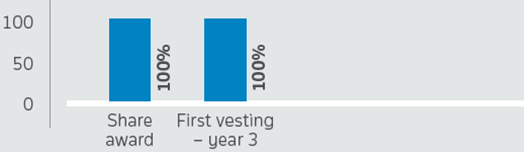
ESOP: Middle management and bargaining unit employees, A to M4/S4
- Three-year vesting conditions
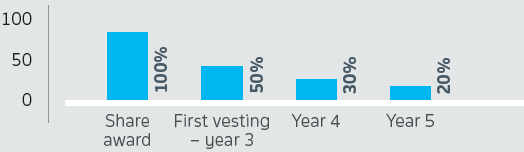
LTIP: Senior leadership, M3 to M0 employees
- Five-year vesting conditions from award date:
- Year 3: 50%
- Year 4: 30%
- Year 5: 20%
- 15% of GP shareholding acquisition requirements
TSA
- TSAs to retain top talent and critical skills specialists
- Three-year vesting conditions
Linked to Telkom and individual performance
No shares are awarded to employees who do not meet individual performance outputs.
No shares will vest if performance conditions are not met.
Performance management
A performance culture and systems are critical strategic enablers that translate business vision into objectives and metrics aimed at achieving high performance with sustainable business results. The business strategy is cascaded through a balanced scorecard approach. Goals are set at Executive management level and filtered down to subsequent levels. As objectives are filtered, they are adapted and translated to suit employees’ specific roles. Cascading objectives allow managers and teams to align their activities with the Group’s strategic objectives.
We focus on defining KPIs for the GCEO, GCFO and business unit CEOs in line with the five areas of our scorecard:
- Financials: Achieving the business plan targets
- Customers: Overall customer satisfaction
- People management: How people are managed
- Operational management: Operational measures to sustain the business
- Strategic: Key strategic milestones
The balanced scorecard aids in ensuring that there is alignment between the day-to-day operational work of all employees and the business strategy, while measuring and monitoring progress towards the strategic targets.
Telkom introduced a clear performance management cadence throughout the Group (called Drumbeat) to adapt and thrive in the changed world of work. An effective Drumbeat establishes a performance rhythm across Telkom that requires a change in the behaviour and mindset of both managers and employees. It creates an up and down fluid flow of engagement focused on real- time feedback and solution generation. The aim is to have more frequent performance discussions and real-on-time feedback to address potential performance challenges.
We created our performance cadence and drumbeat through:
- A common focus on key business results with aligned and cascaded objective plans
- Weekly check-in sessions with feedback on leading indicators
- Interlinked process – weekly check-ins feeding into monthly and quarterly progress reviews
- All engagements being proactive and specific
- Shared focus on problem resolution
- Coaching approach aimed at creating growth opportunities for individual employees
The Group implemented a “cloud-based” performance management system, which enables and drives our balanced scorecard and continuous performance management approach. The system is well embedded across the business at all levels.
Linking total remuneration to performance
Our remuneration outcomes are determined by on-target performance with three performance drivers:
- Group performance, focusing on Group financial and non- financial targets
- Business unit targets, focusing on business unit financial and non-financial targets
- Individual performance focus on individual KPIs
These drivers aim to achieve a high-performance culture with sustainable business results with a clear line of sight in linking Group, business unit and individual performance.
Individual performance
Guaranteed package
Individual performance
- Financials: Achieving the business plan targets
- Customers: Overall customer satisfaction
- People management: How people are managed
- Operational management of the business: Operational measures to sustain the business
- Strategic: Key strategic milestones
Weightings might differ between different levels of employees.
Short-term incentives
Group target: FY2021 STI

Business unit targets
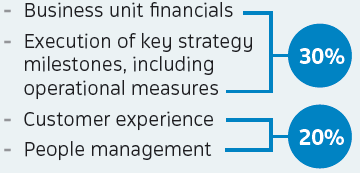
Weightings might differ between business units.
Long-term incentives
Group target
Performance vesting conditions
for 01 June 2020
LTIP: 20% of the 2015 award
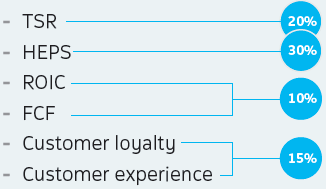
LTIP: 30% of the 2016 award
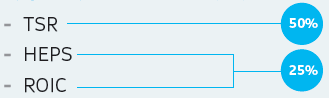
LTIP: 50% of the 2017 award
ESOP: 100% of the 2017 award
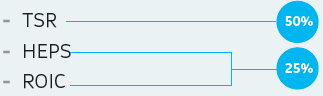
LTIP: 100% of the 2017 TSA award

Executive Directors’ key performance areas
GCEO
The GCEO is rewarded based on the delivery of the strategic and operational objectives in line with shareholder expectations and business strategy. The remuneration strategy for the GCEO is designed to align remuneration with long-term shareholder growth and sustainable profitability. The reward should demonstrate the critical and pivotal role he plays in the achievement of the Group’s strategic objectives and operational goals.
The following key performance areas were contracted with the GCEO:
| Category and weighting | Key metrics | Measures |
| Financial (40%) |
|
|
| Executing key strategic milestones (25%) |
Respond to COVID-19:
|
|
| Customer experience (20%) |
|
|
| Group combined assurance framework and people (leadership and employees) (15%) |
|
|
GCFO
| Weighting | Category | Key metrics | Measures |
| 40% | Financial |
|
|
|
|
||
|
|
||
| 25% | Executing key strategic milestones |
|
|
|
|
||
| 25% | Operational |
|
|
|
|
||
|
|
||
|
|
||
|
|
||
|
|
||
| 10% | People |
|
|
|
|
Benchmarking
For the Remco to set appropriate remuneration levels and GPs for Directors and senior Executives, remuneration is benchmarked by independent remuneration consultants, data is provided in national Executive remuneration surveys, and information is disclosed in the integrated reports of industry-specific and JSE-listed companies. Companies with similar market capitalisation and size are used in the benchmarking process.
Remco ensures an appropriate peer group review is conducted to retain the integrity and appropriateness of the benchmark data. Executive pay is benchmarked annually.
Executive Directors’ and senior management’s remuneration is benchmarked against Executive remuneration surveys provided by Remuneration Consulting, Korn Ferry and 21st Pay Solutions. PwC remuneration surveys are used for lower-level employees.
Total remuneration, GPs, STIs and LTIs are set against a market median for targeted performance.
GPs
GPs are aligned throughout the Group with no significant disparities. Benefits and service conditions are similar within the Group.
Employees are not entitled to annual GP increases. Annual increases are subject to industry market conditions, employee performance, internal equity, strategic investments and the Group’s overall financial position, financial performance and affordability. GPs are reviewed against individual performance, set against a market median and determined on a total cost-to-company basis.
Remuneration adjustments outside the annual remuneration review process may be considered in exceptional circumstances and will be subject to approval by the GCEO and recommended by business unit CEOs and Chief Officers.
Executive and management employees
GPs for management levels are reviewed annually as part of the Group’s overall remuneration review process and are assessed against individual performance. The average GP increase was 0% (FY2020: 6%) for Group Exco and Executive and management employees.
Bargaining unit employees
Telkom follows a balanced approach in granting annual salary increases for bargaining unit employees with due consideration of the consumer price index, market movements and affordability. The current substantive agreement ended on 31 March 2020. Substantive negotiations with organised labour commenced on 16 March 2021. The Company and the alliance concluded a one-year substantive wage collective agreement for the period 01 April 2021 ending on 31 March 2022. Refer to the human capital report.
The average GP increase was 0% (FY2020: 6%) for bargaining unit employees.
STIs
The STI scheme rewards management employees who meet and exceed annual performance targets if the Group meets its financial threshold targets. The level of achievement determines payment against each weighted Group performance measure. The STI plan is designed and aligned with shareholder expectations.
The FY2021 plan was approved with the following clearly defined principles. The Remco annually recommends the STI plan’s rules, targets and measurements to the Board for approval, subject to the final audited actual Group performance.
Triggers
EBITDA and PAT must be achieved on a Group level to trigger any STI payment for the Group.
If the Group meets its targets, the final STI payment/amount available at the end of the financial year will be allocated to business units based on the discretion of the GCEO and the business unit’s performance.
Allocation
The STI pool will be determined by achieving the following targets, and each allocation has a 25% weighting:
- Group EBITDA before STI
- Group PAT before STI
- Group revenue
- FCF
STI payout
- STI Pool is set at 12% of Group PAT before STI
The STI payout mechanism is based on the actual achievement of financial targets.
| Target | Achievement (%) | Payout of STI pool (%) |
| Less than hurdle rate | <85 | 0 |
| Hurdle rate | 85 | 85 |
| Target | 100 | 100 |
| Stretch | 110 | 110 |
| Maximum cap | 120 | 120 |
Eligible management employees participate in the STI plan. Employees who perform at least at a “3” performance qualify for payment. This payment is calculated based on the individual GP value, subject to the Group meeting its financial performance targets. An individual must be in the employment of the Group on payment date to qualify for the STI payment.
Eligible bargaining unit employees participate in Performance Pays and 14th cheque payment. Employees who perform at or above a score of “3” performance rating each year, will receive a 14th cheque. This is calculated based on the individual GP value, subject to the Group meeting its financial performance targets. An individual must be in the employment of the Group on payment date to qualify for the 14th cheque payment.
STI payment awarded for FY2021
In accordance with the approved Group STI plan, STIs were allocated to business units based on their actual achievement and divisional performance. Individual performance is recognised in the respective business units based on the achievement of individual performance contracts. The FY2021 Group STI targets and achievements are shown below.
| Performance criteria | Weighting % |
Baseline FY2020 Rm |
Actual achievement Rm |
Target achievement |
| Group EBITDA before STI | 25 | 9 144 | 11 703 | ✓ |
| Group PAT before STI | 25 | 1 230 | 2 428 | ✓ |
| Revenue | 25 | 43 043 | 43 222 | ✓ |
| FCF | 25 | 1 709 | 2 024 | ✓ |
Group STI pool payment for FY2021: R407.9 million (after tax).
LTIP
The plan is designed to align management’s and shareholders’ interests and grow shareholder value. The objectives are to motivate long-term sustainable performance and retain business-critical and top talented employees.
Termination of employment
The following conditions will apply when an employee’s employment is terminated:
- Resignation, dismissal and/or abscondment: If a participant ceases to be employed by the Group before the vesting date, through resignation, dismissal or abscondment, they shall cease to be entitled to any rights associated with the award. The forfeitable shares that are the subject of the award shall be forfeited
- Death, redundancy, medical disability and retirement: If a participant ceases to be employed by the Group before the vesting date for these reasons, a portion of the award shall vest on the date of cessation of employment. The portion that vests shall be pro-rated to reflect the number of full months that have lapsed at the date of cessation of employment relative to the total months of the performance period (with any remaining balance not vesting being forfeited). The performance condition shall not apply to the vesting of the awards
Vesting of awards
The performance conditions are measured after three years, and the number of shares to vest is based on the extent to which the performance conditions are met.
Vesting period: LTIP (%)
LTIP (M0 – M3) – vesting period
Vesting period: ESOP (%)
ESOP (M4 – A) – vesting period
The following graph indicates the percentage target achievement to determine the number of shares to vest.
Share vesting percentage based on actual target achievement
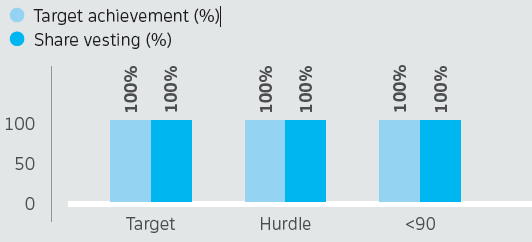
Vesting percentage based on actual achievement percentage

TSAs
Telkom’s talent management aims to identify, develop, refresh and retain highly talented and diverse individuals to ensure a continuous supply of candidates and successors in leadership and critical positions. Telkom aims to reposition itself as a leading professional community with a talented and skilled workforce, which will provide a competitive edge.
The purpose of the additional TSAs is to provide a reward mechanism that motivates and retains key critical and core talented individuals to meet business requirements. Talent shares are awarded for top talent and critical skills specialists based on the talent mapping process and business requirements. TSAs vested in FY2021 for 29 employees.
Vesting conditions of the TSAs are as follows:
- Vesting is based on achieving the TSR over the three-year vesting period
- The employee must remain in the service of the Group for the full three-year vesting period
- In accepting the shares, the employee further agrees to a restraint period of six months. It is required that the employee signs a restraint of trade agreement. On resignation, the employee forfeits all shares
Summary of Telkom Group 2020 vesting (shares awarded in 2015, 2016 and 2017)
The following shares vested on 01 July 2020 at a price of R31.35 cents per share:
| Award date | Scheme | % of performance conditions achieved |
Potential vesting % |
Actual vesting % |
Total number of shares vested |
Total shares forfeited |
Total shares awarded on Award Date |
| 2015 | LTIP | 97.58 | 20 | 17 | 81 919 | 14 425 | 96 344 |
| 2016 | LTIP | 99.42 | 30 | 28 | 191 750 | 30 919 | 222 669 |
| 2017 | LTIP | 94.34 | 50 | 35 | 234 806 | 100 582 | 335 388 |
| 2017 | TSA | 100.00 | 100 | 100 | 1 301 576 | – | 1 301 576 |
| 2017 | ESOP | 94.34 | 100 | 70 | 1 069 835 | 454 737 | 1 524 572 |
| Total | 2 879 886 | 600 663 | 3 480 549 |
LTIP: 20% vesting of the 2015 share award – achievement
| Target – rand value | ||||||||
| Category | Performance condition |
Weight | FY2016 | FY2017 | FY2018 | FY2019 | FY2020 | % Achievement |
| Financial (70%) | TSR | 20% | Risk free + 4% (R21.88) |
Risk free + 4% (R24.0) |
Risk free + 4% (R26.67) |
Risk free + 4% (R29.63) |
Risk free + 4% (R33.29) |
20.00% |
| Overall achievement | R57.57 | R75.03 | R52.94 | R72.92 | R20.53 | |||
| Achievement % | 263.00% | 312.00% | 198.50% | 246.10% | 61.67% | |||
| HEPS | 30% | 333 cps | 526 cps | 616 cps | 536.5 cps | 400 cps | 29.84% | |
| Overall achievement | 330 | 729.8 | 598 | 591.8 | 208.1 | |||
| Achievement % | 100.00% | 138.00% | 97.08% | 110.31% | 52.03% | |||
| FCF | 10% | R2 958 m | R4 021 m | R996 m | R764 m | R292 m | 10.00% | |
| Overall achievement | R2 212 m | (R862) m | R501 m | R32 m | R1 709 m | |||
| Achievement % | 74.70% | 0.00% | 50.00% | 0.00% | 585.27% | |||
| ROIC | 10% | 9.80% | 12.10% | 14.90% | 9.00% | 10.50% | 9.81% | |
| Overall achievement | 9.60% | 14.50% | 10.60% | 11.20% | 8.10% | |||
| Achievement % | 97.96% | 119.83% | 71.14% | 124.44% | 77.14% | |||
| Operational (30%) | Customer First | 15% | 61.7 | 63.4 | 65.79 | 67.99 | 68.10 | 13.13% |
| Orange Index | Actual: 55.5 | Actual: 56.7 | Actual: 63.72 | Actual: 55.29 | Actual: 54.65 | |||
| Achievement: 89.95% |
Achievement: 89.43% |
Achievement: 96.85% |
Achievement: 81.32% |
Achievement: 80.25% |
||||
| Overall achievement | 87.56% | |||||||
| Customer experience | 15% | Composite score: 1 | Composite score: 1 | Composite score: 1 | Composite score: 1 | Composite score: 1 | 14.79% | |
| TSA 100 Index | Threshold: 0.90 |
Threshold: 0.90 |
Threshold: 0.90 |
Threshold: 0.90 |
Threshold: 0.90 |
|||
| Composite score: 0.99 | Composite score: 0.96 | Composite score: 0.87 | Composite score: 0.97 | Composite score: 1.14 | ||||
| -Assurance index | Actual: 0.93 | Actual: 0.87 | Actual: 0.81 | Actual:1.01 | Actual:1.19 | |||
| -Fulfilment index | Actual: 1.05 | Actual: 1.05 | Actual: 0.93 | Actual:0.92 | Actual:1.09 | |||
| Overall achievement | 98.60% | |||||||
| Total vesting | 97.58% | |||||||
LTIP: 30% vesting of the 2016 share award – achievement
| Target – rand value | |||||||
| Category | Performance condition |
Weight | FY2017 | FY2018 | FY2019 | FY2020 | % Achievement |
| Financial (100%) | TSR | 50% | Risk free + 4% (R24.0) |
Risk free + 4% (R26.67) |
Risk free + 4% (R29.63) |
Risk free + 4% (R33.29) |
50.00% |
| Overall achievement | R75.03 | R52.94 | R72.92 | R20.53 | |||
| Achievement % | 312.63% | 198.50% | 246.10% | 61.67% | |||
| HEPS | 25% | 526 cps | 616 cps | 536.5 cps | 400 cps | 24.88% | |
| Overall achievement | 729.8 | 598 | 591.8 | 208.1 | |||
| Achievement % | 138.75% | 97.08% | 110.31% | 52.03% | |||
| ROIC | 25% | 12.10% | 14.90% | 9.00% | 10.50% | 24.54% | |
| Overall achievement | 14.50% | 10.60% | 11.20% | 8.10% | |||
| Achievement % | 119.83% | 71.14% | 124.44% | 77.14% | |||
| Total vesting | 99.42% | ||||||
LTIP 50% vesting and ESOP: 100% vesting of the 2017 – achievement
| Target – rand value | ||||||
| Category | Performance condition |
Weight | FY2018 | FY2019 | FY2020 | % Achievement |
| Financial (100%) | TSR | 50% | Risk free + 4% (R26.67) |
Risk free + 4% (R29.63) |
Risk free + 4% (R33.29) |
50.00% |
| Overall achievement | R52.94 | R72.92 | R20.53 | |||
| Achievement % | 198.50% | 246.10% | 61.67% | |||
| HEPS | 25% | 616 cps | 536.5 cps | 400 cps | 21.62% | |
| Overall achievement | 598 | 591.8 | 208.1 | |||
| Achievement % | 97.08% | 110.31% | 52.03% | |||
| ROIC | 25% | 14.90% | 9.00% | 10.50% | 22.73% | |
| Overall achievement | 10.60% | 11.20% | 8.10% | |||
| Achievement % | 71.14% | 124.44% | 77.14% | |||
Total vesting |
|
94.34% | ||||
TSA: 100% vesting of the 2017 TSA – achievement
| Target – rand value | ||||||
| Category | Performance condition |
Weight | FY2018 | FY2019 | FY2020 | % Achievement |
| Financial (100%) | TSR | 100% | Risk free + 4% (R26.67) |
Risk free + 4% (R29.63) |
Risk free + 4% (R33.29) |
100.0% |
| Overall achievement | R52.94 | R72.92 | R20.53 | |||
| Achievement % | 199% | 246% | 62% | |||
FY2021 share award
No forfeitable shares were allocated to LTIP and ESOP participants for the FY2021 share award.
Based on the share allocation policy, in terms of the TSA scheme, 3 762 402 forfeitable shares were awarded to Group Exco Members, who were in the Group’s service on the award date, 01 July 2020. The number of shares was based on the share price of R19.78 which is the volume-weighted average share price from 01 April 2020 to 11 June 2020.
In addition, based on the share allocation policy, in terms of the TSA scheme, 5 517 778 forfeitable shares were awarded to 82 top talent and critical skills employees across the Group who were in the Group’s service on the award date, 06 July 2020. The number of shares awarded was based on the share price of R19.78 which was the volume-weighted average share price from 01 April 2020 to 11 June 2020.
Vesting conditions of the TSAs are as follows:
- Vesting is based on achieving the TSR over the three-year vesting period
- The employee must remain in the service of the Group for the full three-year vesting period
- In accepting the shares, the employee further agrees to a restraint period of six months. It is required that the employee signs a restraint of trade agreement. On resignation, the employee forfeits all shares
The following performance vesting conditions will apply:
- TSR
- The employee must remain in the Group’s service for the full three years
- Vesting period of three years
| Performance condition | FY2021 | FY2022 | FY2023 |
| Total shareholder return (TSR)1 | Risk free + 4% |
Risk free + 4% |
Risk free + 4% |
| 1 | TSR combines share price appreciation and dividends paid to show the total return to the shareholder expressed as an annualised percentage. |
- Employees are required to accept or reject any awards
- In accepting the shares, employees are required to agree to a restraint period of six months, should the employee resign at any stage and for whatever reason. Upon resignation, the employee will be required to sign a restraint of trade agreement
- A malus and clawback clause is included in the share award letters for gross misconduct or negligence on the part of any employee, including cases of fraud, misrepresentation and/or material errors discovered after the departure of the employee for any reason or if the employee resigns during a formal disciplinary enquiry/hearing
Total number of shares issued up to 31 March 2021
| Year awarded | FY2014 | FY2015 | FY2016 | FY2017 | FY2018 | FY2019 | FY2020 | FY2021 |
| Date awarded | November 2013 |
April 2015 | June 2015 | June 2016 | June 2017 | June 2018 | June 2019 | June 2020 |
| Total number of shares available | 26 039 195 | 23 614 292 | 21 033 323 | 22 577 505 | 19 548 838 | 17 130 452 | 14 101 274 | 12 790 232 |
| Total number of shares awarded: Telkom | (6 559 290) | (4 685 734) | (4 733 159) | (4 886 209) | (5 266 158) | (4 690 718) | (3 507 227) | (9 280 180) |
| Gyro | (178 645) | (222 356) | (129 830) | – | ||||
| BCX | (881 075) | – | (127 008) | (1 404 181) | – | |||
| Trudon | – | |||||||
| Sub Total | 19 479 905 | 18 928 558 | 16 300 164 | 16 810 221 | 14 104 035 | 12 090 370 | 9 060 036 | 3 510 052 |
| Total number of forfeited shares: | ||||||||
| Telkom | 4 134 387 | 2 104 765 | 2 567 215 | 2 203 036 | 1 585 343 | 956 275 | 708 855 | 982 000 |
| Gyro | 140 513 | 81 011 | 21 438 | – | ||||
| BCX | 535 581 | 72 550 | 251 887 | – | ||||
| Trudon | – | |||||||
| Shares purchased: Telkom | 3 710 126 | 1 300 561 | 901 068 | 1 688 016 | 8 000 000 | |||
| Gyro | – | |||||||
| BCX | 1 060 000 | |||||||
| Trudon | ||||||||
| Remaining shares available | 23 614 292 | 21 033 323 | 22 577 505 | 19 548 838 | 17 130 452 | 14 101 274 | 12 790 232 | 12 492 052 |
Telkom repurchased 8 million shares from the market through Rossal No 65 (Pty) Ltd at an average price of R35.51 per share, for the purposes of the employee share plan.
Employment contracts

GCEO
Sipho Maseko was appointed on 01 April 2013. He is a full-time employee with a three-month notice of termination period. He may be required to work notice, be placed on garden leave or, if not required to work, full notice may be paid in lieu of notice period on duty. Remco completed detailed succession planning for senior Executive management, including for the GCEO.
There are no other obligations in Executive employment contracts that could give rise to payments on termination of employment or office. Refer to Leadership for the GCEO’s other Directorships.

External Directorships
Executive Directors can hold one external Directorship in any Company following Board approval. All compensation earned from external Directorships will accrue to Telkom. The Board may decline Executive Directors’ external Directorships as it sees fit. Refer to Leadership for external Directorships. The treatment/approval thereof varies according to the applicant level.
Other prescribed officers
All prescribed officers are employed on a full-time employment contract. Employment contracts require three months’ notice of termination by the employee or by Telkom. Employees may be required to work notice, be placed on garden leave or, if not required to work, full notice may be paid in lieu of notice period on duty.
Employees must be in service on payment date to qualify for STI payments, subject to individual and Group performance. No STI is payable in cases of dismissals. Pro rata payments only apply to new appointees for the number of months in service during the financial year. Employees must be in service on the vesting date of shares to qualify for any vesting.
There are no other obligations in Executive employment contracts which could give rise to payments on termination of employment or office.
The retirement age for Executive Directors is 65 years. A standard restraint of trade clause is incorporated into the employment contract for a maximum of three months without reward.