Productive capital




FTTH connectivity rate of 51.1%
Launch of Openserve Connect app
Aggressive increase in fibre footprint in latter part of year
Growth in fibre to the base stations
Evolution fixed business
Increased competition in fibre broadband
Scalable
network
Commercialise
the network
Transform
service delivery
COVID-19 impact
Surge in fixed-data consumption
Increased demand to connect to fibre services
Accelerated decline in fixed-voice

Image: Openserve employee
Openserve is committed to providing a scalable and state-of-art next-generation network that caters for current and future demands through continued investment in modernising and transforming its network. While we continued to experience a decline in legacy data and voice revenue, the need to consume multiple digital services led to an upsurge in data traffic, resulting in an increase in revenue across fixed fibre and carrier connectivity solutions. The adoption of new ways of working due to the pandemic has shown the importance of high-speed connectivity.
Our focus on providing next-generation and higher-speed connectivity solutions resulted in revenue growth in FTTH and carrier-based connectivity solutions while COVID-19 impacted the enterprise segment significantly, weakening its data requirements as well as accelerating legacy voice decline in the consumer segment. The decrease in legacy broadband revenue, mainly due to the decline in services with speeds below 10 Mbps, was offset by an increase of 14.8% in the provisioning of carrier services with these customers migrating to wireless technologies such as long-term evolution (LTE) to fulfil their connectivity needs.
While this led to an overall revenue decline of 10.9% to R13 485 million, which resulted in an overall EBITDA reduction of 8.1% to R4 175 million, it is in line with our transformation journey of moving from legacy-based copper to sustainable next-generation connectivity-based revenue.
The EBITDA margin increased due to cost optimisation initiatives which not only supported Openserve’s performance but also positively contributed to Telkom Group at large. Employee expenses and selling, general and administrative costs reduced by 24.4% and 10.0%, respectively, yielding an overall reduction of 12.5% in opex costs. This was underpinned by the redesign of Openserve’s operating model, which saw a reduction of 28.7% in permanent employees.
 Scalable network
FY2021 signalled the importance of high-bandwidth services, which have grown exponentially, and this is reflected through the increased fixed-data consumption of 28.3% across Openserve’s network. Openserve’s continued investment in modernising and expanding its network, including the capital investment in FY2021 of R2 942 million, has enabled a flexible, modular and scalable network architecture. This has ensured that Openserve delivers high-speed and increased-capacity networks across South Africa.
As we continue to invest in our robust infrastructure network, we aggressively increased our footprint in the latter part of FY2021 to pass approximately 549 900 homes with fibre, an increase of 20.7%. Furthermore, we upgraded existing fibre nodes, allowing us to use our strategic network investments to provide the ability to connect approximately 300 000 additional premises to our fibre footprint. This increased the overall premises that can connect and activate services on Openserve’s fibre footprint to over 800 000.
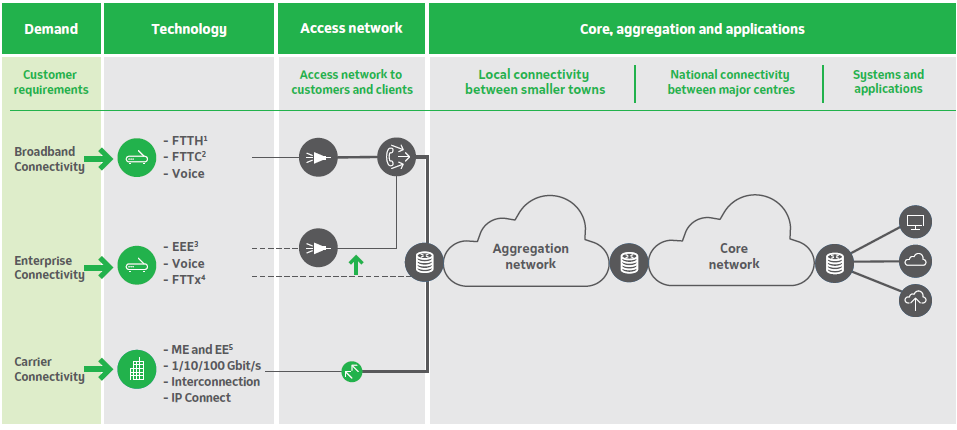
1 FTTH is fibre to the home.
2 FTTC is fibre to the curb/cabinet.
3 EEE refers to Enhanced Ethernet Express.
4 Fibre to the x (FTTx) is a collective term for various optical fibre delivery topologies that are categorised according to where the fibre terminates.
5 ME and EE refers to Metro Ethernet and Ethernet Express, respectively.
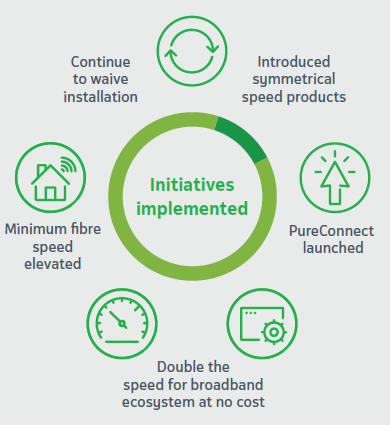
Commercialise the networkThe new norm of work and study from home led us to enhance fibre speeds and set the new South African benchmark of 25 Mbps minimum FTTH speed and introduce symmetrical speed offerings at no additional cost. This resulted in a 27.9% increase in fibre-ready homes, with more than 280 000 homes connected to our network, improving the connectivity rate to 51.1%.
As we saw greater adoption of next-generation high-speed broadband, we continued to experience the migration of the low-speed digital subscriber line customer base to wireless solutions for their minimal data consumption requirements. While this negatively impacted the digital subscriber line base, the decline was offset by increased carrier backhaul provisioning growth of 14.8%. This aligns to our drive to commercialise high-speed fixed broadband on our network while providing sufficient capacity to grow all other market segments.
As we pursued innovative solutions, we further enhanced our broadband product portfolio by doubling speeds while maintaining the same price point and connecting homes at no cost, giving more value to customers. These attractive value propositions resulted in the activation of more than 370 000 services, including broadband and other value-added services like voice over internet protocol, intercom and security.
Fibre to the home
Homes passed
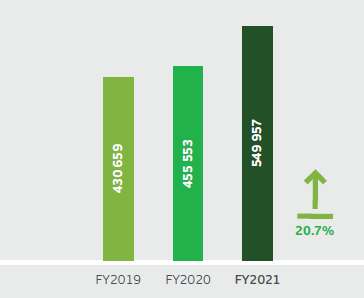
Fibre homes connected 1
Connectivity rate

| 1 | FY2021 homes connected measure as per the FTTH Council Global Alliance Definition of Terms. |
Our digital and innovation team which leads our transformation agenda focused on digitising our applications, processes and customer experience interactions. As a wholesale connectivity provider, we launched the Openserve Connect app, a first of its kind, putting self-service capability in the hands of the customer. Such platforms enable customers to manage their broadband network and track order and diagnostic requirements, driving our customer-centric approach. By adopting digital processes, Openserve focused on improving operational efficiencies which resulted in a 40.6% decrease in our assurance visits. This resulted in a reduction of 11.5 million km travelled by our frontline workers, thus positively contributing to our CO2 emissions through a decrease of approximately 18% in fossil fuel usage.
Openserve took the necessary steps to reconfigure its delivery framework to improve the installation times of next-generation connectivity, such as FTTH, by approximately 46%. Additionally, our investments in our core, aggregation and access network ensured that we continued to maintain high standards of network availability, ensuring that our clients and their customers remained connected. The support and high delivery standards were recognised and reflected in a year-on-year increase of 1.8% in our interaction Net Promoter Score.
Broadband product evolution
Openserve will continue to create an agile, future-focused organisation which is built on our robust network and distinctive customer experience.
Openserve is confident of creating an agile environment that is underpinned by innovative product offerings, digital transformation and network modernisation. Openserve is upgrading its portfolio of systems, enabling automation of processes and migrating its products and services to modern applications that enable a digital experience both for its customers and its employees.
Recognising the varied needs of our client and customers, Openserve will continue to drive efficiencies across its network footprint, reengineer its processes and build digital platforms to provide a distinctive customer experience with competitive and innovative products as part of our value propositions to all market segments. With our investment to modernise the network, Openserve plans to continue to upgrade its network nodes to provide fibre connectivity and extend our fibre to the home footprint. With increasing number of users consuming video-centric content, RAN bandwidth demands will continue to grow and as such, Openserve is confident that such investments to our network will enable it not only to connect more premises with fibre but also provide fibre backed connectivity to small and macro sites to support future 5G bandwidth, availability, coverage and speed requirements.
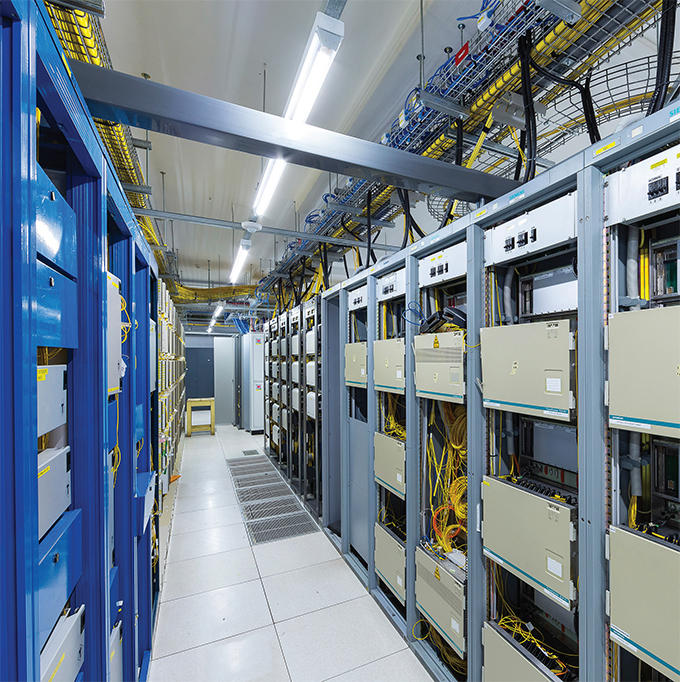
Image: Rosebank Exchange