



Intellectual capital
The rapidly changing economic, social and business environment required Telkom to focus on technologies and processes that fast-tracked the digital transformation objectives of the Company. These included harnessing collaboration tools, implementing governance protocols and, importantly, enabling new capabilities for our customers through our various digital channels.

Performance snapshot

Secure remote access was prioritised to enable collaboration with all stakeholders

Customer and workforce experience
Efficient service and product launches
Actionable insights
Security posture

Accelerated digitalisation
Improved customer experience
Modern workplace
Improved decision support
Effective governance and risk

Successes
- Accelerated and extended adoption of new collaboration technology enabling remote work
- Deploying digital self-service capabilities for multiple customer segments
- Productivity gains
Challenges
- Heightened information security risks
- Strained power supply and interruptions impacting remote work
* International Organization for Standardization (ISO)/International Electrotechnical Commission (IEC).
Technology and information governance
Our governance of technology and information is based on King IV, Control Objective for Information Technologies 2019 and ISO/IEC 38500*. In complying with these, the Board assumes ultimate responsibility for policy and direction over matters pertaining to technology and information. The IT governance structures are integrated with corporate governance to align IT governance objectives with corporate governance ambitions.
We revised the Telkom IT policies, standards and risks to align with the changing business and threat landscape as a result of accelerated digital transformation due to remote work.
Information security
The digital enterprise of the future, enabled by a remote workforce, interconnected devices and rapid cloud adoption, presents an evolved and increased cyberattack surface. Attacks are becoming more organised and employ increasingly sophisticated methods that are designed to disable security controls and remain undetected for long periods.
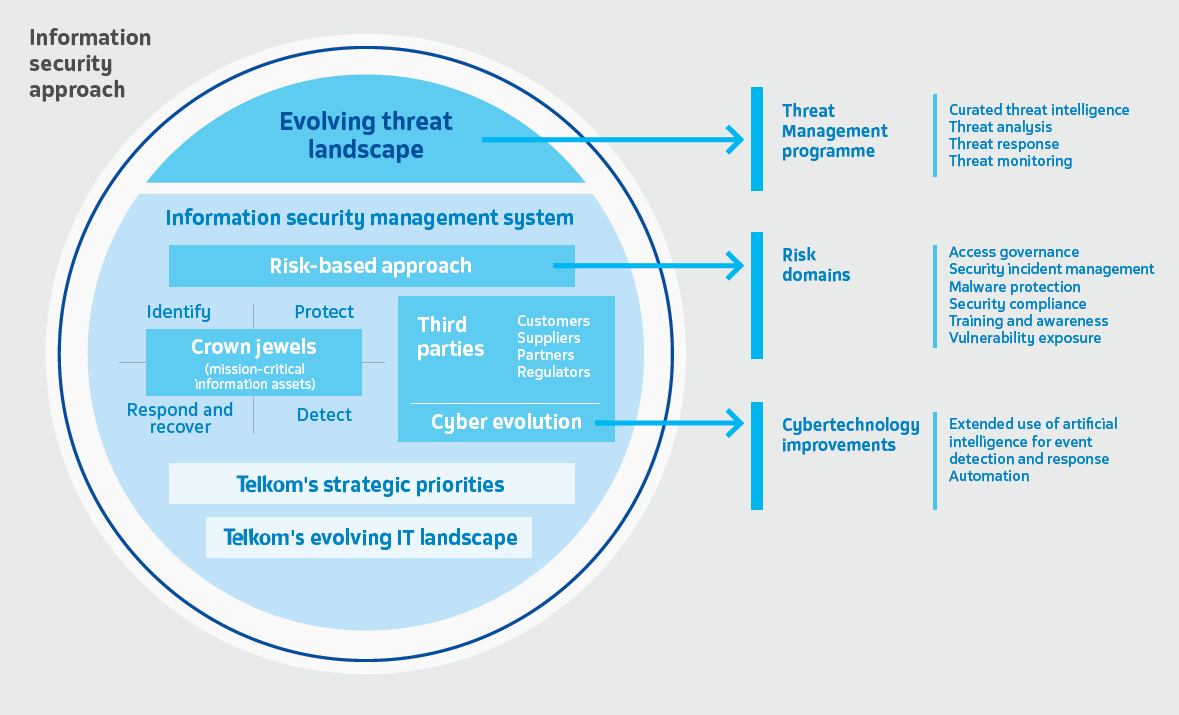
In response to the ever-changing threat and technology landscapes, Telkom pursues a risk-based approach to information security. Telkom has improved its security posture. It continues to improve the maturity of its Security programme, in line with regulatory requirements, best practice guidelines and industry benchmarks.
Telkom was awarded ISO/IEC 27001:2013 certification for information security management for the effectiveness and adequacy of its comprehensive information security management system.
Strategic direction
Our transformation journey is focused on unlocking value by using digitally enabled processes and technology that drive improved customer experience and a clear business outcome. This digital transformation is enabling flexible and scalable business models and is aligned to the evolving Telkom Group operating model.
In aligning with the Telkom value unlock strategy, we enabled growth through system stabilisation, process simplification and accelerated deployment of the digital layer.
Integrated governance approach
Corporate governance

Performance
Implementing a secure remote workplace was prioritised to ensure we could enable stakeholder collaboration through the ongoing COVID-19 pandemic. In addition, analytics and business intelligence capabilities were enhanced to drive actionable insights. To drive the omni-channel experience forward, we launched and improved multiple customer-focused initiatives such as mobile apps and e-commerce platforms. Such initiatives were underpinned by the reconfiguration of business processes to prioritise digital touchpoints and customer interaction needs.
The unprecedented need for orchestration, communication and flexible configuration has been the key driver underpinning our efforts to constantly engage, enable and support customers and employees. This was supported by accelerated digitisation and anchored by simplifying business value chains across the complete ecosystem.
Key focus areas in FY2022
We aim to continue to focus on our digital transformation journey while continuing to strengthen and improve our current capabilities across our customer-facing and network-facing technologies. The growing demand to understand our customers' needs will drive our investments into data insights and will see us focusing on improving their experience while interfacing with us.
In addressing the growing risks of cyberattacks and the increased need to enable remote working, we will continue to improve our security posture.
As we look forward, continued implementation of a modern workplace will be a strategic thrust, utilising new and improved enterprise technologies.