




Maintaining our business integrity
Building an ethical culture
Telkom has a zero-tolerance policy regarding unethical behaviour, fraud and corruption. The GCEO designated the Group Company Secretary as the Group Ethics Officer with effect from 15 March 2021. The Group Ethics Officer will focus on continuous ethics awareness initiatives, embedding a Groupwide ethical culture and through conducting an ethics and fraud survey, monitor the ethical behaviour of employees.
The Board remains committed to building a Group that maintains the integrity of the business while supporting management to enhance the assurance functions and promote an ethical culture. The Group Company Secretariat and BCX risk and Group Forensics teams developed a joint integrated ethics rollout online plan for the Group.
The established Combined Assurance Awareness Forum is a mechanism to ensure that the Group has a convergence point for the Cloud-based Ethics and Fraud training programmes, which were launched in October 2020. The online training consisted of four modules on:
- My role in ethics
- Conflicts of interest
- Gifts and entertainment
- Prevention of fraud and corruption
The modules were based on the Group ethics handbook and were designed to help promote and encourage ethical behaviour and decision-making in Telkom. This was endorsed by the GCEO and the respective subsidiaries' and business units' CEOs.
The Group ethics strategy is being enhanced to align with operational requirements and best practice. The strategy will consider outcomes from ethical dilemmas reported internally and externally. An updated Group ethics plan will be developed based on the Board-approved combined assurance framework for implementation in an integrated manner. The Group ethics handbook is being embedded into the Group culture, and it is underpinned by our values (Our values and culture).
Share dealing policy
Telkom’s share dealing policy was reviewed due to the amendment in the JSE Listings Requirements. The policy is included in the Group ethics handbook but remains a standalone policy due to its critical role in promoting transparent disclosure requirements. This policy is informed mainly by the Financial Markets Act, 19 of 2012 and the JSE Listings Requirements.
All Directors and employees are required to adhere to the policy’s provisions. Trading in the Company’s securities is not permitted during prohibited periods, which comprise price sensitive periods and closed periods (which comprise financial and cautionary closed periods).
In FY2020, the policy was aligned with the new JSE Listings Requirement which states that in the event that Telkom securities are used as security, guarantee, collateral or otherwise, such transactions would require disclosure in the Company’s annual financial statements and on SENS.
Zero tolerance for fraud and irregular conduct
Telkom Group Forensics (TGF) is responsible for the Group’s fraud risk management. TGF uses risk-based approaches to prevent, detect and respond to fraud, corruption, irregularities and theft. Telkom has zero tolerance towards fraud and irregular conduct. As such, allegations of fraud and irregular conduct are investigated without regard to any employee’s relationship with the business, stature, position or length of service.
TGF executes fraud risk management activities as per the annual fraud risk management plan. Most of the planned activities relate to proactive forensics. TGF, working with other assurance providers, conducted various Group and business-unit-specific initiatives during FY2021 to help prevent, detect and deter fraud. These included various virtual, targeted and tailor-made fraud awareness campaigns, online ethics and fraud training and a roundtable discussion involving employees on the impact of fraud and corruption in South Africa. Among others, the initiatives to prevent and detect fraud included regular fraud risk assessments, proactive fraud detection reviews and the use of fraud data analytics. We regularly engage management on prevalent cases to create awareness, foster learning and to obtain feedback on the implementation of forensic recommendations.
During FY2021, TGF initiated a project to increase the whistle-blower touchpoints from two to six. In addition to the original two (email and telephone), we have added reporting through a software application, intranet, website and WhatsApp. These new touchpoints will make it easier for internal and external stakeholders to report allegations of fraud and irregular conduct.
The Telkom hotline and other reporting channels are independently managed and operate 24 hours a day. Complainants can choose to report anonymously and are updated on the progress of the investigation or outcome if they elect that option. There was an overall 2% decline on reports to the Telkom hotline due to reduced economic activity in the first half of the year due to COVID-19. Since then, reports have increased, but not to the pre-COVID-19 level.
1 467 reports were made mainly for security, network protection services and TGF. Some of these reports were converted into cases that were investigated. The outcomes of substantiated forensic investigation led to identification of fraud vulnerable areas and improvement of internal controls, corrective actions against employees and other stakeholders, recovery of fraud loss, opening of criminal cases and provision of litigation support during civil proceedings. The graph below shows the percentage split of various fraud schemes that were reported and investigated.
Reported and investigated cases
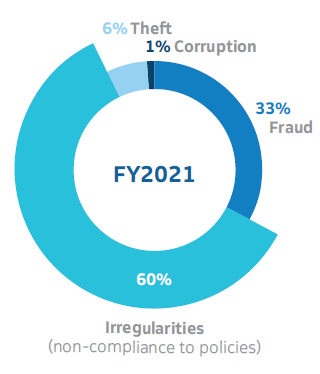
The outcomes and insights obtained from these investigations were shared with other assurance providers and governance structures and were also used to influence and guide fraud prevention and fraud initiatives. The following corrective actions stemmed from forensic investigations:
- Eight employees or third-party employees were dismissed
- Eight employees received various types of warnings
- Five employees resigned or took a VSP during the investigation or disciplinary hearing process
- Two service provider contracts were terminated
- Two service providers received warnings
As at 31 March 2021, three employees were on suspension, and a further 12 employees and one service provider were due to be disciplined based on the outcomes of forensic investigations. Criminal acts were reported to the South African Police Service, and the cases are in various stages of the criminal justice system. Where Telkom suffered fraud losses, appropriate remedies were used to recover losses from responsible parties.