



Human capital
The outbreak of COVID-19 at the start of FY2021 required a swift repositioning of key human capital priorities. The Group’s journey to remote work was propelled forward requiring immediate intervention to support and enable employees to work from home. Employee wellbeing became a central focus area due to increased stress and anxiety. People interventions ensuring a holistic focus (physical, financial, mental and psychosocial) were deployed across the Company to safeguard employees' health and safety while ensuring business and employee productivity.

Performance snapshot

Non-quota leave for employees with underlying conditions who were unable to work remotely
Compulsory leave was extended for employees from July 2020 to December 2020 due to COVID-19 travel restrictions and limited vacation options

Employee voluntary turnover
Training and development spend
Number of graduates and learners supported
Number of learnerships and internships
Employee diversity statistics
Research and development investment
Total recordable injury frequency rate
Lost-time injury frequency rate

Building a sustainability mindset
Transforming our culture
Enabling diverse, adaptive teams
Developing next-generation future leaders

Decrease in skills expenditure for training and development
Increased expenditure for employee
COVID-19 testing
Increased impact on employees' holistic wellbeing
Risk of employees returning to work with underlying conditions
 A snapshot of Telkom’s workforce
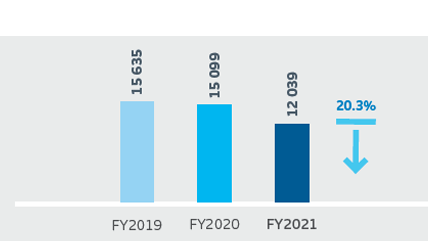
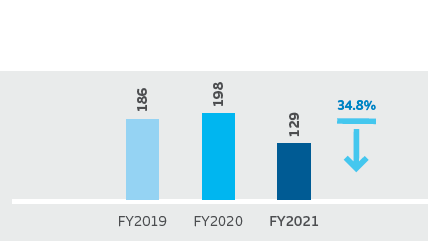
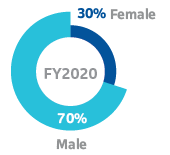
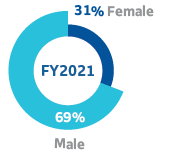
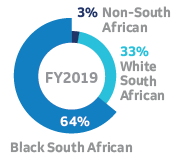
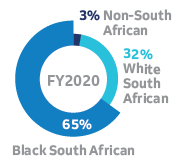
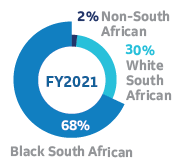
Redefining Telkom ’s operating and service delivery models to better serve the evolving needs of customers, resulted in a 20% decrease in permanent employees, without negatively impacting gender and race diversity. The number of differently abled employees was primarily impacted by employees’ decisions to elect VSPs/VERPs.
Number of permanent employees
Employee voluntary turnover
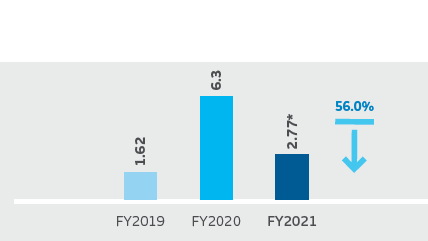
Number of differently abled employees
| * | Employee voluntary turnover was changed to reflect exits through natural attrition from the Group and not to include exits from one legal entity to another legal entity in the Group (as reported in FY2020). This explains the lower exit rate compared to FY2020. |
Gender diversity of permanent employees
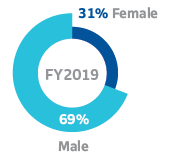
Race diversity of permanent employees
Building a sustainability mindset
The sustainability mindset includes leveraging HR tools and processes to support sustainable business objectives. To achieve operational efficiency and to future-proof the Group, we need to embed new ways of working. We are evaluating how we organise and complete work, with the view to embed remote work.
The remote work archetype is one of the strategies to support employees through COVID-19 and to create business sustainability. Remote work allowed the Group to ensure the safety of employees and made a critical difference to individuals and their families who were reliant on their physical and financial support. Employees could now focus additional time, previously devoted to commuting to work, on caring for their children, parents and communities.
The adoption of a change management framework ensures the focused and integrated execution of change management activities to drive strategic transformation. The agile and flexible approach can be used across projects and business activities. Lastly, the change approach allows scalability and "fitness for purpose" based on the level of change maturity in the Group.
Our new ways of work need to ensure employees thrive and that we create sustainable performance momentum. Enabling and sustaining this transition requires digital literacy, resilience, effective communication and emotional intelligence capabilities. We will leverage technology to enable and optimise this strategy while engaging and aligning our stakeholders throughout the process.
Partnering with our employee wellness provider (ICAS) to service employees and their families, contributes to a healthier and more vital society. The Mental Health programme and additional investment into employee health and wellbeing aim to improve employee motivation and productivity. This is achieved by addressing pivotal employee concerns and challenges through facilitated sessions to ensure guidance, support and building employee capacity.
Transforming our culture
Telkom’s culture is assessed through an annual survey. The FY2021 survey centered on Telkom’s remote work culture. The survey tested areas such as employee collaboration across the digital divide, remote leadership and employees’ psychosocial wellbeing.
The survey’s response rate was 58.9% (7 092 employees). The data analysis presented Group-wide findings and businessunit- specific themes. The Group-wide findings highlighted the comprehensive Group communication and leadership engagement as positive aspects of a remote work culture. The following future focus areas were identified: the need to normalise seeking help in difficult times, cognitive load management, improved psychological defence and positive coping mechanisms. These insights enable the implementation of meaningful interventions. This informs the way forward for a deliberate organisational remote work culture journey.
Interventions were Group-wide and business unit specific and are implemented through the remote work framework. The framework consists of five pillars aimed at effectively shifting Telkom’s culture to a remote work culture and to enable a positive business impact. The pillars are:
- Remote work (leaders and employee guidelines)
- Wellbeing (psychosocial, financial and social aspects)
- Physical (physical health and environment)
- Engagement
- Governance
The interventions are embedded in the Group’s day-today operational activities to support and guide the culture transformation.
Enabling diverse, adaptive teams
Telkom emphasises attracting and building a diverse workforce. This is implemented through its integrated talent management policy with people practices that support its human capital strategy. Our robust talent management framework continues to enable the clear identification, development and retention of key and critical skills, enabling proactive succession plans and internal career mobility. A key outcome of the framework is actionable career development plans aligned to personal career aspirations and business needs.
Our differently abled policy and three-yearly revised employment equity plan guide us as an equal opportunity employer. The three-year plan came into effect on 01 April 2020. Refer to the social and relationship capital section.
Talent management
Talent acquisition
Employees joining Telkom can make a meaningful difference in people’s lives by being part of the country’s digital acceleration while growing their own potential and careers. 211 new hires were made, of which 66 are females, and 218 employees were promoted, of which 120 are females.
External recruitment continues to focus on attracting skills to meet our digital strategy needs. These include date science, data engineering, data analytics, digital channels and e-commerce, and IT security. These skills continue to be in demand.
Succession and career mobility
Clear succession plans with emergency cover were identified for all Executive-level and key roles, with development actions for successors to build deeper and more diverse talent pipelines. Our succession planning and internal talent mobility process played a significant role in ensuring business continuity of key leadership roles in FY2021.
Due to restructuring in some areas, the FY2021 talent review cycle focused on ensuring succession for Executive-level roles. The remainder of management levels and key/critical roles will be reviewed during the first quarter of FY2022. An average bench strength of two to three successors was identified per role:
- 46.9% of successors for the Executive layer are deemed ready in less than two years
- 30% of successors have a longer-term readiness level (three to five years). We will focus developmentinvestments over the next two years on this category
During the previous review cycle of all management levels, 28% “ready now” successors were identified. Our aspiration remains to build our internal talent aiding us to have 50% "ready now" successors across all management levels. The majority (92.4%) of high-potential talent was identified as successors for specific roles, enabling career pathing within the Group.
Leadership and talent development
Our Talent Development programmes are designed to fast-track the development of high-potential talent, the building of internal talent pools and the deepening of succession pipelines. A range of programmes are under way to address required talent and leadership skills as identified through the talent mapping and succession planning processes.
The following programmes focus on strengthening female representation at middle and senior management levels:
- The Female Leadership Development programme concluded its third cohort in September 2020 with 38 delegates. The fourth cohort starts in April 2021. The programme invests in leadership development of high-potential middlemanagement-level women, preparing them for more senior leadership roles. The retention rate is 95%, and although only one promotion was achieved so far, more are expected next year
- The Women in Operations programme within Openserve and Group IT aims to equip qualified high-potential, highperformance women at an operational and junior management level for future leadership and critical and scarce skills positions within the business. A total of 16 women graduated from the pilot programme in March 2020. Based on its success, a second intake of 32 women started in November 2020
Two Digital Leadership programmes aimed at building digital skills concluded in March 2020, with 104 leaders in the Emerging Leadership programme and 85 leaders in the Accelerate Leadership programme. During FY2021 the new intake focused on formalising digital leadership skills by partnering with the University of the Witwatersrand for a formal qualification (Post-Graduate Diploma in Digital Leadership). In total, 47 highpotential senior leaders form part of this 18-month programme which commenced in November 2020. The programme includes a formal qualification and a practical application that has a strong business integration element, bringing the learning into the business in real time.
Leadership 4.0 launched with four cohorts of senior and Executivelevel leaders. Cohorts one and two started in October 2020 with 43 delegates and cohorts three and four started in March 2020 with 66 delegates. This programme aims to start preparing leaders for future business and leadership requirements. It is designed to bring the learning closer to the business through practical business application. We envisage rolling the programme out to other leadership levels next year.
 Training and development
By investing in employee development, we ensure an enabled and empowered workforce that engages at the maximum level of its capabilities. This is evidenced in the variety of diverse yet inclusive development programmes for employed and unemployed individuals. By investing in the employability of individuals, we help them to manage their own careers and support a more robust economy, particularly as "jobs for life" can no longer be considered.
The development programmes identified are aligned to the sector skills plan and to the skills required for the business.
| Training and development spend (R’million) | FY2019 | FY2020 | FY2021 |
 |
189 | 199 | 93* |
 |
102 | 63 | 51 |
 |
1 | 1 | 1** |
 |
293 | 265 | 145 |
* Telkom spend for FY2021 includes spend for Yep!.
** Gyro include
1 Telkom includes Openserve, Telkom Consumer and Corporate Centre.
The 45% decrease in training and development spend was primarily due to our inability to run many of our programmes that are designed for classroom participation due to COVID-19-related social distancing and lockdown regulations. The impact of VSPs/VERPs and retrenchments further decreased the number of employees requiring training.
| Part-time bursaries | 258 new bursaries were awarded for the 2021 academic calendar year across the Company, with 58 continuing from 2020. Bursaries were awarded for a range of formal qualifications (NQF* 5 to NQF* 9), with bursaries for scarce or critical skills areas such as digital, technical and data science emphasised. |
| FTTH technology upskilling | Openserve’s FTTH course requires physical and practical training. Due to Telkom’s effort to reduce the spread of COVID-19, no training took place but will recommence in FY2022. |
* National Qualification Framework.
| Mental health webinars | Mental health challenges can impact absenteeism, rates of illness, accidents and employee turnover and have been highlighted and exacerbated by the COVID-19 disruption. The Group launched the mental health platform and live webinars powered by BCX. The webinars are facilitated by registered psychological professionals and seek to transform access and delivery of healthcare interventions through a bespoke online psychological intervention. A pilot group of 5 000 employees participated on a voluntary basis.
The platform was launched in conjunction with Telkom’s "One's"* campaign. It aims to extend beyond the COVID-19 disruption, and to shed light on previously stigmatised and stereotyped challenges many employees face. |
| SAP success factors learning solution | The SAP success factors learning solution launched in August 2020 with six learning modules aimed at improving employees’ remote work capabilities. The solution will serve as the foundation for an accelerated approach to learning for employees, supporting a culture of continuous learning and performance. It will also further strengthen our ability to build soft skills and technical capability across Telkom. |
* Telkom “One’s” campaign is the dedicated mental health communication campaign through which all mental health initiatives are run.
Developing next-generation future skills
 Next-generation skills
Telkom began the Centre of Excellence (CoE) technology research and development initiative in 1997. We sponsored eight postgraduate learners with an R820 000 investment (FY2020: 11 learners, R640 000) and permanently placed three postgraduate learners in the Group.
Approximately 180 full-time post-graduate students benefit from the CoE programme yearly, and Telkom provides R8.6 million in research funding to 15 CoEs (FY2020: R9.9 million).
Refer to the social and relationship capital section for information on WeThinkCode (WTC) and the Explore Data Science Academy.
Learnerships and internships
Telkom focused on widening opportunities where possible for unemployed and employed learners, in line with business requirements. Learnerships and internships for unemployed learners are a critical pillar in building future skills and offering experience and insights into the world of work.
In FY2021 Telkom had 669 learnerships and internships in progress with 193 continuing from FY2020 and 476 new programmes (FY2020: 1 146). They cover areas including business administration, management, project management, ICT network maintenance and IT system support.
employed learners
Learnerships (150) and
internships (126)
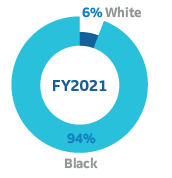
1% increase in black learners from FY2020
unemployed learners
200 of the total participants, are
differently abled
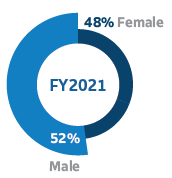
1% increase in male learners from FY2020
Organised labour
Telkom’s labour relations system appreciates trade unions' involvement as material stakeholders. Telkom has a recognition agreement with the Communication Workers Union and South African Customs Union (the alliance) as a strategic business partner. The alliance has organisational and collective bargaining rights and is represented at business unit and Company forums, including the GCEO strategic briefing sessions.
Health and safety is a standing agenda item at the Company forums where Telkom and the alliance interact on national matters. This ensures that parties engage on all health and safety matters, particularly measures taken in response to COVID-19.
| Permanent employees belonging to a union (%) | FY2019 | FY2020 | FY2021 |
|
53 | 54 | 52 |
 |
47 | 57 | 26 |
|
0 | 0 | 0 |
|
32 | 31 | 32 |
* Telkom includes Openserve, Telkom Consumer and Corporate Centre.
BCX does not have any recognition agreement or stop order facilities with any union.
Freedom of association
Telkom embraces the right of freedom of association. There are three unrecognised unions (Information Communication Technology Union, National Union of Metalworkers of South Africa and Solidarity) with members at Telkom. These three unions’ membership percentages are below Telkom’s 30% union membership representativity threshold.
S189 – Telkom
Openserve, Telkom Consumer and Yellow Pages began a judicious process to redefine their operating and service delivery models, driven by operational requirements, including customers’ evolving needs, technological advancements and evolving technologies. The Company issued a notice in terms of S189 of the Labour Relations Act, 66 of 1995 in January 2020, and offered VSPs/VERPs to affected employees as an alternative to retrenchments.
The consultation process experienced several challenges until it was suspended in March 2020 due to the national COVID-19 lockdown. The suspension was lifted in May 2020 and consultation resumed in June 2020, concluding in November 2020. The consultation process was facilitated by an appointed Commission for Conciliation, Mediation and Arbitration commissioner. Termination notice letters were issued to all unplaced affected employees on 01 November 2020 and they exited the Company on 30 November 2020.
Originally, Telkom SOC* contemplated retrenching 3 000 employees in Openserve and Telkom Consumer; however, due to alternatives explored during the consultation process, 2 271 employees accepted VSPs/VERPs and 329 employees were forcefully retrenched.
The legal entity Trudon*, commonly known as Yellow Pages, followed a similar S189 process with 62 employees accepting VSPs/VERPs and 17 employees being retrenched.
S189 – BCX
BCX* faces significant market and industry challenges such as the economic recession, deferred customer spending, changing customer demands and high competition – placing pressure on pricing and margins. COVID-19 exacerbated the challenges customers face, with some applying for business rescue while others requested payment relief or deep discounts. This puts increased pressure on BCX’s overall performance.
BCX responded to these challenges by critically reviewing and adapting the go-to-market and delivery strategies. BCX issued a S189 notice in October 2020 regarding the contemplated retrenchments of about 284 employees, inviting the Information Communication Technology Union, Solidarity and the alliance to a consultation process.
The Commission for Conciliation, Mediation and Arbitration facilitated a judicious process, starting in November 2020 and concluding on 29 March 2021. BCX proposed VSPs/VERPs as an alternative to retrenchment to all BCX permanent employees; 271 employees accepted VSPs/VERPs; 101 employees were retrenched and exited BCX on 31 March 2021.
Employee engagement
The HR function led each S189 employee engagement process and established channels of communication for affected and nonaffected employees. It established business-unit-specific portals as “living documents” to ensure updated information relating to the processes was readily available to employees. Employee questions were routed from the portal to the HR team with a 24-hour turnaround. Frequent questions were transposed into a frequently asked questions document to proactively manage employees’ anxiety.
Employee assistance centered on upskilling employees and emotional, psychological and financial support and guidance. Counselling services were provided to employees and their direct dependants through ICAS. Psychological debriefing sessions were offered to teams experiencing high levels of anxiety during this period.
The placement process was completed virtually via Microsoft Teams and conference calls, aligned with COVID-19 protocols.
Stakeholder engagement
The remote work archetype provides the opportunity to increase the number of forums held annually through virtual engagement sessions. Traditionally, six business unit sessions per business unit and four Company forums are held annually. During the period, engagement forums with key stakeholders were increased and held bi-weekly to enable more opportunity to engage and ensure involvement. The sessions allow more frequent engagement and the occasion to raise issues or challenges without the need to wait for a formal meeting. This results in a quicker feedback loop and the conclusion of challenges or issues timeously.
Substantive negotiations
In the absence of a signed wage settlement agreement between the Company and organised labour for FY2020, the Company implemented its final wage settlement offer unilaterally which expired on 31 March 2020.
When the unilateral implemented final wage settlement offers expired, substantive negotiations with organised labour did not commence because organised labour and the Company were involved in a S189 process which concluded at the end of November 2020.
The Company and the alliance agreed to conclude a oneyear substantive wage collective agreement effective from 01 April 2021 and ending on 31 March 2022, was signed between the parties on 29 April 2021
Occupational health and safety and employee wellness
We are committed to providing a safe working environment where zero incidents are achievable. This is demonstrated through visible leadership, accountability and commitment to safe operations and driven by sound policies, frameworks and processes.
Telkom’s Occupational Health and Safety programme facilitates workplace hazards/risk identification and control thereof and was a critical part of Telkom’s COVID-19 response. We implemented extensive measures to protect employees and contractors and enabled operations to continue responsibly and safely during the COVID-19 pandemic. Some of the measures implemented included a Telkom COVID-19 hotline offering clinical risk assessment and medical advice for employees and their families, employee testing, COVID-19 hygiene measures, provision of PPE and enabling 80% of employees to work from home from 26 March 2020 to 31 March 2021. Refer to the risk section for more information.
Our improved safety performance, including a 16% reduction in the lost-time injury frequency rate and an 18% reduction in the total recordable injury frequency rate, can be attributed to an improved safety culture and a heightened level of employee awareness and responsibility due to our previous safety initiatives.
Motor vehicle safety remains one of the high-risk activities in our operations, and we continue to monitor and foster good driver safety behaviour using tele-matrix systems, employee safety behaviour coaching and safety knowledge reviews.
* The legal entities that went through the S189 processes in 2020/21 are BCX, Telkom SOC and Trudon.
We deeply regret the passing of one of our employees, an Openserve technician. She was involved in a fatal motor vehicle accident on 16 February 2021 in the Limpopo province.
| FY2019 | FY2020 | FY2021 | FY2021 target |
||
 1, 2 1, 2 |
|||||
| Total recordable injury frequency rate | 1.24 | 0.93 | 0.76 | 0.79 | |
| Lost-time injury frequency rate | 0.98 | 0.68 | 0.56 | 0.60 | |
| Fatal injury frequency rate | 0.02 | – | 0.01 | 0.00 | |
| Fatalities | 2 | – | 1 | – | |
 1 1 |
|||||
| Total recordable injury frequency rate | 0.41 | 0.55 | 0.17 | 0.79 | |
| Lost-time injury frequency rate | 0.29 | 0.45 | 0.15 | 0.60 | |
| Fatal injury frequency rate | – | – | – | – | |
| Fatalities | – | – | – | – | |
1 Permanent employees only.
2 Telkom includes Openserve, Telkom Consumer, Corporate Centre and Yep!.
The Group has taken extensive measures to ensure employees are protected against COVID-19. Telkom has actively managed the risk to employees considered vulnerable as per government regulations – those aged 60 and above and those with underlying conditions. ICAS, the Group’s employee wellness partner, assisted us with a declaration process for underlying conditions: 3 408 employees declared their underlying conditions, with 1 517 of the declarations validated with medical certificates. The most prevalent underlying condition is hypertension, followed by type 2 diabetes.
Employees in these two categories were required to work from home. Where this was not possible, work was repurposed to accommodate them, or they were put on special non-quota leave. Telkom implemented stringent safety processes for employees who needed to access Telkom premises and resume duties as usual. 16% of employees were permitted to return to work and were provided with mandatory PPE. Risk mitigations are in place to manage their potential exposure to COVID-19.
Telkom implemented interventions to enable employees to work remotely while keeping safe. Change management and communication play a crucial role in ensuring employees are kept updated, are empowered to adapt to the new work environment and are able to maintain productivity. Topics such as information security, online engagement, work and home-life balance and personal development were communicated using blended channels, including learning management system modules.
Key focus areas in FY2022
Embedding new ways of working is a priority in FY2022. Working remotely can be a key differentiator in improving productivity, customer satisfaction and employee cost saving. A critical review of FY2020’s learnings must inform developing new ways of work, introducing new capabilities and achieving new levels of performance.
In this new world of work, an accelerated approach to the continuous, significant upskilling and reskilling of employees will be a key strategic lever for sustained, exceptional organisational performance. Employee development will remain a priority to ensure an internal and external pipeline. The learning management system is the key mechanism to support remote work and employee development.
Telkom will entrench the performance framework to support the remote work archetype and development. The framework will embed a clear and continuous approach to performance management focused on leading indicators, performance plans aligned to business goals, future-focused objectives and rhythmic cadence.
The HR digital transformation project seeks to transition the HR system and processes to new technology. Implementing the SAP Employee Central cloud platform will enable a central location for employee data with an integrated view across business units and real-time reporting with improved accuracy. HR will be better equipped with meaningful workforce data to deliver tangible insights.
Digital literacy, resilience and emotional intelligence capabilities will be critical in enabling the FY2022 approach, and the relevant technology should be leveraged to enable and optimise this strategy. This approach will allow Telkom to become more competitive, improve engagement, reduce costs and enable greater work-life balance while reducing its carbon footprint.
Telkom has started bilateral and multilateral discussions with government and private sector to potentially use Telkom facilities as vaccination points for Telkom Group employees, their families and the public. Feedback on this initiative will be disclosed in the FY2022 Integrated Report.