
Our strategy review
Our customers are at the heart of all we do, and this is reflected in our intent to derive value by putting our customer first.
We constantly review our strategy to ensure it remains relevant in our rapidly changing operating environment, which is increasingly complex and challenging. In September 2020, we reviewed our strategy relative to COVID-19 and other changes in our external environment. We concluded that, while specific tactics and actions are changing, our strategy framework remains resilient.
We are playing a leading role in South Africa’s digital revolution by leveraging our converged ICT leadership to enable solutions that enrich our customers’ lives, be it at work, through online education, or via entertainment (movies, music and gaming). This positions us for long-term sustainability through returns to shareholders and aligns to the four SDGs which are most applicable to our business. Our reporting approach to SDGs and our performance against the SDGs is included in Telkom's contribution to the United Nations SDGs.
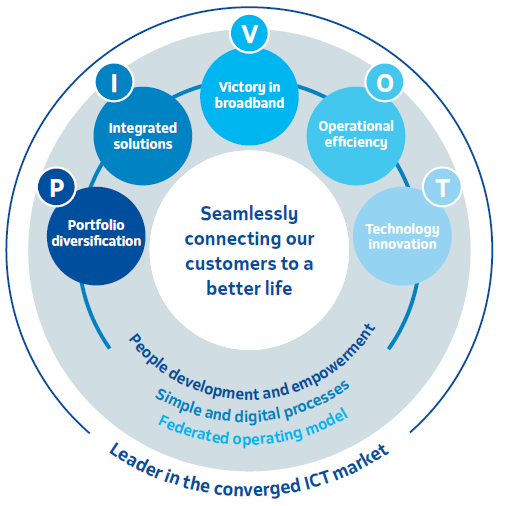
While our strategy remains unchanged, we have reviewed the communication thereof with the aim being to simplify it. Our strategy is being achieved through five strategic pillars which form our north star as we navigate a time of both local and international uncertainty.
PIVOT captures the transformational changes to our core business by moving from voice to data, from legacy to fibre, fixed wireless to mobile, and from connectivity to IT services solutions and digital ecosystems.
These five strategic pillars are largely executed through different business units. Based on the overarching five strategic pillars, each business unit has its own strategic objectives and focus areas. Progress against these are described on the pages that follow. Each business unit’s performance is discussed in productive capital.
The strategy is underpinned by Group enablers with initiatives to drive continuous improvement in these areas as part of our strategic planning and execution. Despite increased digitalisation, our people remain the driving force of our business and we remain committed to their ongoing development and empowerment for decentralised decision-making. Our move to a more federated operating model, with a lean Corporate Centre, is one facet of this. We realise that improved customer experience is dependent on us simplifying and digitising our processes, and we are implementing initiatives to drive this. Refer to human capital for more information. We continue strengthening the interaction and synergies between business units, while maintaining their focus and accountability. This improves our agility and responsiveness to the market, and the delivery of products and services to customers.
Strategy

Refer to natural capital for further information on climate change.
Description of the climate-related risks and opportunities the organisation has identified over the short, medium and long term
Telkom has identified climate-related risks and opportunities over the short, medium and long term. Climate-related risks and opportunities may influence Telkom’s strategy and/or financial planning. This includes:
- Extreme weather events, which have always negatively impacted our means to do business by affecting the network
- The introduction of carbon tax legislation, of which the second phase (2023 onwards) is expected to have a significant impact on Telkom due to the potential broadening of the tax base to include scope 2 emissions
Description of the impact of risks and opportunities on business strategy and financial planning
Risks that significantly impact the execution of Telkom’s strategy are managed by the Group Emergency Management Team. The Group Emergency Management Team has developed Group-wide response plans for water and electricity shortages, adverse weather conditions as well as fires and earthquakes. These plans include the rapid deployment of temporary electronic communications networks where required.
Our strategic pillars
We seek opportunities to generate new revenue streams from existing and emerging digital services. Each opportunity will be considered on its merits, and will inform the decision to build, buy or partner.
Insurance
policies

Total masts and
towers leases

Continued growth in insurance as well as masts and towers revenue streams.
solutionsI
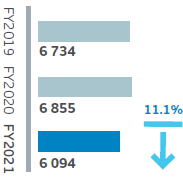
We aspire to strengthen Telkom’s ability to comprehensively address our customers’ ICT needs. This requires the appropriate access solution to seamlessly integrate with a wide range of IT services, from traditional (hardware and software) to new and emerging IT services (cloud, Internet of Things) and analytics.
Enterprise IT service
revenue (R'million)
Enterprise next-generation
data
revenue (R'million)
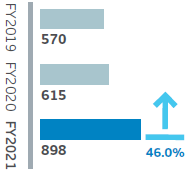
Despite a fall in enterprise IT service revenues, next-generation data showed strong revenue growth.
broadbandV
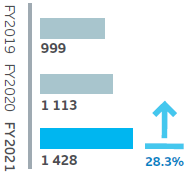
New digital services are built on high-speed data services. We are accelerating our capability to disrupt the local broadband market by leading in the delivery of innovative, value-rich solutions. These are offered to residential and commercial customers over the optimal access technology – fibre, fixed wireless, mobile, satellite and copper.
Fixed broadband
data traffic (petabytes)
Mobile broadband data
traffic (petabytes)
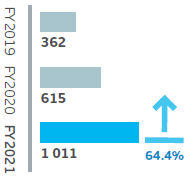
Both fixed and mobile data traffic increased significantly.
efficiencyO
In an increasingly competitive world, our success depends on continually improving the efficiency and effectiveness of our operations.
Fibre connectivity
rate (%)
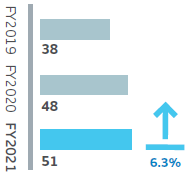
Fibre average time
to install (days)
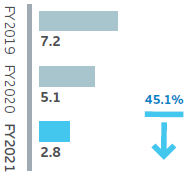
The fibre connectivity rate continued to rise, and fibre installations were completed faster.
innovationT
We aspire to operate with the best scalable and most efficient network. Telkom will invest in the optimal mix of technologies to
Carrier
services
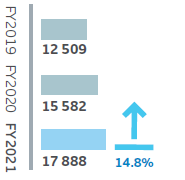
Mobile
base stations

The fixed network delivered more carrier services and additional base stations were added to the mobile network.
Telkom operating model
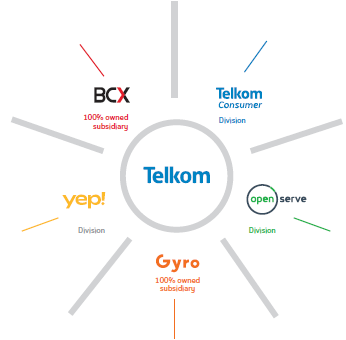
Our federated operating model enables focused strategy execution through the five business units, as set out in the Overview of our business, and discussed in more detail in Telkom’s business units.
Some of our businesses are separated functionally (Openserve, Telkom Consumer and Yep! (previously Telkom SMB)) while some are separated structurally (BCX and Gyro). We are in a process of structurally separating Openserve, to enable a greater range of value unlock opportunities and to complete the federated operating model.
We are reviewing our business portfolios and exploring how we can unlock value from them over the next three years. The Group’s valuation is not a reflection of its intrinsic value and it is trading at a telco multiple, yet its portfolio of businesses also consists of IT, masts and towers and infrastructure businesses which are valued at higher multiples than telcos globally. The Value Unlock programme, which is underpinned by valuation, strategic imperatives and capital allocation, seeks to realise value for shareholders.
Business unit strategic focus and performance

network Commercialise
the network Transform
service delivery

mobile growth Drive
high-speed broadband Expand
the mobile network Improve
customer experience

approach Adjacent
offerings

organisational sustainability Drive
digital transformation

and grow the masts and towers portfolio Commercialise
the property portfolio Enhance
building costs and operational efficiencies
rate of 51.1% Launch of
Openserve Connect app Aggressive
increase in fibre footprint in latter part of year Growth in fibre to the base station Provided more value to customers, by doubling broadband speeds at the same price point Decreased CO2 emissions by 18%, due to reduced site assurance visits
Refer to Openserve
for further details.
Refer to Telkom consumer
for further details.
e-commerce platform, improving customer experience significantly Launch of Telkom Digital Wallet on the WhatsApp channel
Refer to Yep!
for further details.
down 12.6% to R13 354 million EBITDA margin
up 15.7% Legacy to next-generation migration strategy is progressing well 21% of our customers have been migrated from Diginet to Metro Ethernet Launch of Artificial Intelligence for IT Operations (AIOps) offering, to help enterprises reduce operational cost of IT services
Refer to BCX
for further details.
Refer to Gyro
for further details.