
Social and relationship capital
COVID-19 spurred fresh thinking and innovative approaches to respond to the immense pressure it imposed on learners, communities and entrepreneurs.
Performance snapshot

Value creation which achieves both social and commercial return where possible

B-BBEE ratings
Employment equity plan targets
Diversification of procurement spend
Number of learners and teachers impacted
R'million invested in Telkom Foundation
Number of SMMEs impacted or supported
R'million invested in digital skills programmes
Number of jobs created (direct and indirect jobs)

Diversify the supply chain and sales value chain (such as dealers) and accelerate innovation in the technology sector, focusing on SMMEs. This is one of the mitigating factors for supply chain risks identified in the business.
Digital skills development for the future
Holistic school development and integrating ICT in schools

Digitisation of SMMEs
Economic impact of lockdowns on SMMEs
Blended learning models
Governing social and relationship capital
The Social and Ethics Committee is ultimately accountable for transformation and B-BBEE oversight. Senior management is responsible for transformation performance, led by Group Exco and supported by functional leadership.
 Supporting ESD: FutureMakers
FutureMakers is Telkom’s ESD unit, supporting 2 522 enterprises since its launch in 2015. Its purpose is to sustainably contribute towards the growth of SMMEs in the technology sector while contributing towards Telkom’s own innovation and diverse value chain mandate. Diverse Supply Chain and Sales Value Chain programmes and innovation are key focus areas.
FutureMakers directly supported 248 enterprises (FY2020: 482) which collectively had just over 5 168 direct and indirect jobs (FY2020: 5 600). It spent R31 million (FY2020: R29 million) on incubation, connectivity and business support to SMMEs. FutureMakers supports entrepreneurs and enterprises that have a high potential to grow and impact both our businesses and society. We kept our Innovation programmes smaller than most years and have ensured that the SMMEs on the Diverse Supply Chain and Sales Value Chain programmes are of good quality.
FutureMakers launched the Township Innovation Incubator in December 2021, and 11 social entrepreneurs will be working through a structured innovation methodology to develop solutions to the social challenges they identified.

IFT programme
Objective: Outsource the fault repairs of our network to SMMEs, providing access to the market.
Outcome: Telkom procured R105 million from 31 participants (FY2020: R140 million; 43 participants). As we upgrade our network, we migrate the IFTs from servicing a copper network to servicing and laying a fibre network. There were 474 (FY2020: 420) technicians employed by the IFT companies.
Consumer Dealers programme
Objective: To work with SMMEs in the distribution of Telkom products in the sales value chain.
Outcome: R20 million revenue generated by 12 Telkom Consumer Dealers in the FutureMakers programme (excluding stores) (FY2020: R21 million; 52 dealers). FutureMakers supported 12 dealers (FY2020: 41) and closed its Internet Café programme, which was part of the number of FY2020 dealers.
BCX Subcontractor programme
Objective: To provide IT companies access to market through subcontracting opportunities from our clients.
Outcome: The programme had 86 registered SMMEs (FY2020: 80). R126 million was successfully subcontracted to SMMEs over five years (FY2020: R83 million).
IDF Future Fund (venture capital fund)
Objective: To invest in technology start-ups from seed to growth stages through equity, quasi-equity and debt. The total fund is R250 million.
Outcome: Total commitments of R207 million in 108 start-ups since 2015 (FY2020: 173 million; 86 start-ups).
Open innovation
Objective: To provide technology support, incubation and acceleration to emerging technology start-ups. This has historically taken place in BCX through the BCX Innovation programme. As there was a need to focus on a Group-wide Innovation programme that results in social and commercial value, Telkom launched a Group-wide Township Innovation Incubator in FY2021.
Outcome: Overall, 11 entrepreneurs were selected based on the strength of their entrepreneurial orientation and the social problems they were solving.
 Developing digital skills for the future
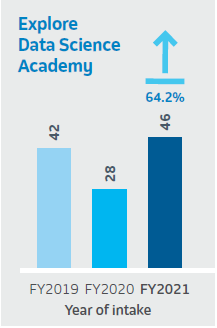
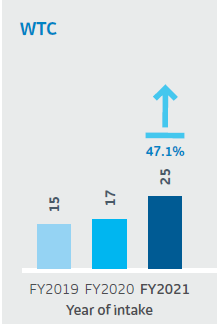
We aim to enable a talent pipeline of young people with future skills to fuel Telkom’s business agenda and support igitalisation of the South African economy. The total investment into this was R37 million (FY2020: R37 million) and our key programmes are the Explore Data Science Academy and WTC partnership.
WTC developed a home-grown coding curriculum which replaced the previous system this year. This was partly to redress the foundational science, technology, English and mathematics (STEM) learning challenges inherited from the high school system, and to make learning more cost effective.
The Explore Data Science Academy’s 2020 curriculum emphasised problem solving and understanding business value. Student internship projects at Telkom generated potential solutions for customer experience and churn, process analytics, the business impact of load shedding and market insights.
This year was significantly shaped by COVID-19, and we needed to adjust to limit its negative impact on our intended outcomes. The agility and flexibility of our partners ensured that performance and quality outcomes remained consistent
- The Explore Data Science Academy transitioned to a completely online model during lockdown; and 80 successful graduates represent an 80% retention rate of the original cohort. By March 2021, 40% of 2020’s graduates were placed in employment positions, a reflection of a slow-growing South African economy
- WTC shut down its campus between March and August 2020 due to concerns about inclusivity and the ability of all students to access the necessary tools to study online. The placement of 80 students who graduate in May 2021 is ongoing while they complete their four-month host employment in corporates and SMMEs. The 80 students represent a 72% retention of the cohort which started in 2019, improving the 50% retention rate of the 2018 cohort. Retention rates would have been impacted to some degree by COVID-19
- Necessary support mechanisms – hardware, software and broadband/data – were put in place to support 300 students studying from home. Innovative pedagogical support through enhanced peer-to-peer support, mentorship and tutoring further assisted students
While the vast majority of supported students are black, gender diversity remains a challenge in the technology industry.
Female representation (%)
Diversity and inclusion remain priorities for WTC:
- The percentage of students coming from the extremely low-income category (household income below R75 000 per annum) increased from 32% in FY2019 to 59% in FY2020
- 81% of students come from low-income households (annual income below R350 000 per annum)
Female representation (%)
Supporting our communities: Telkom Foundation
Telkom Foundation supports young people in performing well in STEM to enable them to access post schooling and future economic opportunities. The Foundation also works with unemployed youth to enable them to attend ICT-certified skills programmes which open potential employment and entrepreneurial opportunities.
The Foundation invested R46.3 million including administration costs, with R29.5 million invested in education, R10.7 million in digital skills and R4.8 million in Social Development programmes (FY2020: R75 million).
COVID-19 resulted in a number of learners not being able to continue with learning due to school closures. We migrated the STEM Supplementary Tuition programme online, enabling learners to continue learning. Over 7 910 learners across the country signed up on our new Lightbulb online education platform. 3 687 learners of the Foundation’s supplementary STEM programme received learning devices and mobile connectivity, making it easier for them to connect and learn remotely. Learners participated in live sessions which were recorded and uploaded on the platform to enable wider access.
We migrated the Digital Skills programme to an online platform. 100 unemployed youths were trained remotely in Technical and Systems Support programmes accredited by the Media, Information and Communication Technologies Sector Education and Training Authority at NQF levels 4 and 5. Our Coding programme continued online with 300 learners.
Given the demand for remote teaching, the Foundation trained 1 950 teachers and education district officials in productivity tools and content useful in remote learning.
Our online programme continues with learners accessing content on our zero-rated platforms. To date, Telkom has zero rated at least 1 000 education sites, enabling learners to access content at no cost to them. Telkom zero rated another 200 sites to enable easy access to public service information.
Supporting learners
We supported a number of learners from struggling families, and families outside the programme, with food parcels. We migrated the Psychosocial programme online to continue supporting learners in and outside the programme. Childline supported 1 213 learners and families to cope with COVID-19 and other related psychosocial issues.
Our partnership with Families South Africa in Port Elizabeth reached 141 learners and their families, while our national Lifeline and Childline jointly reached 642 936 people.
Supporting B-BBEE
Expected changes to the ICT sector codes may impact the FY2022 rating. It is uncertain when these will be gazetted, as it was expected in January 2021.
The Employment Equity Amendment Bill was published for public comment in January 2021. When enacted, there will be ICT sector targets and related compliance certificates. Depending on the date of enactment, this will have a significant influence on our targets and employment equity plans.
B-BBEE ratings
| Scoring element and weighting points | FY2019 | FY2020 | FY2021 |
 |
|||
| Ownership (25) | 23.00 | 15.91 | 17.08 |
| Management control (23) | 17.39 | 19.29 | 16.66 |
| Skills development (20) | 19.44 | 16.69 | 17.06 |
| ESD (50) | 47.87 | 47.06 | 47.41 |
| Socio-economic development (12) | 12.00 | 12.00 | 11.92 |
| Total (130) | 119.70 | 110.96 | 110.12 |
 |
|||
| Ownership (25) | 23.00 | 18.76 | 17.08 |
| Management control (23) | 16.27 | 17.67 | 15.82 |
| Skills development (20) | 21.13 | 18.78 | 20.67 |
| ESD (50) | 48.22 | 51.41 | 49.47 |
| Socio-economic development (12) | 12.00 | 12.00 | 12.00 |
| Total (130) | 120.62 | 118.82 | 115.04 |
| Telkom SA has maintained a B-BBEE level 3 status largely impacted by the ownership score. BCX has maintained B-BBEE level 2 status. |
Procurement with black-owned businesses
| Category | FY2019 R’billion |
FY2020 R’billion |
FY2021 R’billion |
| Overall spend with black-owned enterprises | 4.00 | 25.00 | 29.87 |
| Spend with black-owned small enterprises | 1.70 | 1.61 | 1.51 |
| Spend with black-owned generic large enterprises | 2.20 | 4.28 | 28.35 |
| Overall spend with black-women-owned enterprises | 8.0 | 9.8 | 7.02 |
Key focus areas in FY2022
Telkom’s black ownership and black women ownership will be a focus next year due to the loss of facilitator status for government-owned shares in FY2020. The changes in facilitator status resulted in Telkom being less than 51% black owned and less than 30% black women owned. Telkom will make every endeavour to reattain this level of ownership.
Management control will be a focus to ensure that the Group complies with the proposed Employment Equity Amendment Bill and its related sector codes and compliance certificates, should it be enacted.
Digital services: COVIDConnect case study
Detecting cases early and identifying contacts, as well as gleaning relevant insights to support longer-term planning, are key to managing the spread of COVID-19.
During the height of COVID-19 in 2020, the Telkom strategic insights team, in collaboration with BCX, the National Institute for Communicable Diseases (NICD) and the Department of Health, collaborated to develop a COVID-19 management solution to:
- Improve efficiencies and access to pandemic information for health workers
- Provide contact tracing and support to positive patients
- Glean insights which could support trend analysis, forecasting and planning
- Uses the public sector’s GovChat and Health Check WhatsApp platforms to provide public screening for COVID-19
- Receives test results from the NICD and links positive patients to monitoring and case management support
- Anonymous contact tracing through Health Check and SMS
- Aggregates data to support better pandemic management through monitoring of mobility and vulnerability patterns, disease incidence and transition
Over four months, the team grappled with complex data sets and stakeholder needs, to design a solution which would provide ongoing support and insights while alleviating the crisis. The solution, called COVIDConnect, incorporates the following:
The solution has been beneficial to health workers in 52 districts and provides a basis for adaptation and application for managing other health conditions. The key outcome was to drive faster pandemic responses and more efficient use of healthcare resources. It demonstrates the power of data in creating value for both commercial and social return, and the flowthrough impact of Telkom’s investment in data science capability.

Lightbulb education and Telkom partnership
At the start of the COVID-19 lockdown in March 2020, many South African learners were faced with the challenge of interrupted schooling and no access to learning.
Telkom wanted to introduce a compelling and unified education value proposition that would provide access through a zero-rated platform. The goal was to provide learners with Curriculum Assessment Policy Statements (CAPS)-aligned curriculum content, specifically on science, mathematics and English, for learners between grades 7 and 12. This education value proposition helps Telkom to deliver on social and commercial priorities, including enabling online access to quality education and product bundling for business-toconsumer marketing and business-to-business service.
We identified Lightbulb, a benefactor of FutureMakers, as our best fit to develop this. Learners are able to access the Lightbulb education platform via the web or on a cell phone. Some of its key features include:
- Free interactive digital CAPS-aligned content focusing on science, mathematics and English
- Personalised learning paths
- Group tutoring and audio and video conferencing features
- Video broadcasts
- Collaborative tools such as live chats, collaborative whiteboards and question and answer forums
- Assessments and self-quizzes
- Content management system
Over 7 000 learners registered on the platform and close to 3 000 learners participated in live virtual classes offered by Telkom Foundation during lockdown. These lessons were recorded and uploaded for learners to access at any time.
Most learners found the platform beneficial. Many of them remarked on the value of interactive assessments and how these were helping them prepare for examinations, especially given limited access to teaching. With learners back at school (mostly on rotation), most continue to use Lightbulb to reinforce learning. Content on the platform is continuously updated to support quality learning outcomes.