


Reporting boundary and approval
Telkom’s purpose is to seamlessly connect our customers to a better life. We aim to provide our stakeholders with transparent, relevant and integrated information to enable them to make better and more informed decisions about Telkom – connecting our reporting with their expectations.
This integrated report (this report) covers the financial year 01 April 2020 to 31 March 2021 (FY2021 or the year) and includes significant subsequent events up to the date of approval of this report. The reporting boundary covers Telkom SA SOC Ltd, which represents the Telkom Group (Telkom or the Group), which comprises Telkom Company (the Company) and its subsidiaries.
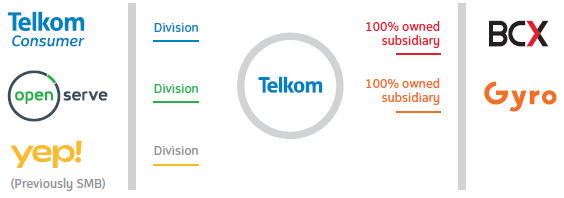
The Telkom Company consists of divisions, namely Corporate Centre, Openserve, Telkom Consumer and Yep! (previously Telkom Small and Medium Business (SMB)). The Group’s subsidiaries are BCX and Gyro. Telkom’s business units are made up of these divisions and subsidiaries.
Telkom SMB was rebranded as Yep! and includes Yellow Pages and the small and medium entities that were carved out from BCX. Yep! is also consolidated with Telkom’s small and medium business entities and is reported under the Telkom Consumer segment.
Telkom’s operating model
 Board approval

The Board of Directors (the Board) acknowledges its responsibility for the integrity of Telkom’s integrated report. It confirms that it collectively reviewed the integrated report’s contents and leveraged off the assurance obtained from its various internal and external assurance providers, including assessments on risk and internal controls. The two new Non-executive Directors, Olufunke (Funke) Ighodaro and Ethel Matenge-Sebesho on Annexure to the notice of annual general meeting were in attendance (not included for the report approval due to tenure).
The Board is of the view that Telkom’s integrated report addresses all of Telkom's material matters and concluded that the information herein is materially presented in accordance with the IIRC <IR> Framework1. The Board approved the integrated report on 02 July 2021.
| 1 | International Integrated Reporting Council’s (IIRC) International Integrated Reporting <IR> Framework, 2013. |
Enhancing our environmental, social and governance (ESG) disclosures
Sustainability reporting combines economic performance, social responsibility and environmental care. This requires a business to have a sustainability strategy that provides a coherent view of business sustainability.
Telkom has addressed sustainability reporting by focusing on compliance matters and assessing its sustainability against international standards. Although Telkom has not published a sustainability strategy, it plans to develop a Group sustainability strategy over the next two years and have implemented various initiatives relating to sustainability matters. The Group has also adopted the various sustainability frameworks and participates in indices as set out below.
The United Nations Sustainable Development Goals
The United Nations Sustainable Development Goals
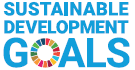
To formalise Telkom’s commitment to the Sustainable Development Goals (SDGs), we conducted an internal survey and held a formal workshop. The aim was to identify, evaluate and prioritise SDGs which Telkom can materially impact. The SDGs were approved by the Group Executive Committee (Exco) and noted by the Social and Ethics Committee.
The four SDGs alongside, with selected SDG targets, were identified as presenting the most material opportunities for Telkom to enhance its positive impact and minimise its negative impact, and align with Telkom's business approach to sustainability issues and opportunity realisation:
Throughout this report, the relevant SDG icon indicates where related information is discussed. More detail is set out in the SDG appendix on Telkom’s contribution to the United Nations SDGs.
Task Force on Climate-related Financial Disclosures

Task Force on Climate-related Financial Disclosures
Telkom has embarked on a journey to adopt Task Force on Climate-related Financial Disclosures (TCFD) recommendations to strengthen our climate-related financial disclosures. In FY2021 we started by incorporating disclosures recommendations regarding risk , strategy and governance . We aim to improve these disclosures over time and intend to focus on the metrics and targets disclosures over the next two years.
Global Reporting Initiative Standards

Global Reporting Initiative Standards
Telkom has aligned its definitions of sustainability key performance indicators (KPIs) to the Global Reporting Initiative Standards’ relevant definitions. This facilitates comparability.
CDP

CDP
Telkom has participated in the CDP (formerly the Carbon Disclosure Project) for the past eight years and will continue to do so in FY2022. This participation provides feedback on how well the Group is managing its energy and carbon emissions inventory to reduce Telkom’s environmental impact within its operational boundary.
Telkom’s score improved from C to B in FY2020, after improving from D to C in FY2019. The B score is higher than the African regional average and the media, telecommunications and data centre services sector average, which have both scored a C. We are currently busy with the FY2021 submission which we will report on in FY2022.
Telkom aims to set science-based emissions targets for the first time in FY2022. For more information on emissions, refer to natural capital.
FTSE/JSE Russell ESG Index

FTSE/JSE Russell ESG Index
Telkom remains a constituent of the FTSE4Good Index series following its June 2020 review. The 67 constituents are companies that reflect strong ESG risk management practices as measured by an overall ESG rating.
Telkom aims to move back into the FTSE/JSE Responsible Investment Top 30 Index over the short to medium term. The last time Telkom was included in the Top 30 was in 2017.
TELKOM’S RESPONSE TO COVID-19
- Tested and provided counselling to employees and families through our wellness partner ICAS Southern Africa
- 88.2% recovery rate for affected employees
- Approximately 80% of employees working from home since the beginning of the national lockdown
- Launched Lightbulb Education and zero rated ~1 000 educational sites
- >7 000 people have access to tutors and counselling
- Developed track and trace tools with National Institute of Communicable Diseases and Department of Health
- Reduced prices and increased speeds and broadband bundle sizes
- Granted payment holidays and extended payment terms during lockdown levels 4 and 5
- Offered free access to the new Yep! marketplace and desktop applications to small and medium-sized enterprises (SMEs)
- Made our training centre available as an additional quarantine site
- Formed a disaster relief fund that supports the Red Cross
- Conveyed the importance of contributing to COVID-19 relief
Refer to engaging with our stakeholders for more information on each stakeholder group.