




As a post-COVID-19 “new normal” started to emerge, Telkom worked on adapting our capabilities to find sustainable solutions to South Africa’s challenges in education, skills development, technology innovation and entrepreneurship. These are key platforms for building an inclusive digital future for all.
These platforms support socio-economic upliftment, which is aligned with our ESG Strategy focus area of Investing with Purpose, and also indirectly contribute to our commitment under our Digital Services focus area.
Number of SMMEs impacted or supported
Number of jobs created (direct and indirect)
R’million invested in digital skills programmes
R’million invested in the Telkom Foundation
Number of learners and teachers impacted
B-BBEE ratings
Employment equity plan targets
Diversification of procurement spend
Diversify our supply chain and sales value chain (such as dealers) and accelerate innovation in the technology sector, focusing on SMMEs. This is a mitigating factor in managing supply chain risks
Digital skills development
Holistic school development and integrating ICT in schools
The Social and Ethics Committee is responsible for transformation and B-BBEE oversight. Senior Management is responsible for transformation performance, led by the Group Exco and supported by functional leadership.

 Supporting ESD: FutureMakers
 Telkom launched FutureMakers in 2015 to develop ICT SMMEs within the sector and our supply chain. We focused on diversifying our supply chain and partnering with SMMEs that have the potential to enhance our innovation capabilities. FutureMakers currently has 289 (FY2021: 248) SMMEs registered on various programmes.
Through our Supplier Development Programmes, incubation and funding initiatives, we have supported over 2 500 enterprises since 2015.
In FY2022 FutureMakers supported SMMEs on various programmes with R88 million (FY2021: R31 million) comprising R37 million in grant funding; R36 million in incubation, training, and prototyping; and R15 million in interest-free loans.
The grant funding was awarded to 74 SMMEs, of which 38 are on our Supply Chain Programmes and 36 on our Innovation Programmes. The purpose of the grant was to help SMMEs scale their businesses and to mitigate against a tough economic climate. The grant was awarded based on a sound business case, potential to create employment, and the experience of the management team.
In our Supply Chain Programmes, we supported 10 women- owned SMMEs on the Independent Field Technicians Programme by purchasing fibre cables to help them roll out Openserve's fibre programme.
In our Innovation Programmes, the 11 selected businesses that are part of the Township Innovation Incubator completed their training modules and moved to the prototyping stage. BCX's Software Development team worked closely with the entrepreneurs to improve their prototypes, and in some cases develop minimum viable products worth R5 million. In addition, Telkom FutureMakers hosted two hackathons which saw seven start-up teams emerge as winners out of over 50 teams in solving some of Telkom's key innovation challenges. The first hackathon was a Gaming hackathon held in partnership with Tshimologong. The second hackathon was a partnership with 22 on Sloane and marked the celebration of the Global Entrepreneurship Week. All participants received more than R8 million in incubation, mentoring, prizes, and marketing exposure.
The Telkom FutureFund, managed by IDF Capital, has made 137 transactions since 2015, with R238 million in total commitments and net investments (considering repayments and disbursements). Most of the indirect jobs (26 463) were created by the invested portfolio. The Telkom FutureFund has now begun its divestment period, which means that that the fund will only be making follow-on investments and engaging in value creation activities to ensure the growth of the invested portfolio.
Diverse Supply Chain and Sales Value Chain Programmes are providing opportunities for SMMEs to thrive in our value chains and mitigate supply chain risks identified in the business.
Objective: Outsource the fault repairs of our network to SMMEs, providing access to the market.
Outcome: Telkom procured R203 million from 32 participants (FY2021: R105 million; 31 participants). There were 599 (FY2021: 474) technicians employed by the IFT companies.
Objective: To work with SMMEs in the distribution of Telkom products in the sales value chain.
Outcome: R17 million revenue generated by 15 Telkom Consumer Dealers in the FutureMakers Programme (FY2021: R20 million; 12 dealers).
Objective: To provide IT companies with access to the market through subcontracting opportunities from our clients.
Outcome: The programme had 177 registered SMMEs (FY2021: 86). Subcontracting opportunities worth about R225 million were created for SMMEs although none were successfully closed in FY2022. Subcontracting opportunities worth R126 million were successfully subcontracted in FY2021.
Innovation programmes are geared towards incubating, investing and commercialising enterprises that are developing solutions using emerging technologies.
Objective: To invest in technology startups from seed to growth stages through equity, quasi-equity and debt. The total fund is R250 million.
Outcome: Total commitments of R238 million in 137 transactions since 2015 (FY2021: R207 million; 108 transactions).
Objective: TTo provide technology support, incubation, and acceleration to emerging technology start-ups solving social challenges.
Outcome: Overall, 11 entrepreneurs were selected based on the strength of their entrepreneurial orientation and the social problems they were solving. They have completed their training and have progressed to the prototyping stage.
 Developing digital skills for the future
We aim to empower a pipeline of young people with future- ready skills to fuel Telkom's innovation and transformation agenda, as well as support the digitalisation of South Africa's economy. This was driven by an investment of R37 million in FY2022 (FY2021: R37 million), with key programmes being the Explore Data Science Academy and WeThinkCode partnerships.
We renewed our contracts with Explore Data Science Academy and WeThinkCode for a further three years from 2022. This will support an additional 600 students over the period and secure a coding and data science talent pipeline.
Despite the ongoing constraints of COVID-19, the students' performance levels remained high. This stands as testimony to the resilience of the students, agile business models and the strength of institutional leadership. With ongoing support, students have continued to adapt well to hybrid learning approaches, and this is providing valuable lessons for scaling digital learning in the future. We enabled students to study from home with the necessary support in hardware, software and data, as well as with innovative pedagogical support through enhanced peer-to-peer interactions, mentorship and tutoring.
The Explore Data Science Academy transitioned to a hybrid model. Thirty BCX-supported students from geographically dispersed towns are now participating completely online in a pilot to see how well they will cope with the complex subject matter when learning at home. The pilot is also testing prospects for greater access and inclusion. Internet connectivity and electricity outages did pose challenges, particularly between September and December 2021 when students were working on their business projects. However, the projects have still generated business value with their focus on a range of issues including retail shelf space insights, prediction of diabetes, customer experience, cable and infrastructure theft, and digital maturity models.
The 2022 cohort of data science students has shown the benefit of the hybrid model, with students from more provinces in South Africa now taking part.
The 2021 WeThinkCode cohort performed well, with a 99% retention rate after four months. Of the 433 students, 49% are women, 94% are black and 90% come from low-income households (with an annual income below R350 000). BCX supported 60 students.
The 2020 cohort has been employed by over 60 companies, many of them small and medium-sized businesses. This was driven by a conscious effort to infuse these skills in technology start-ups as engines of growth.
We made steady progress in improving the representation of women in our coding and data science cohort, as illustrated in the graphs alongside.
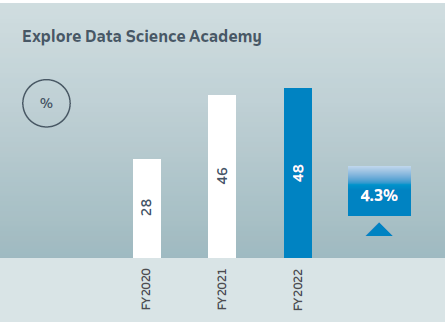
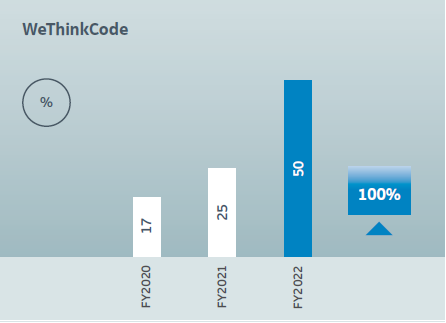
Investing in digital skills will drive shared value for our business by growing the pipeline of talent to take our business into the future. It also drives our ESG commitment to impact 30 000 lives through digital literacy by 2023. This will directly support national objectives to enhance economic and social innovation in all sectors built on digital skills1.
 Supporting our communities:
Telkom Foundation
Supporting our communities:
Telkom FoundationThe Foundation invested R76.8 million (including administration costs), with R36.4 million invested in education, R25.3 million in digital skills and R7.8 million in Social Development Programmes (FY2021: R52.7 million).
Our social investments are aligned to our purpose and core business, and thus support a shared-value approach to education in a digital age.
The Telkom Foundation (the Foundation) continued to support young people in improving their performance in science, technology, engineering and mathematics (STEM) subjects, which will enable them to access post-schooling and future economic opportunities. The Foundation also continued to invest in reskilling unemployed youth through training accredited by the Media, Information and Communication Technologies Sector Education and Training Authority (MICT SETA), to enable them to access employment and entrepreneurial opportunities in the ICT sector.
In 2021, the Foundation's integrated High School Support Programme reached a five-year milestone with the first group of 1 343 of the 3 140 learners reaching Grade 12. This group achieved 354 distinctions. Telkom offered bursaries to 25 learners who achieved two or more distinctions. The Foundation provided Grade 12 learners within supported schools with a facilitated and structured programme to help them to apply for and secure post-school study and funding opportunities.The programme supported 492 learners, of whom 187 were able to secure opportunities in various institutions. The STEM Supplementary Tuition Programme continued through a hybrid model of online and physical classes.
Nationally, over 10 700 learners access learning through Lightbulb, the Telkom-supported education platform. Of these, 3 687 learners accessed the platform through learning devices and mobile connectivity provided by the Foundation, making it easier for them to connect and learn remotely.
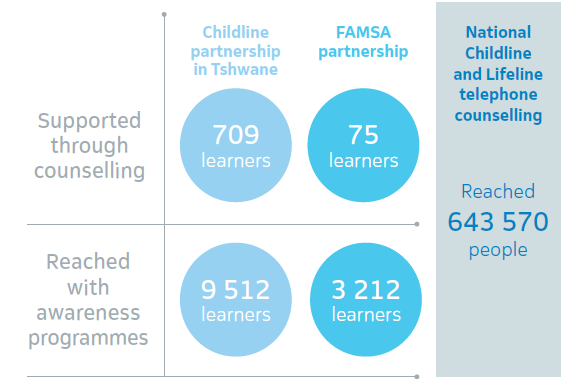
The Psychosocial Programme continued to support learners in need of counselling. It conducted awareness programmes on relevant topics within the 22 Foundation-supported schools in Tshwane West in Gauteng and Gqeberha in the Eastern Cape.
We migrated the Digital Skills Programme onto an online platform, enabling learning to continue despite COVID-19 challenges. This year, 228 high school learners completed year 3 of the programme. We introduced these learners to various types of technologies including robotics, systems development, fintech and blockchain.
To ensure sustainable and long-lasting impact, the Foundation deployed comprehensive ICT solutions in supported schools that included devices, connectivity, ICT labs and interactive white boards. Support also included training teachers and principals to ensure that they could utilise this investment. We trained at least 150 teachers on the ICT equipment and its role in improving pedagogy and content in STEM subjects. We extended the training to approximately 6 000 teachers outside the seven schools during the pandemic.
The Foundation worked with the schools to develop instructional leadership among the principals. It also focused on creating a network where they can support and share insights and lessons on how to deal with school challenges.
The Foundation worked with Telkom to identify education sites that could be zero rated, thus widening access to learning beyond Lightbulb. To date, over 1 000 education sites have been zero rated, enabling more learners to access content at no cost.
Telkom zero rated an additional 200 public service sites to enable easy access to public service information.
In partnership with the Department of Education, the Foundation developed a virtual framework to support the establishment of virtual schools. We also developed a framework to manage partnerships to deploy ICT in schools and guidelines on the use of digital content, particularly in general education and training. Furthermore, as part of our ESG drive under the focus area, Investing with Purpose, we piloted the use of technology to improve teaching in schools with multi-grade classes in the Free State and Eastern Cape.
The Foundation worked with its partners to migrate the Digital Skills Programme onto an online learning platform. The programme reached 250 unemployed youth:
Of the 240 youths, 205 completed the training programme. We placed 85 within the Group for experiential learning. We also placed 95 within Gauteng libraries through the Foundation's partnership with the Gauteng Department of Sports, Arts, Culture and Recreation, and a further 25 within SMMEs.
 Case study | Matric class of 2021
The journey with the class of 2021 started in 2017. The Foundation provided these learners with comprehensive support over the years, prioritising supplementary STEM tuition. It included psychosocial support and management as well as digital skills training to develop their skills and expose them to careers in ICT.
This cohort faced unique challenges due to the impact of COVID-19 for Grade 11 and 12 (in 2020 and 2021), drastically reducing their teaching time at school. Through the Foundation's supplementary tuition support, they achieved significantly improved results as illustrated below.
Quality of passes
Of the 979 learners who passed:
Number of distinctions
The cohort achieved 256 distinctions:
The Foundation assists learners with career management by offering structured hybrid support to assist them connect to post-school opportunities.
Supporting B-BBEEAs an integral driver of economic and social transformation in South Africa, B-BBEE continues to be an area of focus and the Telkom Group constantly strives to maintain and/or improve its performance. A Youth Employment Services (YES) partnership was entered into this year which was aimed at contributing to the alleviation of the youth unemployment challenge whilst also improving the B-BBEE level for Telkom Soc by a level.
The Telkom Group therefore was able to achieve level 2 for both BCX and the rest of the Telkom Group:
| Scoring element and weighting points | FY2020 | FY2021 | FY2022 |
|---|---|---|---|
 |
|||
| Ownership (25) | 15.91 | 17.08 | 18.52 |
| Management control (23) | 19.29 | 16.66 | 17.81 |
| Skills development (20) | 16.69 | 17.06 | 19.36 |
| ESD (50) | 47.06 | 47.41 | 44.13 |
| Socio-economic development (12) | 12.00 | 11.92 | 12.00 |
| Total (130) | 110.95 | 110.13 | 111.82 |
 |
|||
| Ownership (25) | 18.76 | 17.08 | 18.52 |
| Management control (23) | 17.67 | 15.82 | 16.17 |
| Skills development (20) | 18.78 | 20.67 | 19.18 |
| ESD (50) | 51.41 | 49.47 | 50.60 |
| Socio-economic development (12) | 12.00 | 12.00 | 12.00 |
| Total (130) | 118.62 | 115.04 | 116.47 |
Telkom SA improved from a B-BBEE Level 3 to a Level 2 status. BCX maintained a B-BBEE Level 2 status.
| Category | FY2020 R’billion |
FY2021 R’billion |
FY2022 R’billion |
|---|---|---|---|
| Overall spend with black- owned enterprises | 25.00 | 29.87 | 28.69 |
| Spend with black-owned small enterprises | 1.61 | 1.51 | 2.09 |
| Spend with black-owned generic large enterprises | 4.28 | 28.35 | 27.92 |
| Overall spend with black women-owned enterprises | 9.8 | 7.02 | 11.03 |
The key focus areas and initiatives for FY2023 are as follows:
Enhance our culture, engagement and employee experience 
Develop the workforce of tomorrow 
Recruit to grow an inclusive workforce 
Grow local SMMEs 
Invest in township innovation 
Zero-rated access to key public websites 
Provide educational videos through TelkomONE 
Expand educational content through Lightbulb 