



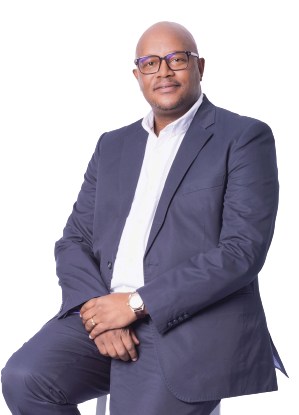
Serame Taukobong
Group Chief Executive Officer
Our focus in recent years has been our Value Unlock journey. This included informing the market about the value of our different business units, and defining their borders so that investors could appropriately assess their value. On reflection, this necessary process required an inward focus, which has resulted in an internally driven organisation.
Now that we have established these strong standalone entities, we need to focus externally to compete aggressively in a market of vertically integrated companies. Over the next three to five years, we will execute as a united Telkom. This includes leveraging our strengths across a range of communications and infrastructure solutions. We are an infrastructure player that competes in several markets, provides high-end solutions and offers the highest customer value possible. We certainly have the potential to be the number one or two player across the respective ICT markets.
In September 2021, we reviewed our Group strategy and our five strategic pillars, namely portfolio diversification, integrated solutions, victory in broadband, operational efficiency, and technology innovation (PIVOT). We concluded that while specific tactics and actions are changing, our strategy framework remains relevant. This strategy is discussed in Our strategy review.

Portfolio
diversification

Integrated
solutions
Victory in
broadband

Operational
efficiency

Technology
innovation
Our portfolio diversification pillar speaks to our desire to expand and invest in e-commerce, big data, gaming and financial technology (fintech). We have developed our fintech building blocks over the past few years, and as at the end of FY2022, this segment of the Telkom Consumer business had generated R800 million revenue with a loan book advance of R2 billion and 5.3 million customers. We will step up our efforts in building this digital business to diversify our revenues.
Under integrated solutions, we aspire to comprehensively address our customers' ICT needs by offering end-to-end converged propositions ranging from connectivity to IT solutions. We provide one-stop solutions from the broad range of products and services available within the Group. This includes the combination of high-speed connectivity services using mobile, wireless, satellite or fibre technology with ISP, content and financial services. For business and enterprise, this also includes hardware and software products, unified communications, software-defined networking, storage and cloud solutions, underpinned by cybersecurity and data analytics capabilities. This enables our customers to source all their ICT services as pre-integrated solutions through a single channel, with tailored service level agreements to support their specific needs.
Victory in broadband is the backbone of our strategy, supporting Telkom's aspiration to become the leading broadband service provider in South Africa. Over the past few years, we have invested in both mobile and fibre infrastructure assets to prepare for 5G, and our combined asset base sets us apart from our competitors. As at the end of FY2022, we have more than 11 million total broadband subscribers – mobile 10.5 million and fixed broadband >500k; and 79% of our fixed-line broadband customers are using 10 Mbps and higher, supporting higher, data consumption. Openserve is one of the market leaders in the South African fixed market with approximately 840k homes passed and a leading fibre to the home (FTTH) connectivity rate of more than 46%.
This year has been a milestone year in terms of victory in broadband with the additional mobile spectrum we secured. We obtained 20 MHz of 800 MHz and 22 MHz of 3500 MHz for R2.1 billion. Telkom's total spectrum portfolio now stands at 170 MHz across all bands. The newly acquired spectrum will enable us to offer a credible 5G proposition. The sub 1 GHz enables us to deploy network more efficiently and increase coverage.
Our drive to promote operational efficiency has yielded positive results for Telkom. Despite our legacy business with high margins declining, Telkom has been able to maintain its EBITDA around 27%. This was achieved through our sustainable Cost Management Programme, which seeks to contain opex growth below inflation and optimise our cost to serve. We will continue to seek operational efficiencies and exploit our scale in infrastructure to lower the cost to serve our customers.
Under the technology innovation pillar, we have been modernising and building a state-of-the-art network. As at the end of FY2022, we had grown our mobile stations by 13.7% to 7 313 while 4.5G2 sites had grown by 42.4% to 6 451. We continue to aim to maintain a fibre backhaul ratio of 70% to 80%. This paid off well, allowing us to effect quick backhaul upgrades at sites where additional traffic was anticipated. As at the end of FY2022, 68% of our base stations had fibre backhaul. We will continue to invest in our own network while utilising roaming agreements to supplement our network footprint, providing our customers with national coverage.
Below is the profile of the infrastructure assets we have significantly invested in over the past few years.
Tower assets
Tower assets |
 |
5 960 | Full portfolio of towers | ||
| 3 916 | Productive portfolio | ||||
| 2 675 | Growth towers: 1 or fewer tenants | ||||
| 1 241 | Mature towers: 2 or more tenants |
| 42% | Anchor tenancy (Mobile and Openserve) |
 |
~2.5 m | Premises covered by fibre-ready nodes | |||
| 839 691 | FTTH | ||||
| 46.3% | Connectivity rate | ||||
| NOC | World-class managed services operations centre | ||||
| Top 3 | Undersea landing stations in South Africa |
| 10 | Data centres carrier-neutral | ||||
| 3 out of 4 | Certified tier 4 data centres in South Africa | ||||
| Size |
~11 MW IT ~6 500 m |
||||
| 78% | Occupancy rate |
| 1 | Broadband Infraco SOC is a licensed state-owned company in the telecommunications sector whose legislative mandate is set out in the Broadband Infraco Act No. 33 of 2007. |
| 2 | 4.5G is essentially LTE Advanced or LTE Advanced Pro. |
We are committed to our Value Unlock Strategy, which is premised on our market capitalisation not representing our intrinsic value. Over and above affirming value, we want to commercialise our infrastructure assets to drive sustainable long-term growth.
Telkom grew its earnings with underlying HEPS and BEPS increasing by 2.5% and 1.4%, respectively, despite a challenging operating environment. This was due to a significant decline in finance charges and fair value movements compared to the prior year. Underlying Group EBITDA was relatively flat, despite a 1.1% decline in Group revenue to R42.8 billion.
Openserve's stabilisation path continues and is well underway in turning around several years of revenue declines. The Openserve business evolved as customers migrated over the years from legacy to next-generation. Today, more than half of its revenue is derived from the new business. However, a pricing gap remains between the new business and the legacy business. Revenue was relatively flat for the first time after several years of significant decline in the legacy business. This was underpinned by growth in high-capacity links for carriers, an increase in demand for fibre services, and a slowdown in fixed voice churn. Openserve continued with its growth trajectory in the fibre market, increasing homes passed with fibre by 52.7% and homes connected with fibre by 38.4%. This is in line with its strategy to accelerate the FTTH footprint while simultaneously focusing on connecting homes. In the second half of the year, overall fixed broadband customers increased for the first time in several years despite the decline in ADSL customers.
Swiftnet, our masts and towers business, increased revenue by 4.4% to R1 292 million, driven by commercialising the existing portfolio, new tower builds and the rollout of In Building Solutions (IBS). This performance includes the impact of terminations and continued focus on modernisation from our Mobile Network Operator (MNO) customers. We expect modernisation to continue over the next year, coupled with the deployment of new base station sites as the MNOs deploy their respective newly acquired permanent spectrum allocations. In the current year, the number of productive sites increased by 5.9% to 3 916. Swiftnet's profitability was impacted by the change in cost allocation methodology in the second half of the year. Global events impacting capital markets led us to review the timing of the separate listing of Swiftnet on the JSE. In March 2022, the Board resolved to postpone the separate listing.
The Mobile business continues to drive growth in Telkom Consumer. The total Mobile revenue growth of 6.3% was achieved against the backdrop of an intensely competitive landscape and challenging economic environment. As the overall macro- economic constraints materialise, the pre-paid surge has slowed as the share of wallet spend has plateaued. We grew our pre-paid customer base by 12% to 14.3 million with the average revenue per user (ARPU) normalising to pre-COVID-19 levels in line with management expectations. In the post-paid market, the base increased by 3.4% to 2.7 million and high levels of ARPUs were maintained at R212. The legacy fixed-line business remains under pressure, due to migration from traditional fixed-voice to newer technologies. The impact of the post-pandemic recovery is still evident in small and medium businesses. We remain encouraged by the growth in our non-connectivity/application services which saw double-digit growth in FY2022.
BCX remains under pressure due to the lingering impact of the lockdown and the global supply chain constraints and shortages of semiconductor chips. The second half of the year saw good growth resulting from investments in new capabilities, progress made with strategic programmes, and renewed activity in the market. Revenue declined by 2.6%, mainly impacted by the IT segment, which faced supply chain pressure while the Converged Communications business stabilised and then started to gain momentum. This bodes well following the 6.1% revenue decline reported in the first half of the year. The improvements in performance seen in the last quarter across the business signal a more positive outlook for the next financial year.
Our ESG Strategy was developed considering all aspects and all parts of our business. The ESG Strategy is supported by our Group Exco and Senior Leadership and was endorsed by the Board. Our ESG Strategy aligns with the overall business strategy and our purpose of seamlessly connecting our customers to a better life. Our core strategy is underpinned by our drive to create sustainable economic, environmental and social value. We strive to deliver digital solutions which enable socio-economic upliftment. We deploy our network and manage our business in a responsible way, always considering how our business could contribute to climate change. We expand and operate our business, including networks, new products and services, in a way that respects our natural environment and encourages shared value for all.
We manage our business in such a manner as to ensure that we are a key trusted partner for our customers, enterprises and government.
The strategy process also highlighted just how much is already under way at Telkom, including the Telkom Foundation's work in education and enabling learning to continue during COVID-19. The strategy draws Telkom's existing ESG-related projects under one banner, breaking down silos and allowing us to consciously drive and track the strategy.
In the South African context, the "S" in ESG is where we can have significant impact. Providing access to the digital world, including online education and career opportunities, will profoundly change the lives of many South Africans.
Delivering on our ESG Strategy will not be a box-ticking exercise. We are embedding the strategy throughout the Group and setting up quantifiable measures to track our progress. The next step is for the Board to link ESG performance measures to management's short and long-term incentives for FY2023 and for Group Exco to implement accordingly.
In a highly competitive landscape, the customer experience we deliver affects our reputation, customer attraction and retention. We continually invest in products, services, systems and employee training to ensure our customer expectations are met. In FY2022, we made solid progress in improving customer service. This progress is visible in the uptick of our Orange Index scores, which measure client retention. We focused on first- time call resolution and reducing customer effort to resolve customer issues as fast as possible. Through empowering our employees, we have seen a dramatic improvement in first-time call resolution, up to 87% now.
Self-service is an increasingly important component of the customer experience. We communicate with customers on the platforms they prefer. Our customers can resolve their queries at any time through WhatsApp, without the need to contact a call centre. In July 2021, we launched a chatbot1 on Twitter to respond to customer social media queries and complaints, and more recently during May 2022 we launched our bot on Facebook too. We are always interested in adopting new technologies that match our customers' behaviours.
A solid financial framework to support the Group strategy and deliver sustainable shareholder returns is essential. We will enhance our financial framework in FY2023 and we expect the Group to return to growth. Telkom Mobile secured third position in the (local) market. Going forward, we expect Telkom Mobile to grow in line with its industry peers. In addition, we expect Openserve to start growing in the next financial year, supporting top-line growth. Given the deceleration in growth in Telkom Mobile and the continuous decline in the legacy business, we expect Group revenue to grow at mid-single digits percentage over the medium term. Our sustainable cost management is also expected to deliver mid-single digit EBITDA growth over the same period.
The release of spectrum provides upside to our growth ambitions in the long term. Telkom Mobile obtained 50 MHz contiguous spectrum in 3500 MHz to support its data-led strategy. The industry will require a significant amount of masts, towers and fibre backhaul to connect to the base stations. Our infrastructure businesses, Openserve and Swiftnet, are well positioned to capture this opportunity. We expect to continue to invest in the business, with a capex to revenue ratio of 16% to 18% per annum, and to maintain a healthy balance sheet of net debt to EBITDA of 1.2x (including the acquisition of spectrum).
| 1 | A chatbot computer program designed to simulate conversation with human users, especially over the internet |
FY2022 was a reset year following changes in the global market and regulatory environment, an intensely competitive landscape and the weak macro-environment. We concluded that our strategy framework remains relevant, and that our broadband-led strategy is the backbone of our PIVOT strategy. Over the past few years, Telkom invested in 5G infrastructure assets, and these set us apart from our competitors. In some of our businesses, we want to strengthen scale and capability to drive growth. Here, we are exploring local and international partnerships.
Telkom remains committed to the Value Unlock Strategy, which is premised on Telkom's market capitalisation not representing its intrinsic value. Our key focus is to drive maximum shareholder value. The suspension of the separate listing of Swiftnet due to volatile capital markets was to protect shareholder value. Our strategic approach going forward is to affirm the valuation of these businesses and their contributions to the valuation of Telkom while ensuring long-term sustainable growth for the Group. To this end, we will continue to explore all strategic options that support our Value Unlock Strategy, which seeks to maximise shareholder value. In support of this approach, we will place more emphasis on driving execution and delivery against our Value Unlock Strategy.
Returning cash to shareholders remains a key element of our capital allocation framework. Telkom is in year two of the three- year dividend suspension period. The Board remains committed to reinstating the dividend policy at the end of FY2023 in line with the Board commitment on suspension of the dividend policy in FY2020. The Board is reviewing the dividend policy. It is imperative for Telkom to generate sustainable positive FCF to reward shareholders. In FY2022, acquisition of spectrum took priority in line with the capital allocation framework principles of prioritising growth.
Despite a challenging regulatory environment, we are hopeful that all of our interactions with regulators will result in a more transparent, stable and equitable regulatory environment.
Telkom acquired 20 MHz of 800 MHz and 22 MHz of 3500 MHz for R2.1 billion. Telkom made a payment of R1.1 billion in FY2022, with the remainder of the payment being due when the sub 1 GHz spectrum, currently occupied by broadcasters, becomes available. However, this licensing process was subject to a court challenge by Telkom, which has since been settled. Telkom opted for a forward-looking settlement with ICASA, addressing Telkom's principal complaints regarding ensuring fair competition in the sector while providing a level of regulatory certainty.
Telkom will use the newly acquired spectrum to support its strategy of building a data-led network. Given South Africa's dual economies, Telkom believes that 4G and 5G will co-exist for some time and is expanding its network based on current data traffic and readiness for 5G deployment. Today, 93% of Telkom's data traffic is on a 4G network and 68% of Telkom Mobile sites use fibre backhaul, giving Telkom the edge for 5G deployment. The acquisition of 22 MHz of 3500 MHz enabled us to secure a consolidated 50 MHz of contiguous spectrum, giving us high spectral efficiency for optimal 5G deployment.
Based on ICASA's undertaking to consider the competitive effect of spectrum-sharing arrangements, Telkom withdrew the referral of the Vodacom and Rain spectrum arrangement to the Competition Tribunal. Telkom is of the view that a broader public process by the sector regulator would be far more effective in addressing the implications of the licensing of spectrum on competition, including spectrum arrangements. In line with the settlement, ICASA undertook to conduct the necessary consultative processes and complete the licensing process within FY2023.
I am thankful to our stakeholders who have continued to support us during uncertain and difficult times.
Our employees continued to perform strongly and have adjusted to new ways of working, including a hybrid model of working from home and the office. Our recent wage negotiations in March and April 2022 went smoothly and swiftly. This demonstrates that our labour unions understand the pressures our Group is facing and the positive co-creative relationship we enjoy.
On a personal note, I thank Sipho Maseko for his commitment to a seamless leadership transition. Sipho was instrumental in both value creation and setting up our Value Unlock journey. Thanks to his guidance, Telkom is a leaner and more efficient organisation primed for the future.
I also thank our Board for their ongoing support and responsiveness. They dedicated significant time at several extraordinary Board meetings to consider pressing matters.
Finally, our customers, communities and dealers continue to support Telkom. This ongoing belief in our brand provides a solid foundation for future growth.
Serame Taukobong
Group Chief Executive Officer (GCEO)