
FY2025
performance
5


The strategic shifts of BCX are generating positive momentum. We focused on strengthening the business fundamentals, expanding our high-margin services portfolio and optimising the cost structure.
These initiatives reduced the cost to serve and enabled us to continue shifting our converged communications offerings to fibre-based platforms. As a result, we saw a marked improvement in performance during the second half of FY2025 and a stronger financial foundation overall.
Key strategic focus areas
Challenges


Strategic achievements
Fibre data service
revenue grew by
EBITDA margin
increased from 9% in
H1 to 13.2% in H2
growth in cloud
solutions revenue
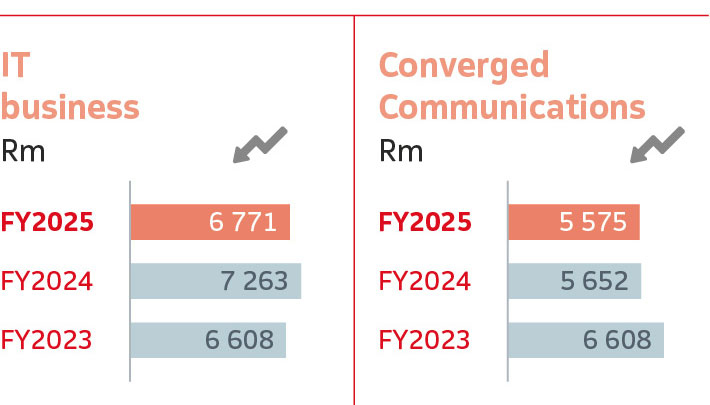
Our performance for the year reflects a transitional period, with encouraging signs of recovery towards the end of the year. The second half saw a positive shift in momentum, with BCX experiencing growth across its key metrics compared to the first half. Specifically, total revenue increased by 1.2%, and EBITDA rose by 48.8%. This helped moderate the overall revenue decline to 4.4%, resulting in total revenue of R12 346 million as we reshaped the revenue mix towards higher-margin IT services.
A key driver of the improved performance was the IT Services portfolio, which delivered 2.6% growth and reinforced BCX’s shift toward higher-value offerings. This increase was mainly driven by strong demand for cloud and IoT solutions. Revenue from managed cloud services climbed by 5.8% and IoT services grew by 1.5% as clients expanded their adoption of connected, data-driven technologies. Application solutions saw a 2.0% increase, reflecting a tough market and muted growth compared to FY2024, which had benefited from one-off SAP implementation projects. However, cybersecurity services contracted by 27.6%, underperforming expectations in a market that remains a strategic focus for future growth.
The deliberate moderation of IT hardware and software sales, which was accelerated in the second half, along with an increase in sales classified as agent revenue, resulted in revenue from this portfolio declining by 23.7%. As a result, BCX reduced the working capital consumption that characterised prior years, with far less cash tied up in inventory and receivables. The strategic rebalance of this business improved overall financial efficiency and aligns with our initiative to improve working capital and profitability.

International business revenue declined by 4.7% to R667 million as a result of a higher portion of revenue being classified as agent revenue. Additionally, the performance was impacted by economic turbulence in many of the African countries we operate in and the clean-up of ageing inventory and receivable balances. The clean-up positions the business for a healthy performance in the coming financial year.
The decline in Converged Communications revenue slowed down from the levels reported in the prior year and first half, decreasing by only 1.4%, reflecting the deliberate migration of clients from legacy services to fibre-based platforms. This proactive transition temporarily reduces revenue, but fundamentally enhances the business mix. Currently, 79% of data services (which grew by 12.7%) and 37% of voice services revenue are delivered over fibre platforms.
The growing prevalence of fibre in the network is already lowering the cost to serve and enhancing customer experience through more reliable, higher-bandwidth connectivity. The fibre-centric pivot is critical to the communications portfolio’s long-term growth, even though it entails a short-term impact on revenue during the migration phase.
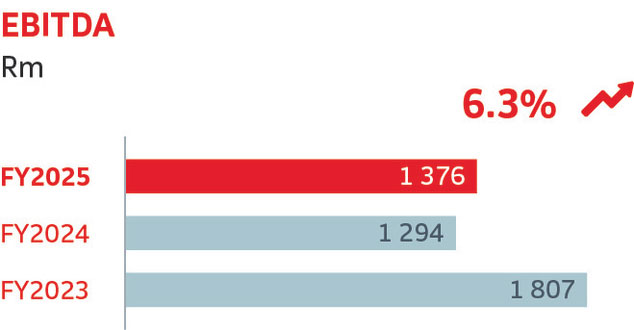
BCX generated EBITDA of R1 376 million before restructuring costs of R157 million, an increase of 6.3% from FY2024, representing an adjusted EBITDA margin of 11.1%. Notably, performance accelerated in the latter half as the EBITDA margin rose to 13.2%, reflecting early gains from the cost transformation programme.
The proactive management of receivables resulted in the impairment of receivables declining by R24 million. BCX optimised its facilities footprint, reduced employee costs, and deployed generative AI-driven automation. Together, these actions streamlined operations and lowered the cost to serve, contributing to sustained gains in margin and cash flow.
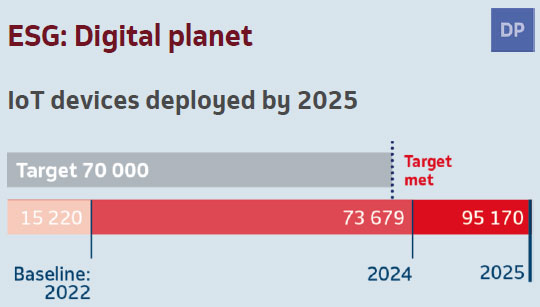
We have successfully deployed 95 170 IoT devices, surpassing our goal and demonstrating our commitment to leveraging technology for sustainable development.
We also initiated several measures to enhance the monitoring of utilities, including electricity, gas, steam and water, as well as environmental conditions. By implementing advanced monitoring systems, we aim to achieve greater transparency and efficiency in our utility consumption. This initiative will help us identify and address inefficiencies, reduce our carbon footprint, and more effectively conserve natural resources.
Looking ahead, BCX is poised to capitalise on the foundational improvements achieved during the year. With strategic initiatives aimed at expanding high-margin IT services, enhancing operational efficiency, and leveraging advanced technologies like generative AI, BCX is well positioned for sustained growth.
Investments in reskilling the workforce, embedding new ways of working, and deepening customer insights will drive seamless experiences and maximise life cycle value. BCX plans to further strengthen its go-to-market capabilities, broaden the scope of service offerings, and position XaaS opportunities effectively to meet evolving client needs.
By continuing to optimise cost structures, fostering innovation through own-IP platforms, and migrating to fibre-based communications, BCX is set to unlock greater profitability, growth and value creation in FY2026.