
Telkom continues to execute a solid, flexible and resilient risk and compliance strategy that supports achieving our strategic objectives. Telkom operates in economically, politically, technologically, and socially changing environments. This provides unprecedented opportunities and significant, poorly understood threats. As a result, the Group's strategic intent has become more critical, requiring us to balance risks and rewards and monitor strategic risks constantly.
Telkom considers internal and external contexts when reviewing the Group's risks and opportunities, and considers the adequacy of key controls and existing regulatory framework controls. We monitor the effectiveness of risk and compliance to identify improvement areas, and track risk metrics to ensure significant efforts are made.
 Furthermore, maintaining and continuously
improving risk management capabilities to
strengthen the Group's performance remains
important. We use control self-assessment
exercises and compliance control validation
reviews to determine the effectiveness of our risk
and compliance management processes. Annual
risk and compliance reviews ensure we meet the
King IV1 requirements
Furthermore, maintaining and continuously
improving risk management capabilities to
strengthen the Group's performance remains
important. We use control self-assessment
exercises and compliance control validation
reviews to determine the effectiveness of our risk
and compliance management processes. Annual
risk and compliance reviews ensure we meet the
King IV1 requirements
| 1 | King IV Report on Corporate GovernanceTM for South Africa, 2016 (King IV). Copyright and trademarks are owned by the Institute of Directors in South Africa NPC and all of its rights are reserved. |
 |
Our approach to risk and compliance management According to their set mandates, Telkom’s governance structures continued to support risk and compliance management across the Group. There were no material changes during the year. |
|||
|
End-to-end assurance |
Board | Oversees risk and compliance across the Group. Provides an integrated approach to governance and management of risk and compliance, supported by a risk and compliance operating model aligned with Telkom’s business model. |
Oversight
|
|
| Risk and Social and Ethics Committees | Monitor and advise the Board on risk and compliance, laws and regulations. | |||
| Group Exco | Integrates risk and compliance management, systems, and people across the Group. | |||
| Integrated Governance, Risk, Compliance and IT Steering Committees | Assess risks and resulting opportunities within the agreed risk framework. Reduce the impact of regulatory risk by driving compliance awareness for all applicable laws, regulations, and supervisory requirements. |
Enablement |
||
| Group risk, compliance, business continuity management | Set policies and standards and provide oversight and control. | |||
| ERM forum | Shares best practices and knowledge and monitors key risks and mitigation plans. | |||
| Business unit assurance forum | Affects the ERM framework through effective risk and compliance management and combined assurance to optimise risk taking. | |||
| Business unit risk and compliance management Business unit management |
Implement the risk, compliance and business continuity management policies, standards, and frameworks. Apply and maintain the compliance risk registers, identify mitigating controls, implement action plans and operationalise the business unit assurance forum. All business units’ Excos are accountable for managing risk and compliance within the approved delegation of authority (DoA). | |||
The Board committed the Group to an ERM
process aligned to the King IV principles, the
COSO (Committee of Sponsoring Organisations)
Integrated Enterprise Risk Management
Framework, ISO 31000 Risk Management
Guidelines, and Control Objectives for Information
and Related Technologies (COBIT) Framework. All
business units, supporting functions, processes,
projects, and other controlled entities are
subjected to the ERM framework.
ERM is an independent function within Telkom that sets out to achieve the following key objectives:
The Risk Committee oversees the activities of ERM and is apprised regularly by management. The Committee also oversees management’s activities to ensure the ERM framework is embedded and adhered to. In managing and dealing with the Group's risks, Telkom continues to ensure:
We are progressing with the ERM Strategy satisfactorily, and made the following key improvements as part of the journey towards becoming a risk-intelligent Group:
Telkom focused on strengthening its business resilience activities. We tested the response plans during loadshedding and extreme weather conditions, such as the floods in FY2023. Loadshedding hours increased significantly in FY2023 due to challenges Eskom faced in meeting the power demand. However, Telkom remained resilient due to adequate and effective response plans that factored in stakeholders, critical resources, and alternative power supply solutions such as lithium batteries, standby and mobile generators.
Telkom remains committed to collaboration principles, maintaining communication services under adverse conditions, and supporting local and national governments should a crisis arise. Telkom continues to ensure that its infrastructure, business processes, and emergency management procedures are flexible enough to protect key stakeholders’ interests, reputation and brand.
Telkom completed a global threats assessment that included a list of 36 threats. There are response plans to address these potential threats, and this assessment is ongoing to ensure minimal impact on Telkom’s objectives.
Certain significant events (listed alongside) occurred in Telkom’s business operations during FY2023. These events are characterised as unintended/unplanned occurrences that expose the Group to risks that have either happened or are imminent and inevitable. These risks significantly affect business-as-usual operations and Telkom’s strategy execution, which might have an immediate and long-term impact on achieving strategic goals.
Disaster management and response structures such as the Group Emergency Management Team and the Regional Emergency Management Teams continue to manage crises effectively, as mandated by the GCEO. In FY2023, the teams managed:
 Power outages: Power outages have
become common in South Africa. As a
result, Telkom had to respond from both
a tactical and strategic perspective to
keep the lights on and, in the long run,
minimise the adverse effects of energy
shortages and create efficiencies. Telkom
manages this by deploying various
response strategies. For example, in
response to escalated loadshedding
levels, Telkom developed a Groupwide power outage preparedness plan
covering all scenarios from Stage 1
to blackout. This plan is continuously
deployed and minimises the impact on
our business operations.
Power outages: Power outages have
become common in South Africa. As a
result, Telkom had to respond from both
a tactical and strategic perspective to
keep the lights on and, in the long run,
minimise the adverse effects of energy
shortages and create efficiencies. Telkom
manages this by deploying various
response strategies. For example, in
response to escalated loadshedding
levels, Telkom developed a Groupwide power outage preparedness plan
covering all scenarios from Stage 1
to blackout. This plan is continuously
deployed and minimises the impact on
our business operations.
 Nelson Mandela Bay water crisis: Water
disruptions affect several suburbs in the
Nelson Mandela Bay Municipality due
to the ongoing drought and declining
levels at the major storage dams. Telkom
continues to participate and contribute
to the various forums led by the city. As
part of the Day Zero Programme in the
Eastern Cape province, Telkom identified
55 sites that should be considered for
audits and interventions to improve
water security. This was achieved by
reducing water demand and diversifying
the water supply.
Nelson Mandela Bay water crisis: Water
disruptions affect several suburbs in the
Nelson Mandela Bay Municipality due
to the ongoing drought and declining
levels at the major storage dams. Telkom
continues to participate and contribute
to the various forums led by the city. As
part of the Day Zero Programme in the
Eastern Cape province, Telkom identified
55 sites that should be considered for
audits and interventions to improve
water security. This was achieved by
reducing water demand and diversifying
the water supply.
 Severe weather conditions: The latter part
of the year saw severe thunderstorms,
record-breaking heavy rainfall and
flash floods that damaged national
infrastructure. There were no significant
incidents that negatively affected
Telkom’s infrastructure. Telkom sent
employees a communiqué to caution
them to practice vigilance and stay
safe during expected heavy rains and
flooding. We continue participating at the
National Disaster Management Forum,
where potential disasters are assessed,
closely monitored, and mitigated. This
approach allows Telkom to improve its
threat detection and enhance its response
plans proactively.
Severe weather conditions: The latter part
of the year saw severe thunderstorms,
record-breaking heavy rainfall and
flash floods that damaged national
infrastructure. There were no significant
incidents that negatively affected
Telkom’s infrastructure. Telkom sent
employees a communiqué to caution
them to practice vigilance and stay
safe during expected heavy rains and
flooding. We continue participating at the
National Disaster Management Forum,
where potential disasters are assessed,
closely monitored, and mitigated. This
approach allows Telkom to improve its
threat detection and enhance its response
plans proactively.
The Group’s Business Continuity Programme is robust and effective in managing various threats that could disrupt our operations, with identified areas for improvement. We will improve the programme further to ensure the Group’s overall resilience and anti-fragility.
In FY2023, Telkom continued to monitor and assess the identified emerging/external risks and opportunities as and when it was of the view that these might impact the Group.
| Potential emerging risk | Description |
| COVID-19 waves | The resurgence of the COVID-19 pandemic remains on the radar. The pandemic re-emerged in China in December 2022/January 2023; however, it had no significant global impact. Telkom ensured that there are plans to deal with the re-emergence of the flu or any other pandemic. The risk is no longer regarded as emerging and is dealt with under operational risk management and occupational health and safety. |
| Increased levels of poverty | This risk remains significant due to the difficulties businesses and communities face in the global and local economies. Loadshedding further impacts the local economy. Due to financial and liquidity issues, technology organisations worldwide reduced their workforce. South African businesses may take a similar approach to generate free cash flow. Therefore, we believe local employment will suffer significantly and poverty levels will rise. |
| Entry of globally dominant players into African markets | Global players such as Google and Amazon have traditionally limited footprint and inroads into South Africa. As opportunities in Europe are limited, there may be a drive to grow their presence in Africa. It would be difficult to compete purely on price. The Group is progressing strategic partnerships that will advance Telkom’s business. For example, Google and Telkom collaborate on the Equiano Cable undersea cable project via Openserve. Alibaba also collaborates with BCX. However, Telkom should closely monitor the effect of these opportunities on its ability to maintain its financial position. |
| Redefining the societal compact | Telkom’s day-to-day operations might have an effect on the environment that would affect the communities in which it operates. Telkom aims to reduce the potential impact by employing reuse, repair, refurbishments, leasing, cascading, capacity sharing and “dematerialisation” strategies. Telkom’s ESG Strategy focuses on the following key initiatives to mitigate this risk:
|
Unanticipated events continued to unfold during FY2023, leading to several critical challenges for Telkom to manage speedily to avoid significant exposure for our business. Therefore, Telkom focused on building a resilient culture that can adapt at the speed of change experienced.
Macro-economic risks likely to impact Telkom’s growth opportunities, such as economic conditions and the capability to access funds.
Strategic risks with the potential to affect Telkom’s business strategy/ objectives. These risks are uncertainties or opportunities that could guide decisionmaking. These are crucial matters that the Board, shareholders, or investors should be concerned about regarding strategic intent
Operational risks with the potential to impact critical operations through increased cyberattacks, supply chain disruption and non-compliance.
Telkom identified the risks in the context of its financial and non-financial strategic objectives. The same key risks were tracked in FY2022 and FY2023. Some residual risk ratings increased due to changes in the micro-environment, specifically relating to the negative global economic outlook.
The risk heatmaps alongside reflect the residual risk rating, which considers the mitigation controls in place.
| 1 | The enterprise risk management and compliance report starting details Telkom’s material risks according to the governance requirements contained the JSE Listings Requirements. This report is available online . |
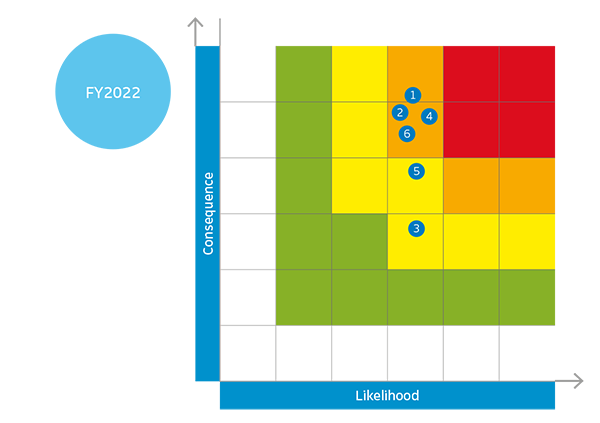

1 |
Unstable and unpredictable regulatory dispensation |
2 |
Market forces and disruption exacerbating competition pressures |
3 |
Inability to attract and retain a suitable, resilient and healthy workforce to service and support the changing ecosystem |
4 |
Increased focus and scrutiny on ESG matters |
5 |
Financial sustainability |
6 |
Macro socio-economic instability |
| Risk definition | Mitigating activities and monitoring | Assessment rationale and opportunities arising from managing risks | |
| Unstable and unpredictable regulatory dispensation influenced by the changing market, customer and technological trends may impact Telkom’s long-term decision-making and investment aspirations. It also creates competitive pressures and unexpected costs that can hamper Telkom’s profitability and sustainability. |
|
Regulators are responsible for creating a stable and predictable regulatory environment where all businesses may function. The regulatory system also needs to adapt in previously unexpected ways to the changing economic, social, and technological realities. This unpredictability makes it difficult for regulators to prepare. The above directly drives Telkom’s exposure to competitive pressures and unexpected costs, impacting the Group’s ability to remain relevant. This uncertain regulatory regime continues to challenge Telkom’s approach to investment cycles and patterns, speed of launching new products and services and enhancement of competitive opportunities. Telkom continues to interact to introduce regulatory flexibility, which is particularly important in a sector constantly undergoing significant technological and market changes. Opportunities still exist for the organisation to continue participating in regulatory discussions to influence various legislation to get the best possible result, including the level of the competitive landscape, to which Telkom aspires. Telkom continues to monitor the risk related to ICASA and spectrum licensing. There is an opportunity to work with the regulator to understand the situation and influence some regulatory aspects to strengthen the Group’s position, including a levelled competitive landscape. An opportunity also exists to review the high cost of compliance, whether in terms of infrastructure, technology or people, and the time spent ensuring compliance. |
| Risk definition | Mitigating activities and monitoring | Assessment rationale and opportunities arising from managing risks | |
| Telkom operates in a competitive and rapidly changing market. The increase in technological innovations, accelerated market deregulations, customer expectations, and new entrants in the connectivity space exacerbate this risk. These put pricing and product offerings under pressure as Telkom strives to remain competitive. Failure to swiftly respond to competitive threats could negatively impact the Group’s prospects, including its market share, relevance, revenue growth and profit margins. |
|
The risk remains a strategic priority as products, services and technology are crucial for our transformation and competitiveness. Competitors have aggressively challenged Telkom’s pricing. This may necessitate market research or benchmarking to remain competitive. The new mobile virtual network operators (MVNOs) segment and OTT partners increase competition in IT services and telecommunications (fibre and mobile), amplifying this risk. Telkom focused on business process reengineering and incremental innovation, evolving the customer value proposition and pricing flexibility, fibre investment, and Value Unlock strategies and projects as risk-reduction initiatives. Telkom remains committed to identifying and implementing opportunities as soon as practicable. Refer to unpacking our pivot strategy for more information on Telkom’s strategy. |
| Risk definition | Mitigating activities and monitoring | Assessment rationale and opportunities arising from managing risks | |
| The world is experiencing several changes, such as a shift in how companies work, hybrid working models, customer behaviours, and technology trends. This requires talent that can provide a sustainable competitive advantage. Failure in this regard could result in loss of competitive advantage, increased employee costs and delays in achieving the Group’s strategy. |
|
Telkom continues to face challenges on talent and employee turnover as people can work anywhere in the world, and the skills of the future are in short supply. The issuance of Section 189 notices and Telkom’s future operating model will exacerbate this risk. Opportunity exists to implement effective internal succession planning and capability development to address the insufficient supply of talent and skills. Furthermore, Telkom and BCX were certified as Top Employers for 2023. This may position the Group towards retaining and attracting external critical skills. Telkom continuously identifies opportunities to improve strategies to attract relevant skills to participate in the digital world and review the retention strategy for critical talent. Refer to human capital chapter for more informatio. |
| Risk definition | Mitigating activities and monitoring | Assessment rationale and opportunities arising from managing risks | |
| Increased focus on ESG matters is due to the rapidly heightened importance of sustainability matters in society, increased climate change awareness, social inequality, and corporate misconduct. This might impact Telkom’s financial sustainability and reputation and limit access to opportunities. |
|
The risk remains a priority and the ESG Strategy is being executed. Governance structures are formed to drive the implementation (i.e. ESG Impact Council) that will guide, integrate, and develop portfolios for the six defined ESG themes across Telkom. In driving the strategy, several inflight projects will translate Telkom’s intention into actions. Telkom has the chance to innovate aggressively to remain relevant and competitive while contributing to the Group’s and the country’s general sustainability goals. Refer to Unpacking our PIVOT Strategy for more information on Telkom’s ESG Strategy. |
| Risk definition | Mitigating activities and monitoring | Assessment rationale and opportunities arising from managing risks | |
Maintaining financial capacity is crucial to sustain or grow operations while building adequate financial resilience to manage unforeseen economic events. This risk is due to:
|
|
Financial sustainability is a priority for the Group. Customer retention and experience are key to building a financially sustainable business. The macro-economic instability increased Telkom’s business cost and resulted in decreased profits due to customers constantly seeking cheaper options. Telkom experienced a financial performance gap due to the loadshedding crisis, inflationary pressure, consumer pressure on living expenses due to interest rate hikes, and high energy and fuel prices. These factors continue to strain Telkom’s operations. We have an opportunity to build financial resilience in the face of a demanding trading environment, focusing on several levers:
|
| Risk definition | Mitigating activities and monitoring | Assessment rationale and opportunities arising from managing risks | ||
| Telkom is not immune to the critical characteristics introduced by socio-economic matters that influence consumers’ behaviours, preferences, attitudes and quality of life. Therefore, this instability creates uncertainty, particularly where consumers are critical to the Group’s success This volatility affects the levels of profitability and cash generation that are considered acceptable. It also impacts our shareholders’ perspective on the Value Unlock Programme and future growth. |
|
This risk is influenced by macro-environmental factors over which Telkom has no control. However, how we manage our financial stability contributes to managing this risk. The macro-economic instability increased Telkom’s business cost and resulted in decreased profits due to customers constantly seeking cheaper options. Weak global economic conditions, rising inflation and the energy crisis hampered South Africa’s economic growth. Unemployment continues to rise. There are opportunities to offer products and services that improve the country’s economic agenda, and to partner with communities to address unemployment issues, break the digital divide, and grow small to medium businesses. Refer to Unpacking our PIVOT Strategy for more information on our strategy and social and relationship capital for more information on our ESD support and the work of the Telkom Foundation. |
||

There are opportunities to partner with communities to address unemployment issues, break the digital divide, and grow small to medium businesses.
Compliance
As an ICT service provider, Telkom is exposed to evolving regulatory and compliance requirements, including growing ESG compliance expectations from stakeholders. We have zero tolerance for regulatory non-compliance, fraud and corruption. We are committed to fulfilling relevant compliance requirements and disclosure and reporting obligations to maintain our reputation.
Group Exco annually reviews and approves the regulatory universe derived from our risk-based approach. Our compliance function reviewed and communicated the compliance management policy and framework through the annual compliance commitment drive. This requires employees to acknowledge the content of the documents and commit to complying with them. Our business units have established compliance functions with the Corporate Centre providing oversight and guidance.
Our compliance plan, with quarterly deliverables, aligns with the ERM Strategy to enhance the Group’s risk and compliance culture. We provide compliance plan progress reports to the various governance structures, including the ERM forum and Integrated Governance Risk and Compliance Committee. The Risk Committee and Board receive a detailed report on the status of the Group’s compliance every quarter.
The stringent compliance regime supports our combined assurance approach through our three lines of defence and regular reporting. The compliance function also reports to the IT governance structures and the economic crimes forum on data privacy, cybersecurity, and potential areas of non-compliance.
We confirm that no material or repeated regulatory penalties, sanctions, or fines for contraventions of or non-compliance with statutory obligations were reported in FY2023.
Two instances of unauthorised access to personal information were reported to the Information Regulator, with limited exposure. The business immediately enhanced the control environment.
We received three customer complaints from the regulator regarding direct marketing and unauthorised access to information. In all events, the business investigated the incidents, reported on the outcome and addressed the control environment.
We remain committed to reducing, recycling and disposing of waste under the Extended Producer Responsibility Regulations of the National Environmental Waste Management Act for the Electronic and Electric sectors. The compliance function monitors the required reporting.
Telkom has acted to protect the environment further and move towards a climate-resilient economy in line with the Climate Change Bill. In FY2024, we will await the finalisation of the bill and the publishing of supporting regulations. Our environmental, sustainability and tax services divisions implemented controls to ensure ongoing compliance with the Carbon Tax Act requirements in line with the government’s commitment to reduce carbon emissions.
We enhanced our employee health and safety relating to the 2022 Asbestos Abatement Regulation by identifying asbestos-containing material at sites and reducing the risk of human exposure, and by monitoring ongoing adherence to labour relations legislative requirements. Telkom addressed customer protection matters and introduced additional data privacy processes to benefit the customer.
The compliance function monitored the Companies Amendment Act requirements, confirmed control
effectiveness with the King IV principles, updated compliance risk registers with amended JSE Listings
Requirements, supported Telkom’s commitment to the ESG frameworks and reviewed the impact on
business of the Protection of Constitutional Democracy against Terrorist and Related Activities Bill.
 |
|
| Focus areas FY2024 | |
| ERM | Compliance |
|
The compliance and regulatory horizon for the
foreseeable future will demand attention on
the following acts before Parliament:
|