

Our hybrid approach to work has evolved to meet and support business and operational efficiencies while continuously serving our customers and other stakeholders.
In September 2022, Telkom further evolved our hybrid work model and implemented a "working three days in the office/two days from home" model. The journey was purposefully planned and focused on meeting the changing requirements of our key stakeholders, including employees and customers. The model further aims to blend the needs of the business for in-person problem-solving, collaboration and innovation while enabling individual "focused" time for deep work.
We continued progressing initiatives focusing on driving shared value through employee engagement, building a high-performance culture and employee experience, and curating and implementing our people strategy.

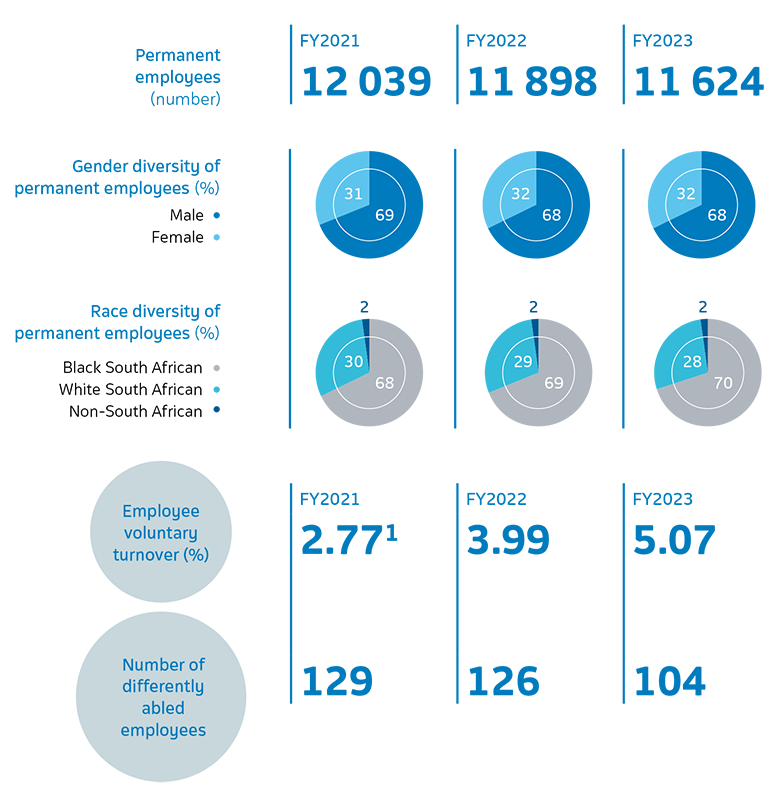
Employee voluntary turnover
Training and development spend
Number of graduates and learners supported
Number of learnerships and internships
Employee diversity statistics
Total recordable injury frequency rate
Lost-time injury frequency rate
Building a sustainability mindset
Transforming our culture
Enabling diverse and adaptable teams
Developing next-generation future leaders
Enabling a positive business experience through our people and customers epitomises the people strategy, which is implemented through business unit-specific employee and customer strategies, values and behaviours. It is embedded in a business-led, HR-enabled and agile approach centred around our employees as the customer.
We build our people strategy on five pillars underpinned by culture and espoused in our employee experience touchpoints.
| Our strategic ambition | Developments | ||
| 1. Driving a high-performance culture | |||
| We are advancing our impact through purpose-led and sustainable initiatives in education, entrepreneur development and the environment. We advance our people by putting people first, winning together in an inclusive environment, versatility and a focus on continuous improvement, openness and trustworthiness. |
A pulse survey across the Group assessed and evaluated the as-is culture in relation to our high-performance model. 44% of our employees participated in the survey, measuring employee engagement, culture, communication, relationships, and the work environment. The overall results were pleasingly positive. Employees rated Telkom and their current environments (service organisations and teams) as a good place to work and our collective products and services as great. More than 80% of employees indicated regularly receiving constructive performance feedback, which suggests that our continued focus on and investment in developing our performance management capability and understanding of the processes are bearing fruit. The survey reflects that we must continue and ramp up our focus on driving a high-performance culture, reviewing the Telkom recognition framework, and introducing and promoting expanded development opportunities. |
||
| 2. Diversity, equity, and inclusion | |||
We have a diverse and inclusive employee landscape. Our talent approach enables us to have the right skills at the right time for the current and future needs of the business. |
We enhance the employee landscape through our talent and succession management programmes, including a focus on developing women across the Group for leadership. Refer to below for more insight. |
||
| Our strategic ambition | Developments | ||
| 3. Engaged, agile and productive workforce | |||
Data analytics drive people decisions. We enable our workforce through a hybrid approach to work underpinned by a strong performance and reward culture. Workforce planning and skilling methodologies empower our agility to meet changing business and landscape demands. |
The pulse survey included a measure on the hybrid model, and more than 81% of employees indicated feeling motivated by working from home. In addition, 88% regularly interact with colleagues using different tools and mediums. This suggests that the remote work framework, tools, and support are robust in supporting employees and sustaining operational and business requirements. An average of 80% and higher of employees agreed with the below statements:
|
||
| 4. Organisation wellbeing | |||
Our employees work in a positive and safe environment where team wellbeing and contributions are valued. Our Employee Wellness Programme supports psychological, financial, emotional and physical wellbeing. |
In 2022, we held two highly successful wellness days in September and October, where employees could network and engage with one another and with a wide variety of wellness service providers while getting health checks done on-site. We held multiple virtual engagements addressing topical wellness issues throughout the year. Financial concerns and financial planning are key priorities for our employees. The overwhelming response to the financial wellness webinar made this clear. The Employee Wellness Programme utilisation trends underscore that employees are focused on balancing their needs and those of their families with the demands of their jobs. Employees most frequently sought support on issues around dealing with loss and resilience, interpersonal relationships, coping with trauma, own and children's mental health, and parenting. |
||
| Our strategic ambition | Developments | ||
| 5. Employee experience | |||
We are a top employer with a competitive and attractive employee value proposition across our employee life cycle – attract, recruit, onboard, develop, performance, offboard and alumni. |
The Top Employer Institute certified Telkom as a Top Employer for 2023. They also certified BCX as a Top Employer for the second year in a row. Telkom was voted one of the top three preferred graduate employers in the telecommunications category at the GradStar Student’s Choice Awards. |
||
| 6. Learning for growth and sustainability | |||
We have a robust learning and development framework enabled by our continuous learning culture. Our internal and external offerings include digital programmes for employees across the Group. |
We spent R145 million on training. Just over 3 000 employees and managers have completed our curated eLearning pathways. The learning paths focus on building the soft skills required for navigating the hybrid world of work, growing an innovation mindset, enhancing customer service, and creating an understanding and awareness of emotional intelligence. Just on 50% of employees have used the Online Learning Programme, with an NPS of 51. This supports our learning-for-growth culture, enabling employees to easily access a wide range of learning content that aligns with their personal development plans and career goals. We awarded 72 new part-time bursaries for the 2023 academic year. We have 159 active bursars continuing their studies. This amounts to a total of 231 part-time bursary students with a total spend of R6.1 million. The bursaries were awarded for a range of formal qualifications (NQF Level 5 to NQF Level 9), and prioritised scarce or critical skills areas such as digital, technical and data science. 138 candidates completed the Optic Fibre technology course in FY2023, with 353 FTTx candidates completing the course in FY2023. Refer to Engaging with our stakeholders, below and Social and relationship capital for more information. |
||
We are proud that five of the seven appointments made at Group Executive level are Black females.
Transformation has been slower that what we would have liked it to be, but this has mainly been due to limited opportunities to recruit talent externally. However, since 2020, we have managed to grow our Black South African representation from 65% to 70% and our female representation from 30% to 32%.
A high-performance culture is founded on accountability, creativity and collaboration. It is the outcome of having several key factors in place. These include performance management, effective communication and collaboration, autonomy and accountability, strong leadership capabilities, training and development and a customer-centric strategy. We made significant progress over the last few years in improving the performance management process, system and measures. Building on and recalibrating the interventions embedded in the Group is critical.
There are three priority goals foundational to a high-performance culture. These are building a coaching culture and skillset, building individual, team, and organisational emotional intelligence (EQ) and enhancing the recognition of employees. Interventions to build and drive these key behaviours have been a central theme over the past year.
We completed 2 169 coaching-specific assets, as well as individual coaching sessions for various Exco Members and a "line manager as a coach" pilot programme in BCX.
The internal Group recognition system and site are in the development phase and a pilot and associated testing are underway. We expect the tool to become operational in FY2024. The tool aims to enable and encourage cross-business unit recognition and behaviours in ultimately driving a high-performance culture.
Telkom identified certain skills that continue to be critical to the business. Talent acquisition efforts continue to build a strong base of skills in the Group. These are skills like cybersecurity and governance, telecommunication and digital products and solutions, systems engineering, data science, data engineering and AI.
Our talent framework supports the business to ensure a thorough review of our internal talent, succession planning and retention strategies. During the FY2023 talent review cycle, we focused strongly on female succession and talent actions to proactively build internal talent and mitigate vacancy risk.
Our internal talent mobility allows wider career growth across our business areas while internally building lateral exposure for higher-level succession. There was a decline in internal talent mobility during FY2023 due to less recruitment opportunities, translating into less internal mobility opportunities.

We have increased our Leadership Development and Talent Development Programmes to support our investment in developing internal talent. Executive coaching has continued throughout the year, supporting our leadership through their personal development.
Our internships, learnerships and Centre of Excellence graduate programmes continued throughout FY2023, aiming to build a young talent pipeline to address the ageing workforce in some of the business areas.
Over and above the development programmes that were underway in FY2022 and continued into FY2023, six new Group-wide programmes, with 306 delegates, were launched during the third quarter. We are gearing these towards developing our high-potential internal talent and a leadership pipeline.
During FY2023, we put the Executive Leadership Programme on hold. This programme will only launch during the second half of FY2024. We designed our leadership development framework and programmes to support our talent management framework as a mechanism to build internal talent. In partnership with UCT GSB, a range of leadership programmes are aimed at developing leaders at operational, tactical and strategic levels.
Telkom has continued to focus on learning and building a learning culture throughout the Group. A wide range of online learning content, formal learning programmes, and other ad hoc training interventions provide employees with the necessary opportunities to build their skills and drive a continuous learning approach.
The decrease in total learning spend was due to the lower numbers of classroom-type training and the migration to online training because of the COVID-19 pandemic. This shift resulted in a reduction in overall costs.
Training and development spend (R'million)
| FY2021 | FY2022 | FY2023 | |
| Telkom1 | 931 | 801 | 44 |
|---|---|---|---|
 |
51 | 50 | 45 |
 |
12 | 12 | 2 |
 1 1 |
– | – | 54 |
| Group | 145 | 131 | 145 |
| 1 | Telkom includes Telkom Consumer, Corporate Centre and Openserve in FY2021 and FY2022. During FY2023 Openserve became a separate legal entity and is now reported separately. |
| 2 | Gyro includes learnership stipends. |
 |
External moderate assurance on selected Key Performance Indicators – Please refer to the FY2023 Independent Assurance Report available online. |
Telkom Foundation learner bursaries Building the external talent pipeline by providing structured support to learners pursuing tertiary education is vital.
21 learners who were part of a five-year Telkom Foundation High School Programme are on the Telkom Bursary Programme, pursuing various studies, including Engineering, Computer Science and Accountancy. These learners receive comprehensive support that goes beyond finance to include psychosocial support and mentorship.
The Telkom Foundation continues to monitor learner progress and is responsive to learner needs to enable them to achieve their academic goals.
Telkom launched the Centre of Excellence (CoE) technology research and development initiative in 1997. This year we sponsored seven postgraduate learners through an R840 000 investment and employed one postgraduate learner permanently.
Approximately 180 full-time postgraduate students benefit from the CoE Programme annually. Telkom provided R8.05 million in research funding to 15 CoEs.
Telkom expanded the CoE focus in 2021 to include a structured learning programme for CoE graduates once they are placed in the business. In partnership with Duke Corporate Education, the graduates participate in the Journey to the Summit Programme to create foundational personal and professional skill sets. The first and second cohorts are in progress (36 delegates) and the third cohort's 12 delegates started in March 2023.
We introduced full-time bursaries as a future feeder talent pipeline to the postgraduate CoE Programme. We awarded five undergraduate bursaries within Openserve in February 2022 and nine in February 2023. The investment averages R100 000 per bursary.
In line with business requirements, Telkom continues its focus on creating opportunities for unemployed and employed learners. Through learnerships and internships, unemployed learners can build skills, attain work experience, and gain insight into the world of work, specifically in the ICT sector. Telkom provides a platform to explore different specialities across several functions, expanding career path knowledge and opportunities for future studies.
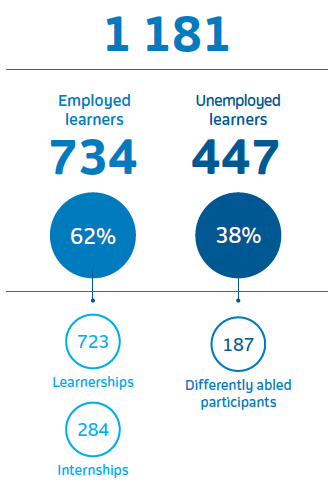
In FY2023, Telkom had 1 181 learnerships and internships, comprising 649 participants continuing from FY2022 and 532 new participants. The programme covers project management, digital skills, leadership, ICT network maintenance, and IT system support.
Race
Black
White
A 19% increase in the total intake of employed learners.
An increase of
29% of black
learners from
FY2022.
Gender
Male
Female
A 19% increase in the total intake of unemployed learners.
A 9% increase in male learners and an increase of 31% of female learners from FY2022.
Following Telkom's labour relations approach and philosophy, the involvement of trade unions as material stakeholders is appreciated and embraced. Telkom has a recognition agreement with the Communication Workers Union and South African Communication Union (the Alliance) as a strategic business partner.
The Alliance has organisational and collective bargaining rights and is represented at business unit and Company forum structures. This includes the GCEO strategic briefing session's structure. Health and safety is a standing agenda item at the Company forum meetings. Telkom and the Alliance interact on national matters during these meetings.
Freedom of association
Telkom embraces the right to freedom of association. The Alliance made up of the Communication Workers Union (CWU) and South African Communication Union (SACU) is recognised at Telkom. There are three unrecognised unions (Information Communication Technology Union (ICTU), National Union of Metalworkers of South Africa (NUMSA) and Solidarity) with members at Telkom.
| FY2021 | FY2022 | FY2023 | |
| Telkom1, 3 | 52 | 45 | – |
|---|---|---|---|
| Telkom SOC2 | – | – | 25 |
 |
26 | – | – |
| 4 |
– | – | 57 |
| |
– | – | – |
|
32 | 30 | 28 |
The Group had two section 197 automatic transfers. The first was between BCX and Telkom SA SOC Ltd and the second was between Telkom SA SOC Ltd and Openserve Ltd as a wholly owned subsidiary.
Telkom has undergone various financial and operational challenges and the interim results demonstrated that Telkom Group, and Openserve and BCX as subsidiaries, are under financial strain. It showed that remedial steps are required across the Group and its subsidiaries to minimise the operational and financial performance slide. Telkom SA SOC Ltd, Gyro (Pty) Ltd, Openserve (Pty) Ltd, and BCX Ltd embarked on a judicious process to redefine their operating and service delivery models.
The restructuring process was necessary for Telkom's sustainability. All the Telkom companies issued notices in terms of section 189 of the Labour Relations Act on 14 February 2023, inviting the unions with members likely to be affected by the contemplated retrenchments for the set consultation process. The Alliance of CWU and SACU is recognised for organisational and collective bargaining rights at Telkom SA SOC Ltd, Gyro and Openserve Pty Ltd. As required by the law, and although Solidarity, ICTU and NUMSA have no recognition status and no organisational nor collective bargaining rights at Openserve (Pty) Ltd and BCX Ltd, they were invited to participate in the section 189 consultation process. For practical and financial reasons, given the small size of Gyro in terms of the number of employees, consultations in respect of Telkom SOC and Gyro take place jointly.
| Telkom SOC | Openserve | BCX | |
| Total employees employed as at 14 February 2023 | 1 617* | 5 679 | 3 783 |
| Contemplated retrenchment | 260 | 1 073 | 252 |
| VSP/VERPs approved | 241 | 679 | 245 |
| Employees placed during manning and business as usual processes | 130 | 2 081 | 327 |
| Employees likely to be retrenched | 36 | 466 | 65 |
* Telkom SOC and Gyro.
All the employees that have not been placed in the new organisational structures have exited as at 31 May 2023, except those whose exit dates have been delayed.
The HR function is leading the employee engagement processes for the section 189 processes and established blended channels of communication for affected employees and non-affected employees. Each business unit has a tailored employee transition process and engagement portal.
The portal is adapted to the process and content is released as required so as not to overwhelm employees. The portal also ensures a central repository of information such as frequently asked questions, Company communications and wellness-related guidance for ease of access for employees and to reduce overall anxiety. The portal includes an interactive functionality that allows employees to pose questions. These are individually answered and consolidated into a "frequently asked questions" document.
The Group's occupational health and safety vision is to provide a safe working environment and create a culture where every Telkom employee, service provider, contractor and supplier believes that zero incidents are achievable. Telkom's safety golden rules underpin this vision. These rules set out the foundation of the desired culture, expected safety behaviours, and performance standards within Telkom. They also enforce zero tolerance for non-compliance to safety standards, processes, and procedures.
We are pleased that Telkom had zero fatalities for FY2023 across all our operations, a total recordable injury frequency rate (TRIFR) of 0.61, and a lost-time injury frequency rate (LTIFR) of 0.51. This performance is the lowest in five years and reflects our commitment to safety and the significant progress towards zero harm.
Motion (slips, trips, and falls), gravity and motor vehicle accidents were the key drivers of safety incidents in FY2023. Root-cause investigations were undertaken for all accidents and incidents to prevent a recurrence. The primary focus for FY2024 is driving individual safety responsibility through "Safety Starts With Me" and other targeted interventions. These will aim to promote individual safety risk assessments to reduce the key drivers of safety incidents.
BCX had a 0.27  LTIFR and 0.29 TRIFR in
FY2023, and the safety incidents were mainly
due to motion and motor vehicle accidents. The
focus for FY2024 will be on deploying targeted
interventions for the key safety incident drivers.
LTIFR and 0.29 TRIFR in
FY2023, and the safety incidents were mainly
due to motion and motor vehicle accidents. The
focus for FY2024 will be on deploying targeted
interventions for the key safety incident drivers.
Safety, health, and environment training continued, focusing on rope access and fall arrest training for 120 attendees. First aid level training has recommenced to empower employees within the workspace to manage first aid, with 180 attendees completing the level 1 course.
A self-declaration process for COVID-19 vaccinations demonstrated that a significant percentage of employees are fully vaccinated or have had one dose of vaccination, which mirrors that of the South African population. The employee data and subsequent engagements with internal stakeholders led to Telkom withdrawing its mandatory vaccination policy and the mandatory nature of vaccine requirements to enter the workplace.
| FY2021 | FY2022 | FY2023 | ||
 1, 2 1, 2 |
||||
| Total recordable injury frequency rate | 0.76 | 0.79 | 0.61 | |
| Lost-time injury frequency rate | 0.56 | 0.70 | 0.51 | |
| Fatal injury frequency rate | 0.01 | – | – | |
| 1 |
||||
| Total recordable injury frequency rate | 0.17 | 0.13 | 0.29 | |
| Lost-time injury frequency rate | 0.15 | 0.07 | 0.27 | |
| Fatal injury frequency rate | – | – | – |
| 1 | Permanent employees only. |
| 2 | Telkom includes Openserve, Gyro, Swiftnet, Telkom Consumer, Corporate Centre and Yep!. |
|
External moderate assurance on selected Key Performance Indicators – Please refer to the FY2023 Independent Assurance Report available online. |
Our key efforts will be supporting and sustaining employees and the Group post the restructuring process. The broad areas of concentration will include:
Telkom's wellness focus will be on "whole health". The programme will help employees build resilience, develop their financial muscle to be better prepared, deal with change, depression and anxiety, and provide information on where to find help and support on marital and parenting issues.