
Our business would not exist without our loyal customers. We continually refine our products and go-to-market approach to meet their evolving needs and expectations.
Telkom is embedded in a world of continual and rapid change. The word “PIVOT” captures our five-pronged strategy. It encourages all employees within every team, division, and business unit to expect continual change as we seek new ways to serve our customers.
The table alongside outlines our PIVOT Strategy and its five strategic pillarsPIVOT
captures the transformational changes to our core business



P I V O T captures the transformational changes to our core business in response to the shift from a monopoly to a world of competition by moving from voice to data, copper to fibre, fixed-line to mobile, and from connectivity to IT services solutions and digital ecosystems. Going forward, our industry will encompass fragmented digital services, increased automation, and data-driven decision-making. The combination of the strategic pillars supports us in achieving our purpose of seamlessly connecting our customers to a better life.
We want to make life better for our customers – at work and at home – whether they are learning, being entertained, or connecting with friends and family across the world. As we achieve these goals, we continue to lead in the converged ICT space, bringing together fixed, mobile and digital services for our customers. Our PIVOT Strategy aligns with the four SDGs most applicable to our business. Refer to Telkom's contribution to the United Nations SDGs for information on our reporting approach to SDGs and our performance against the SDGs on Telkom's contribution to the United Nations SDGs.Strategic pillars
Up to last year, the "P" in PIVOT stood for portfolio diversification. At the strategy review in September 2022, we reflected on our ability to be a relevant role player in some of the adjacent and OTT service areas. While we had gained traction in some areas, there were other areas where the market share was insignificant.
As a result, we have resolved to move away from developing in-house digital assets in areas such as content streaming and fintech, and instead to focus on improving our ability to partner with best-of-breed third-party providers.
Therefore, the "P" in PIVOT now stands for partnerships. We are building many different types of partnerships and, by deploying the right digital platforms, we aim to plug ourselves into best-of-breed partners and deliver relevant services quickly and efficiently.
Our core PIVOT Strategy, apart from replacing portfolio diversification with partnerships, remains unchanged. The remainder of our strategic framework remains relevant and resilient to the changes in the local and global environment. Within this framework, we will modify our specific tactics and actions accordingly as we continue to play a leading role in South Africa's digital revolution.
Integrated solutions express an aspiration to provide value-added services on top of connectivity services. For example, the fibre fixed-line consumer space includes content services such as streaming and smart home solutions such as web-based security. For mobile, this includes bundling social media applications and creating synergies between fixed, mobile, and digital services. In the enterprise space, this includes applications that streamline business service – e-commerce, point of sale systems, inventory control, cloud services, development of digital platforms and embedded cybersecurity. For small and medium businesses, this comprises the tools to enable a mobile sales force, and the cloud-based tools to digitally transform how small businesses can become more agile, responsive, and professional.
Victory in broadband acknowledges our strength as a connectivity provider in fixed and mobile and that our future lies in being primarily a data provider, with voice as a service over the data network. It emphasises our ability to serve a broad range of customers with data services.
Operational efficiency reflects the need to be efficient with our resources, digitise our processes and procedures, and leverage platforms and applications to deliver IT services. In essence, we aim to take out cost, so that we can offer utility-type connectivity services.
Technical innovation addresses our aspiration to deliver value for customers through the optimal deployment of technology to improve network experience and reduce service costs. This includes the rollout of 5G base stations for better spectral efficiency, introducing the latest fibre-optic transmission modules to increase FTTH speeds, as well as investing in new digital platforms to deliver best-of-breed services.
Group enablers
The PIVOT Strategy is underpinned by four Group enablers with initiatives to drive continuous improvement in these areas.
Improved customer experience depends on simplifying and digitising our processes, and we are implementing initiatives to drive this.
Despite increased digitalisation, our employees remain the driving force of our business. We need to enable them to cope with our industry's relentless changes and empower them to make decisions at a local level. Therefore, we remain committed to ongoing people development and empowerment for decentralised decision-making. This also considers the technology evolution, internal efficiencies and external cost pressures, which require Telkom to streamline the workforce and introduce new capabilities to maintain financial sustainability. Refer to Human capital for more information on human capital.
Openserve's self-help Connect app received the Customer Experience and Trust award at the 15th annual TM Forum Excellence Awards as part of Digital Transformation World held in Copenhagen, Denmark, in September 2022. The Connect app helps customers manage their broadband network connection and internet service at the push
of a button.
Our move to a more federated operating model, with a lean Corporate Centre, continued. We established Openserve as a separate legal entity from 1 October 2022. BCX, Gyro, Swiftnet and Openserve are now all separate legal entities. We continue strengthening the interaction and synergies between business units while maintaining their focus and accountability. This improves our agility and responsiveness to the market and underpins the consistent delivery of products and services to customers.
Our final important enabler is a sustainable financial framework. Telkom's future sustainability depends on our ability to generate cash from operations consistently. To maintain growth, we need to reinvest that cash into the network, pay off debt, and provide the appropriate returns to our shareholders.
4
Group enablers with initiatives to drive continuous improvement in these areas
Partnerships
Target
Leverage partnerships optimally to support the achievement of the Group Strategy
Partnerships are critical to enabling the Group Strategy. We seek to simplify and maximise the partnership opportunities for the Group.
1 411
Revenue from global IT hardware and software partnerships (R'million)
FY2022: 965
FY2021: 927

Why are these metrics important
It shows the development of new partnerships to complement our core services.
Integrated solutions
Target
Offer end-to-end converged propositions from connectivity to IT solutions
We want to strengthen our ability to address our customers' ICT needs comprehensively. This requires the appropriate access solution to seamlessly integrate with various IT services, from traditional (hardware and software) to new and emerging (cloud and IoT) IT services and analytics.
454
Cybersecurity product and service revenue (R'million)
FY2022: 410*
FY2021: 293
* Restarted.
1 177
Enterprise nextgeneration data revenue (R'million)
FY2022: 1 147
FY2021: 898
Why are these metrics important
It indicates the progress in replacing traditional fixed-line revenues with cybersecurity and next-generation data revenue.
Victory in broadband
Target
Become the leading broadband provider in South Africa
We are building new digital services on highspeed data services and accelerating our capability to disrupt the local broadband market by delivering innovative and value-rich solutions. Telkom offers these to residential and commercial customers over the optimal access technology – fibre, fixed wireless, mobile, satellite and copper.
1 895
Fixed broadband data traffic (petabytes)
FY2022: 1 665
FY2021: 1 428
1 167
Mobile broadband data traffic (petabytes)
FY2022: 973
FY2021: 942
Why are these metrics important
Continuous growth in data traffic highlights the increased demand for data-centric services.
Operational efficiency
Target
Develop operational superiority, which provides a competitive advantage
In an increasingly competitive world, our success depends on continually improving the efficiency and effectiveness of our operations.
47.4%
Fibre connectivity rate (%)
FY2022: 46.3
FY2021: 51.1
2.5
Fibre average time to install (days)
FY2022: 3
FY2021: 3
Why are these metrics important
The market-leading fibre connectivity rate indicates success in monetising the fibre rollout. We maintained our fast installation times despite accelerated fibre rollout, demonstrating robust operational efficiency.
Technology innovation
Target
Modernise and build a state-of-the-art network
We aspire to operate with the best scalable and most efficient network. To achieve this, Telkom will invest in the optimal mix of technologies.
492 812
Fibre access connections (number of connections)
FY2022: 389 109
FY2021: 281 065
7 546
Mobile base stations (number of base stations)
FY2022: 7 313
FY2021: 6 430
Why are these metrics important
It shows the accelerated growth in fibre access connections and the steady growth in Telkom's mobile network.
Telkom executes the strategic pillars and underlying enablers through the different business units, each with specific strategic objectives and focus areas aligned with their mandates.
Refer to the productive capital chapters for
information on each business unit's performance.
NGN revenue up 10.2% to R8 716 million
Successfully executed digital transformation initiatives
Aggressively increased homes passed with fibre by 23.9% to exceed one million homes
Recognition by LinkedIn for being one of the top 25 best workplaces to grow your career in South Africa in 2022
Mobile operating revenue up 4.0% to R21 617 million
Mobile service revenue up 1.8% to R17 819 million
Mobile active subscriber base up 7.8% to 18.3 million
Mobile data revenue up 2.9% to R12 926 million
Mobile broadband subscribers up 9.2% to 11.6 million
Mobile EBITDA down by 23.3% to R4 472 million
Revenue down 0.2% to R14 252 million
Total expenses increased by 0.2%
8.1% growth in artificial intelligence for IT operations (AIOps)
Growth of 11.1% in the IoT business
The SAP business grew by 2.4%
year-on-year
Healthy EBITDA margin of 68.8%
Capex invested of R209 million
66 new towers built and 8 In Building Coverage Solutions (IBS)
Productive portfolio sites 2.5% to 4 016 towers
Launched our first 5G outdoor Distribution Antenna System (oDAS) small cell sites.
Successfully tested the technical capability of our PaaS solution at 10 sites
Concluded non-binding memoranda (MOUs) with property development investment partners for the execution of development projects
Sold 39 properties for R64 million
Terminated non-essential services and reduced property operating costs
Executed on several energy management and efficiency projects with ongoing focus on pursuing carbon neutrality and net zero as part of Telkom's ESG Strategy
Telkom has made significant strides in its ESG journey with the introduction of a new operating model to support the execution of the strategy approved in FY2022. This is a hybrid model led by a small Group central team, supported by ESG champions in each of the business units, and the establishment of a Groupwide ESG Impact Council for oversight and accountability. We are heartened by the measurable progress made in FY2023 on the goals we set ourselves and will continue to refine our approach through the lenses of governance, strategy, management, metrics and performance, in line with market and stakeholder expectations.
Telkom is intentional and unequivocal in its pursuit to deliver sustainable value to stakeholders, and our ESG Strategy provides a framework for deliberate action to achieve this.
Legend
| Achieved | |
| Making progress but long-term target not achieved | |
| Not achieved, progress needs to be improved | |
| No specific target set as part of the initial ESG Strategy |
| * | Excludes call centre escalations managed at the call centre. |
 |
External moderate assurance on selected Key Performance Indicators – Please refer to the FY2023 Independent Assurance Report available online. |
| SDG | ESG pillar |
Focus area | Goal statements | FY2022 performance |
FY2023 performance |
% change from FY2022 |
Status | Comment | ||
| Impact | Influence |  Environment Environment |
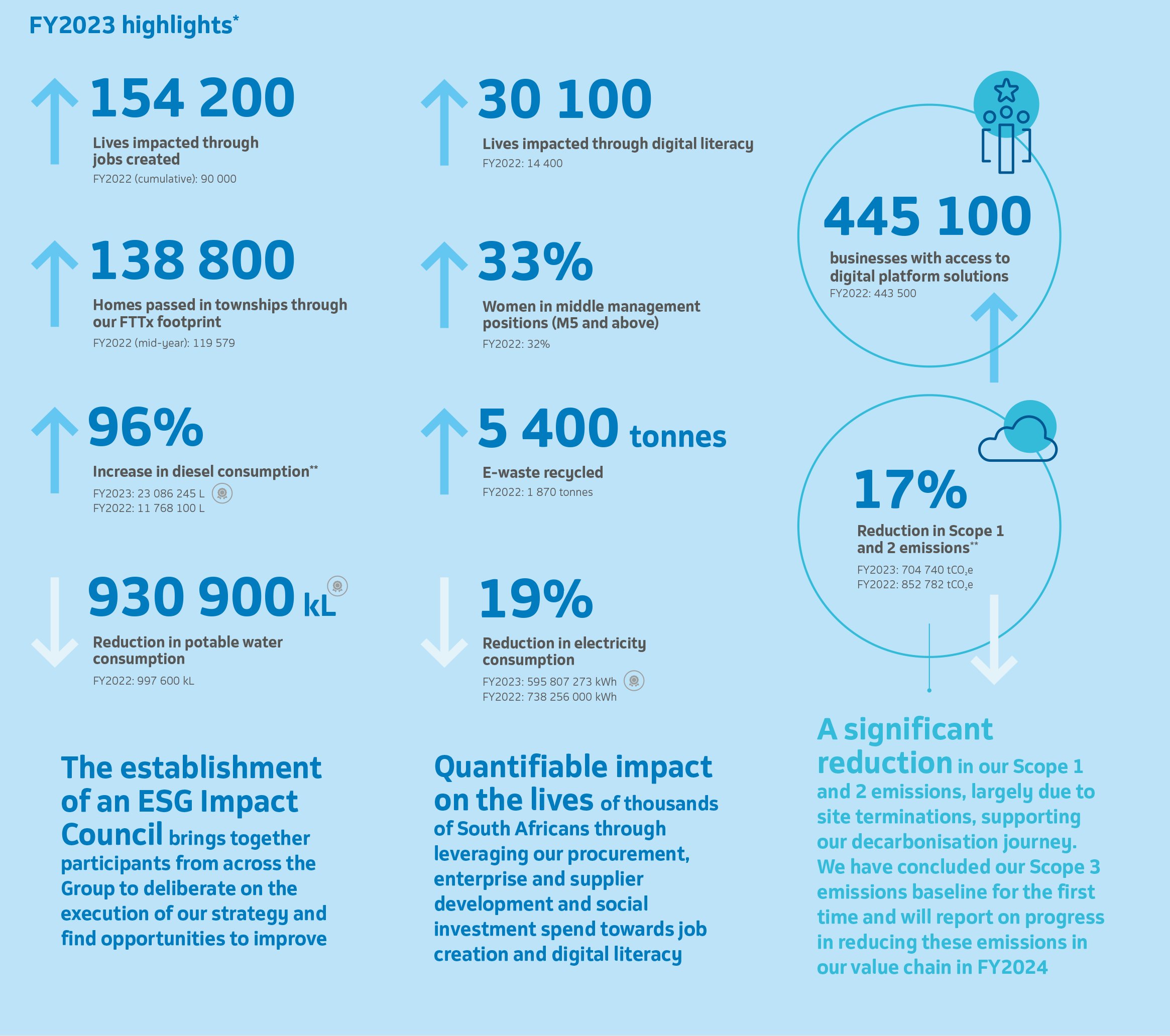
Operational efficiencies | Carbon neutral by 2035 (tCO2e) | 852 782 | 704 740 | (17%) | We have achieved an 17% reduction in Scope 1 and 2 emissions, thereby exceeding the 4.2% linear annual reduction rate per the guidance of the Science Based Targets initiative. | ||
|---|---|---|---|---|---|---|---|---|---|---|
 |
 |
50% | Reduction in fossil fuel consumption by 2030 (tCO2e) | 55 466 | 85 100 | 53% | Although Telkom has reduced its overall Scope 1 and 2 emissions, the increase in the frequency of loadshedding has resulted in increased Scope 1 emissions due to the increase in backup diesel consumption. | |||
| 100% | Usage of renewable energy sources by 2035 | <1% | <1% | 0% | In FY2022, we commenced with the installation of the solar plant at the Belville Office Park in Cape Town, which is now operational. In FY2023, the solar plant at the Telkom Office Park in Centurion was commissioned. We continue to make efforts to increase the use of renewable energy within our portfolio. | |||||
| Net zero by 2040 | ||||||||||
| – | Determine Scope 3 emissions and set a target | 949 515 | Scope 3 baseline has been calculated and a reduction target will be set in FY2024. | |||||||
| 75% | Reduction in waste to landfill by 2030 (tonnes) | 681 | 622 | (9%) | ||||||
| 50% | Reduction in potable water consumption by 2030 (kL) | 997 617 | 930 900 | (7%) | Telkom uses municipal water for cooking, drinking, hygiene and landscaping purposes. We continue to make efforts to minimise our water consumption and resort to alternative water sources. | |||||
| 25% | Migration from R22 refrigerant gases in 2025 and 100% by 2035 (tonnes) | 38 | 36 | (4%) | We have reduced our R22 gas consumption by decommissioning legacy sites and replacing HVAC units that have exceeded the commercial expected life cycle by 30%. | |||||
| Digital planet | 50 000 | IoT devices deployed by 2025 | 15 220 | 58 567 | 285% | We have increased the number of IoT devices installed to measure water and electricity consumption, including on our own properties. We intend to review and update the target in FY2024. | ||||

 |
 |
 Social |
100 000 | Lives positively impacted through SMME spend by 2025 | 91 357 | 154 206 | 69% | We have surpassed the target by 35%. This target will be reviewed in FY2024. | ||
| Investing with purpose | 30 000 | Lives impacted through digital literacy by 2023 | 14 420 | 30 120 | 109% | |||||
| 2023 | Become employer of choice | – | – | Certified as a Top Employer in South Africa for 2023 by the Top Employers Institute. | ||||||
| 35% | Women in middle management positions (M5 and above) by 2025 | 32% | 33% | 1% | ||||||
| Digital services | 4.3 million | Customers with access to Telkom’s diversified digital platforms by 2025 | 2 039 684 | 3 873 170 | 90% | |||||
 |
 |
500 000 | Businesses with access to digital platform solutions by 2025 | 443 467 | 445 119 | 0.4% | ||||
| Empowered communities | 15 million | Customers connected to broadband and fixed wireless broadband connectivity by 2025 | 11 700 000 | 14 451 014 | 24% | |||||
| 1.5 million | SA homes and businesses connected through our FTTx footprint by 2025 (homes passed) | 839 691 | 1 040 565 | 24% | ||||||
| Underserved area |
Fibre rollout in townships (homes passed) | 119 579 | 138 813 | 16% | ||||||
| Fibre rollout in townships (homes connected) | 47 619 | 60 928 | 28% | |||||||
 |
 Governance Governance |
Business stewardship |
Culture of responsible technology and information use | ESG KPIs are continuously expanded to align to global frameworks. Targets will be set by the business as we evolve. | ||||||
| Reduction in number of data breaches | 0 | 0 | 0% | |||||||
| Fair and ethical practices towards our customers and within the Group | ||||||||||
| Reduction in escalated complaints* | 7 416 | 4 907 | 34% | |||||||
| Decrease in whistle-blowing incidents reported from FY2022 | 152 | 147 | 3% | |||||||
Priorities in FY2024
On the premise that “what is managed can be measured”, we will be broadening the scope of ESG KPIs measured by the business, as well as refining our data analytics, to deepen our compliance with evolving frameworks and standards for sustainability-related disclosure.
Improved management of our energy, waste and water nexus to improve resource efficiency and further reduce our emissions, as well as building partnerships and initiatives to address and influence Scope 3 emissions in our value chain over which we have indirect control, are further priorities.
We will strive to find additional opportunities for innovation in the strategic pillars we have chosen to focus on. In line with global trends, Telkom has committed to linking a percentage of pay to ESG performance. Embedding the link between ESG and remuneration in FY2024, through both STIs and LTIs, will help to focus collective accountability on our key ESG goals.
| * | Numbers have been rounded off. |
| ** | Telkom experienced an increase in diesel consumption due to loadshedding, which has resulted in higher Scope 1 emissions. However, the Group has achieved an 18% reduction in Scope 1 and 2 emissions as a result of the energy-efficiency initiatives that were implemented in the financial year. |
|
|
External moderate assurance on selected Key Performance Indicators – Please refer to the FY2023 Independent Assurance Report available online. |
Carbon neutral by 2035
Carbon emissions

The Group’s Scope 1 emissions increased by 53% in FY2023 due to increased use of diesel generators to keep the network running during unprecedented levels of loadshedding. To optimise diesel costs, reduce emissions and provide a reliable supply of alternative energy, the Group has accelerated the installation of lithium batteries at exchanges and towers. To date, we have installed lithium-ion batteries at 317 sites and smart controllers at 223 sites. Cumulatively, this resulted in the avoidance of 1.09 million litres of diesel usage, and we aim to intensify this drive. However, we have observed a 96% increase in diesel consumption resulting from electricity disruptions, which remains a constant challenge.
The Group’s Scope 2 emissions decreased by 22.3%. More than 10 000 tCO2e were avoided through the replacement of diesel generators with lithium-ion batteries as backup on our masts and towers, as well as the removal of high energy consuming and unused equipment from exchanges.
Energy

Several macro trends impact the energy landscape in South Africa, such as inconsistencies in the utility grid, infrastructure vandalism, unprecedented levels of loadshedding and consequent pressure on backup generation sources such as diesel to maintain the network. Energy from the electricity grid constitutes 96% of the emissions profile of our operations and is the most critical component of our emissions reduction strategy. The implementation of renewable energy and energy-efficiency initiatives has resulted in significant avoidance of emissions, which has contributed to the overall 17% reduction in Scope 1 and 2 emissions from our FY2022 baseline.
In designing our energy pathway, we focused on energy-efficiency and renewable energy initiatives in our top 500 sites, which account for 73% of our energy consumption, including our data centres, which although comprising less than 1% of our sites consume 24% of our total energy mix.
At this stage, less than 1% of our consumption is from renewable energy sources, derived from solar plants at the Centurion and Belville office parks.
Net zero by 2040

In 2022, Telkom submitted a commitment letter to the Science Based Targets initiative (SBTi) with our intent to submit net zero emissions reduction targets for validation.
Through a materiality lens, we identified the emission sources that contribute to our Scope 3 emissions (i.e. indirect emissions produced along our value chain). Out of the 15 Scope 3 categories, 14 apply to Telkom’s operations. Data on the 14 categories was gathered, assessed and the relevant emission factors applied. Four categories were deemed material to Telkom’s Scope 3 emissions, namely, purchased goods and services, capital goods, use of sold products and downstream leased assets, which is in line with industry trends. We used FY2022 as our base year. The Scope 3 emissions determined for Telkom in FY2022 are 949 515 tCO2e, which will be the baseline for the Group and make up 57% of our total Scope 1, 2 and 3 emissions in FY2023. We will refine our Scope 3 methodology as we evolve and our Scope 3 emissions profile will inform the areas to prioritise and influence in decarbonising our value chain.
Ultimately, we intend to reduce Telkom’s carbon footprint according to the SBTi guidance, and play our part in contributing to climate action and combating the effects of climate change.
Waste

Telkom increased recycling of e-waste generated in its operations by 189% during the year, to 5 400 tonnes. Openserve sells copper recovered from recycling processes on local and international markets through a third-party contractor, with 3 942 tonnes of copper recovered in FY2023.
General waste to landfill decreased by 9% in FY2023, but we remain steadfast in our goal to reduce waste to landfill by 75% by 2030. Our operational waste streams are managed responsibly, in line with the National Environmental Management Waste Management Act, 59 of 2008.
We are identifying opportunities to improve composting of our food and garden waste, as well as increase recycling quantities.
As part of our commitment to reduce our Scope 3 emissions and take end-of-life responsibility for the devices we sell, we evaluated the e-waste contribution of our sold products and will develop an approach to reducing this in the years to come.
Water


Owing to South Africa being a water-scarce country with its infrastructure under strain, Telkom’s commitment to a 50% reduction in potable water consumed by 2030 has become imperative. We need to constantly explore innovative conservation methods to help navigate the impacts of climate change and assist others to do so.
In FY2023, Telkom reduced its potable water consumption by 7%, a good achievement despite the return to office work, which also impacted consumption levels. Plans for water harvesting projects were put on hold due to budget constraints.
Read more in the Natural capital.

| * | Telkom experienced an increase in diesel consumption due to the effects of loadshedding, which has resulted in higher Scope 1 emissions. However, the Group has achieved an 18% reduction in Scope 1 and 2 emissions as a result of the energy-efficiency initiatives that were implemented in the financial year. |
Telkom endeavours to combat inequality in the South African economy by leveraging its assets, spend and investments in the domains of entrepreneurship and education, with a focus on digitalisation and futureproofing our society. Through our investments, we try to redress race and gender disparity, and endeavour to do the same within our business.
Job creation
A significant number of lives were impacted* through our spend on procurement, the FutureMakers Programme and Openserve Field Technicians. We support small businesses in the services, technology, security, construction, logistics and marketing sectors. We have surpassed the target to impact 100 000 lives through our spend on SMMEs by 2025. Overall, we have impacted 154 206 lives, which translates to 35% more than the set target. This target will be reviewed in FY2024.
Number of lives impacted in FY2023
128 532
FutureMakers

24 763
Procurement

911
Openserve Field Technicians
| * | We calculate the number of lives impacted as follows: Where we have the number of people employed at an SMME we use that number. Where we do not know the number we multiply the entity by a 4.1 average as per guidance of the Small Business Institute SA to estimate the number of jobs. On the assumption that each job impacts more than one life, we multiply the number of jobs by 3.3 – the average number of people in a household (StatsSA). |
| ** | Procurement numbers are based on a supplier survey, which was completed by 78% of targeted suppliers, so it does not reflect the full total of jobs created through our procurement spend. |
Access to broadband infrastructure
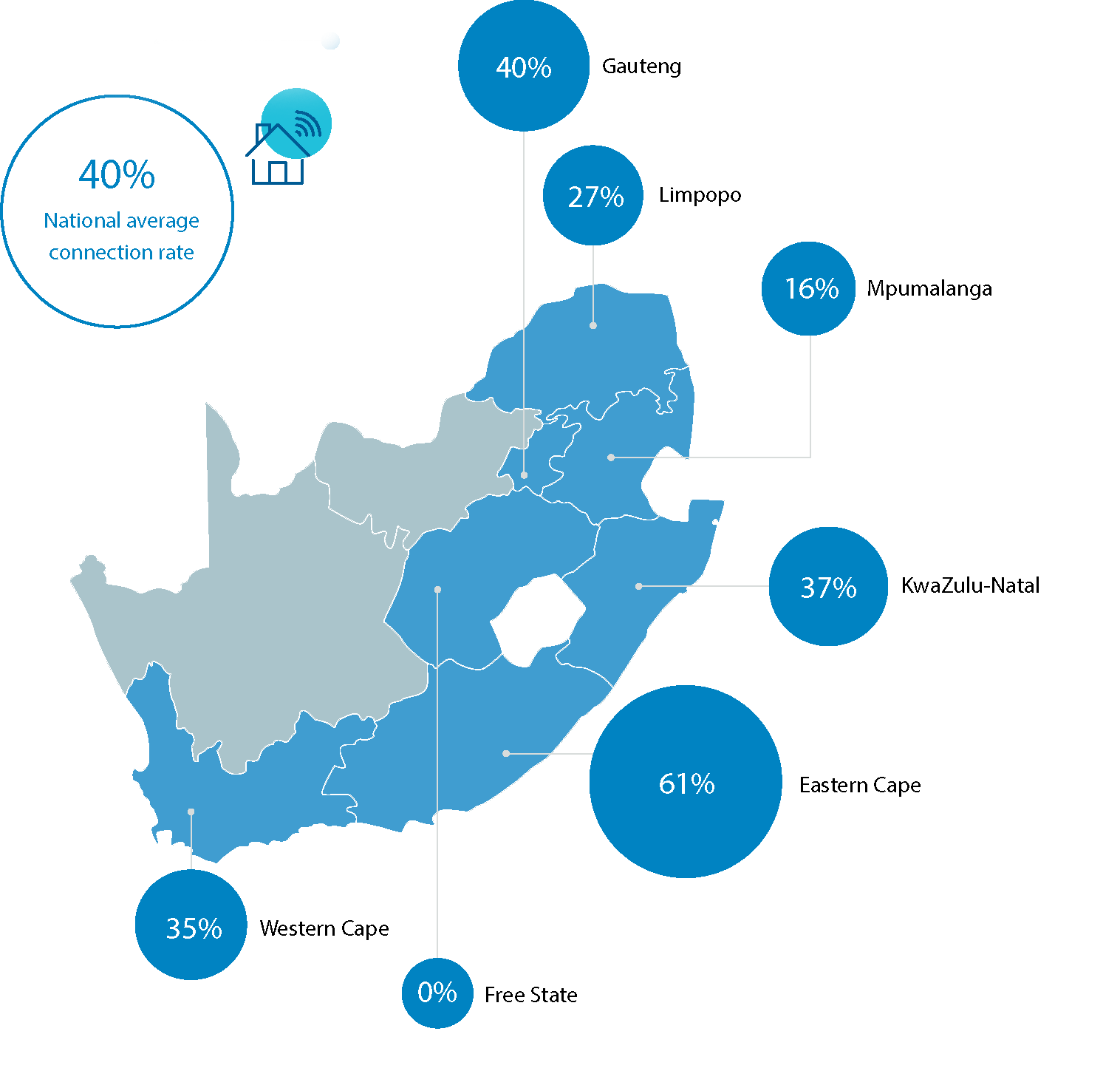
We have passed 1 040 565 homes through Openserve. We are especially proud of our performance in under-serviced townships, where we have connected 47 township areas with working coverage, in seven of the nine provinces in South Africa, passing 119 579 homes.
To create faster accessibility once fibre has been laid, we pursue a fibre on demand strategy which allows us to reach specific pockets of customers where significant demand exists.
Township fibre rollout
Number of homes passed 00
Connect rate
Digital literacy and platforms
A total of 43 732 lives were impacted to date through our combined investments in digital literacy*, as compared to a baseline of 14 220 in FY2022. This is a composite figure which comprises Telkom’s edtech platform, digital skills training, and digital enterprise management platform for schools, much of which is funded by the Telkom Foundation. The lives impacted exceed the target we had set ourselves to impact 30 000 lives through digital literacy in FY2023.
We have 3.87 million customers on digital platforms such as Telkom Plus and VS Gaming. Telkom One was migrated to the new SABC streaming platform, SABC Plus, during the year. 2.7 million of these customers accessed our Emergency Top Up service to borrow airtime or data. Through our Yep! platform, we are connecting 445 000 small businesses to a digital marketplace to help grow and enhance their reach through e‑commerce and other connection opportunities.
| * | Digital literacy is defined as the ability to use technology to connect with the world around us, to access opportunities and to use digital content to learn new skills/knowledge to contribute in a digitally connected society (UNESCO, UNICEF, EU). |
Gender diversity


Telkom improved gender representation on its Board to 33% female Board Members.
We had set ourselves a target to increase women leadership in the business to 35% by 2025. Women represent 36.6% at Senior Management and 33.2% at middle management levels as at 31 March 2023. The pipeline of female technical skills in the industry remains a challenge, hence our investment in early-stage digital skills, leadership development programmes such as the Female Leadership Development Programme and applying a positive bias towards female candidates in recruitment and promotions, where possible.
Read more in the Openserve section, and in the Social and relationship capital and the Corporate governance report
Governance performance summary
Privacy and data security
Telkom’s information security policy and framework includes data protection as a domain and governs all our business units and functional areas. External independent audits are conducted annually, governing general IT controls, which include information security. The Board is the ultimate custodian of data security, and training on data security and privacy-related risks and procedures is provided to all employees and contractors.
Data privacy is addressed through a privacy statement and framework, as well as documents to assist our stakeholders with navigating the Protection of Personal Information and Promotion of Access to Information Acts (published in 2013 and 2000, respectively).
Digital ethics
Our IT governance approach provides guidance on the adoption of emerging technologies, while ensuring that ethical practices are not compromised. Telkom approved a digital ethics framework, which guides employees and contractors to ensure that our digital products and services are managed and offered in an ethical manner. Best practice and principles to be applied at both the data and algorithm level include privacy, justice, equality, security, sustainability, reliability, traceability, and transparency.

Anti-corruption and whistle-blowing
In FY2023 we observed a 3% decline in whistleblowing incidents compared to FY2022. Our policy approaches on bribery and anti-corruption are contained in our Group Ethics Handbook and the Supplier Code of Conduct, which the majority of our suppliers have signed. Audits on our ethical standards are conducted annually, and all employees are trained on ethical standards
Read more in the Corporate governance report.
Read more in the Intellectual capital report.