

Telkom strives to create shared value for its business and society through strategic interventions that meaningfully impact the South African economy, creating social and commercial value.

Number of SMMEs impacted or supported
Number of jobs created (direct and indirect)
R'million invested in digital skills programmes
R'million invested in the Telkom Foundation
Number of learners and teachers impacted
B-BBEE ratings
Employment equity plan targets
Diversification of procurement spend
Diversify our supply chain and sales value chain (such as dealers) and accelerate innovation in the technology sector, focusing on SMMEs. This is a mitigating factor in managing supply chain risks
Digital skills development
Holistic school development and integrating ICT in schools
The Social and Ethics Committee's oversight responsibilities include Telkom's transformation, B-BBEE and corporate social initiatives. The diagram below depicts the key accountabilities.

FutureMakers aims to grow the digital economy by developing and investing in black-owned, high-growth enterprises that create jobs and economic outcomes within society and the Group. We do this by developing leading entrepreneurial programmes that:
FutureMakers’ Programmes fall within two focus areas – diverse supply chain programmes and innovation programmes. Telkom has 102 SMMEs (FY2022: 112) and 218 BCX SMMEs (FY2022: 177) – of which 30 are registered on the BCX supply chain with contracts in place – on the various incubation and investment programmes, totalling 320 SMMEs (FY2022: 289).
FutureMakers has supported approximately 2 600 SMMEs since 2015.
The portfolio of SMMEs within Telkom (excluding BCX) has 66 536 jobs (1 439 direct and 65 097 indirect jobs). This increased from 27 275 jobs in FY2022 (772 direct and 26 503 indirect jobs). BCX SMMEs currently have 1 192 jobs created.
In FY2023, FutureMakers launched two new investment vehicles to enable further investments in SMMEs offering innovative solutions and in strategic SMMEs in our supply chain, in addition to the Telkom Future Fund.
In November 2022, FutureMakers received an award for its investments in SMMEs during the Department of Small Business Development’s inaugural Presidential SMME and Cooperative Awards. This award was in recognition of our R250 million investment in the Telkom Future Fund, with IDF Capital as our Fund manager.
In FY2023, we refined our programmes to ensure that they address the full start-up life cycle and that we focus our investment vehicles across all our programmes. The diagram alongside maps our programmes according to the start-up life cycle and classifies programmes according to our two focus areas.

Our investments in SMMEs and development programmes resulted in positive social and commercial outcomes for society and within Telkom in the following ways in FY2023:
Telkom
|
Societys
|
|||
| Commercial | Telkom Consumer distribution channels: R152 million in sales | SMMEs in our programmes generated a collective revenue of R334 million. | ||
| Social | A contribution to Telkom’s ESG Strategy to impact 100 000 lives through SMME development by FY2025, meeting the target in FY2023. | 39 261 new jobs created in FY2023, resulting in livelihoods that impacted 129 561 people. (According to Statistics South Africa, every income supports on average 3.3 people.) | ||

Digital technology is transforming unsustainable medicine and healthcare industries and systems into sustainable ones. It does so by levelling healthcare equity and providing faster and more costeffective disease detection and management solutions. Although health technology precedes the pandemic, its visibility, funding and development were accelerated during COVID-19.
The increase in using wearable devices to monitor personal health with sophisticated software and apps has turned users into personalised health clinics. According to Deloitte Global, 320 million consumer health and wellness wearable devices were sold globally in 2022, and demand will likely reach nearly 440 million units by 2024 (Deloitte, 2021). It is projected that South Africa could be the next big market for smartwatches as adoption levels of wearable technology gradually increase as it becomes more widespread and affordable.
Telkom’s Consumer Strategy is underpinned by data leadership while enriching our customers' digital lifestyle through innovation. These social and commercial priorities rely on partnerships and investments in a strong ecosystem of consumer services such as media, gaming, e‑commerce and e‑health.
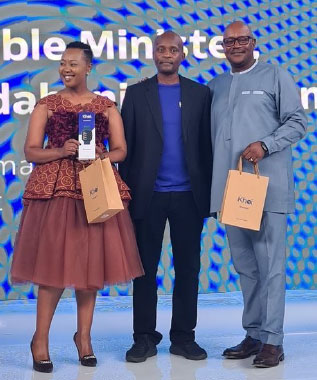
A prime example of Telkom’s impact investment is the funding and development of the African health technology start-up, Khoi Tech (Pty) Ltd, established in 2020. The Company is a benefactor of FutureMakers and specialises in consumer electronics and related software services.
Khoi Tech’s premier offering includes the Khoi Afriwatch1 smartwatch with innovative health and sports features integrating modern technologies such as AI, IoT, blockchain and cloud computing. “Our vision is to democratise self-service vital health care monitoring. We want to contribute to the wellbeing of our customers and become the number one consumer tech brand in Africa,” explains Seati Moloi, CEO and founder of Khoi Tech.
Khoi Afriwatch1 is ICASA tested and certified and comes with a one-year warranty. The smartwatch includes health features such as monitoring real-time heart rate, sleep, body temperature, body stress and blood oxygen levels.
After a comprehensive due diligence process, FutureMakers approved a R500 000 grant to Khoi Tech to fund the development of the prototype, which they launched in September 2022. Khoi Tech also received additional digital marketing support to boost sales on social media and e-commerce stores. The team has gained good traction since launching and achieved the below key milestones as at March 2023:
With the rise in health-conscious consumers and smartwatch innovation moving from pure fitness tracking to overall wellness management, Telkom’s investment in Khoi Tech places it in a good position to capture growing demand locally and claim market leadership.


Skills development continues to be a major focus across the Group. The skills strategy, aligned with Telkom's strategy, aims to increase the digital skills pipeline and positively impact the South African economy. We aim to empower a pipeline of young people with future-ready skills to fuel innovation and contribute to the transformation agenda.
We invested R29 million in FY2023 (FY2022: R37 million) with our key programmes, the Explore Data Science Academy and WeThinkCode partnerships. This will support 600 students over a three-year period and secure a coding and data science talent pipeline.
We invested a further R15 million in other IT skills for people with disabilities.
45% of the 2022 data science cohort was placed in fixed-term or permanent contracts, many in small and medium-sized businesses. This was driven by a conscious effort to infuse these skills in technology start-ups as engines of growth.
We made steady progress in improving the representation of women in our coding and data science cohort, as illustrated in the graphs alongside.
56
Explore Data Science Academy
%
FY2022: 48
FY2021: 46

60
WeThinkCode
%
FY2022: 50
FY2021: 25
The Telkom Foundation’s Social Investment Programme supported initiatives that empowered and enabled youth to build the requisite skills to be future-fit.
The Foundation invested in programmes focused on improving teaching and learning in science, technology, English and mathematics (STEM) as gateway subjects to accessing science and technology post-schooling studies and future economic opportunities.
The Foundation expanded its programmes to support unemployed youth to reskill them through training programmes accredited by the Media, Information and Communication Technologies Sector Education and Training Authority (MICT SETA). This enabled them to access employment and entrepreneurial opportunities in the ICT sector.
The Foundation invested R64 million (including administration costs), with R26 million invested in education, R20 million in digital skills and R7 million in social development programmes (FY2022: R76.8 million).
The learners supported by the Foundation since 2018 (Grade 8) through the integrated High School Support Programme, reached Grade 12 at the end of the 2022 academic year.
External moderate assurance on selected Key Performance Indicators – Please refer to the FY2023 Independent Assurance Report available online.
The 4 496 learners sat for matric exams and achieved a 77.4% pass rate, with 43.2% achieving bachelor passes and 35.6% achieving diploma passes. The programme contributed 2.3% towards Gauteng province’s bachelor passes and 0.6% towards national bachelor passes. The Group achieved 870 distinctions, contributing 0.4% towards the national number of distinctions.
Recognising the challenges that Grade 12 learners face with transitioning to post-school studies, the Foundation provided them with a facilitated and structured programme to help them apply for and secure post-school study opportunities. Telkom provided 25 of these learners with bursaries for their tertiary studies. This is in addition to the 21 learners already supported with bursaries by Telkom from the 2021 class.
By providing academic support nationally, the Foundation continued to support the zero-rated Telkom Lightbulb Education platform, providing 21 430 learners with online access to interactive content of basic education. Of these, 4 828 learners accessed the platform through learning devices and mobile connectivity provided by the Foundation.
The programme continued to invest in digital skills by introducing learners to various technologies, including robotics, systems development, fintech and blockchain. The Digital Skills Programme reached 300 high school learners in the Free State and Mpumalanga provinces. They are undergoing a three-year certificated programme in addition to their Grade 12 certificate.
In light of the many challenges learners face, the Foundation continues with its Psychosocial Programme to support learners needing counselling. The programme also identified and addressed patterns of social issues emerging and impacting young people in the communities we serve. To date, awareness sessions have been conducted on various issues and relevant topics within the 22 Foundation-supported schools in Tshwane West in Gauteng and Gqeberha in the Eastern Cape.
Telkom is responsible for contributing to the socioeconomic environment as part of our licence to operate. The Foundation drives partnerships with communities to contribute to Telkom’s corporate citizenship status. In delivering on this, the Foundation contributes to SDG 4 (Quality of Education) and Telkom’s ESG Strategy.
Supported through counselling
| Childline partnership in Tshwane 732 learners |
FAMSA partnership 193 learners |
 National Childline and Lifeline telephone counselling |
|||
| Reached with awareness programmes |
|||||
| 34 127 learners |
1 371 learners |
Reached 289 990 people |
|||
The Foundation also continued with the Youth Digital Skills Programme, focusing on reskilling unemployed youth with MICT SETA accredited ICT training and job experience. The programme benefited 542 youth placed in Telkom and various government departments and SMMEs. This includes a group of 120 youth who are part of the Foundation’s partnership with the Gauteng Department of Education’s Gauteng City Region Academy. This partnership programme reskills unemployed youth and places them in schools with ICT resources to provide IT helpdesk assistance.
| Scoring element and weighting points | FY2021 | FY2022 | FY2023 |
 |
|||
| Ownership (25) | 17.08 | 18.52 | 19.32 |
| Management control (23) | 16.66 | 17.81 | 18.21 |
| Skills development (20) | 17.06 | 19.36 | 23.47 |
| ESD (50) | 47.41 | 44.13 | 47.06 |
| Socio-economic development (12) | 11.92 | 12.00 | 12.00 |
| Total (130) | 110.13 | 111.82 | 120.06 |

| Ownership (25) | 17.08 | 18.52 | 19.32 |
|---|---|---|---|
| Management control (23) | 15.82 | 16.17 | 18.71 |
| Skills development (20) | 20.67 | 19.18 | 19.36 |
| ESD (50) | 49.47 | 50.60 | 50.68 |
| Socio-economic development (12) | 12.00 | 12.00 | 12.00 |
| Total (130) | 115.04 | 116.47 | 120.07 |
| Procurement with black-owned businesses |
 |
||
| Category | FY2021 R’billion |
FY2022 R’billion |
FY2023 R’billion |
| Overall spend with black-owned enterprises | 29.87 | 28.69 | 28.72 |
|---|---|---|---|
| Spend with black-owned small enterprises | 1.51 | 2.09 | 3.08 |
| Spend with black-owned large enterprises | 28.35 | 27.92 | 25.64 |
| Overall spend with black women-owned enterprises | 7.02 | 11.03 | 11.00 |